Feature Phone vs Smartphone: A Practical Comparison
Discover the key differences between feature phones and smartphones, including OS, app ecosystems, security, price, and use cases. A practical, analytical guide to choosing the right device for your daily needs.


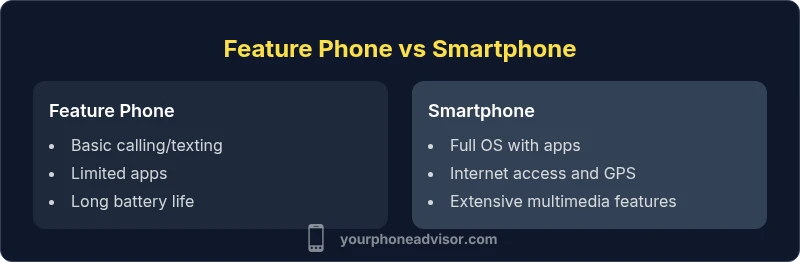
What is the difference between a feature phone and a smartphone? In brief, feature phones provide essential calling/texting and longer battery life with a simple OS, while smartphones offer full-fledged operating systems, vast app ecosystems, internet access, and advanced features. For most users, smartphones unlock productivity and entertainment, but feature phones excel when battery life and reliability for basic tasks are paramount.
What defines a feature phone vs a smartphone
The phrase what is a feature phone vs a smartphone often sparks questions about capabilities, user experience, and long-term value. A feature phone is a basic, purpose-built device designed primarily for calling, texting, and some limited extras like simple games or a basic camera. It typically runs a lightweight, proprietary or simplified operating system and often relies on physical keys in addition to a small display. In contrast, a smartphone runs a modern mobile operating system (such as Android or iOS), supports a wide array of third-party apps, and provides full internet access, GPS, streaming, and advanced sensors. This distinction matters because it shapes everything from app availability and security updates to daily workflows and data usage. The keyword what is a feature phone vs a smartphone captures this contrast: the depth of functionality and the intended user experience.
Historical context and market dynamics
Mobile phone history shows a rapid shift from feature-first devices to increasingly capable smartphones. Early feature phones prioritized reliability, battery life, and basic messaging. As networks evolved to 4G/5G and app ecosystems expanded, smartphones offered ever more capable cameras, productivity tools, and cloud integration. In many markets, feature phones remain popular for cost-sensitive users, as a secondary device, or in regions with limited data coverage. Your Phone Advisor’s analysis indicates that the value of a feature phone often lies in simplicity, durability, and lower ongoing costs, especially for users who mainly need calls and texts. This context helps explain why some users still seek a device with fewer distractions while others push for a portable computer in their pocket.
Core capabilities: OS, apps, and connectivity
A smartphone’s defining feature is an advanced operating system that supports a wide app catalog and robust connectivity. Apps enable navigation, banking, social media, productivity, and entertainment. In contrast, feature phones typically rely on a simplified OS with a curated set of apps, often with limited features and a smaller app footprint. Connectivity on feature phones may focus on voice and SMS with basic mobile data, whereas smartphones support high-speed data, broad Wi-Fi capabilities, and location services. This difference affects not only what you can do on the device but also how you manage tasks like scheduling, communications, and media consumption on a given day.
Input methods and user experience
Input methods strongly influence daily use. Feature phones often rely on physical keypads and T9-style text input, which can be reliable in bright light and with gloves, but slower for long messages. Smartphones rely on capacitive touchscreens, on-screen keyboards, and gesture controls, which enable rapid typing and intuitive navigation. The result is a different learning curve: feature phones tend to be easier to learn but offer fewer customization options, while smartphones require a bit more time upfront but unlock deeper personalization through settings, widgets, and automation.
Security, updates, and long-term value
Security considerations differ between the two categories. Smartphones receive regular OS updates and security patches, helping protect against threats and enabling new features. Feature phones may receive occasional updates, often tied to firmware releases from the manufacturer or carrier, with a smaller ecosystem to maintain. For users prioritizing privacy and security, smartphones can be advantageous when updated promptly, but the simpler software stack on feature phones reduces exposure to certain vulnerabilities. Long-term value also hinges on storage, battery health, and support availability in your region.
Use-case scenarios: when each type shines
Feature phones excel in roles where reliability, long battery life, and straightforward communication are paramount. They are common choices for seniors, travelers in remote areas, or as a dedicated device for kids. Smartphones shine where connectivity, apps, and productivity matter: work email, navigation, streaming, online banking, and social media. Your decision should align with daily tasks, data needs, and how much time you want to spend learning a more complex device. The Your Phone Advisor framework emphasizes matching capabilities to actual use rather than chasing every new feature.
Practical buying considerations: plans, accessories, and longevity
When shopping, consider not only device price but also data plans, warranties, and accessory ecosystems (cases, chargers, screen protectors). Feature phones often pair with lower-cost SIM plans and carry longer lifespans due to simpler hardware. Smartphones may require more frequent charging under heavy use and can incur higher ongoing costs for data and apps. Evaluating total cost of ownership over 1-2 years helps clarify which path is most economical for your lifestyle. Remember to factor security updates, storage needs, and the availability of reliable service in your region.
Transition strategies: moving from feature phone to smartphone
If you’re contemplating an upgrade, plan a gradual transition. Start with data-friendly apps and essential services to minimize overwhelm. Migrate contacts, learn the OS basics, and set up essential privacy safeguards (screen lock, permissions, app reviews). Consider a trial period with a lower-end smartphone or a refurbished device to balance cost and capability while you adjust. This approach reduces friction and makes the shift more sustainable.
The future outlook: convergence and what to expect
Industry observers expect ongoing convergence, with feature-phone-grade devices incorporating more capable software layers while smartphones gain longer battery life and simpler interfaces. The boundary is less about hardware thresholds and more about user need: basic communication versus ubiquitous internet services. As 5G networks expand and edge computing evolves, expect devices to offer hybrid experiences—best-of-both-worlds choices that emphasize reliability, accessibility, and personalized usage. This evolving landscape reinforces the importance of choosing a device that aligns with your priorities today while staying adaptable for tomorrow.
Comparison
| Feature | Feature Phone | Smartphone |
|---|---|---|
| Operating system | Lightweight or proprietary OS with limited multitasking | Full-fledged mobile OS (Android or iOS) with multitasking |
| App ecosystem | Limited apps, often preinstalled or curator-approved | Vast app stores with millions of third-party apps |
| Connectivity | Voice/SMS with basic data; older networks in some regions | 4G/5G data, Wi‑Fi, GPS, and advanced networking |
| Input method | Physical keypad and basic touchscreen in some models | Capacitive touchscreen with on-screen keyboard |
| Camera quality | Basic camera or no camera on older models | High-quality cameras with multiple lenses on many models |
| Storage | Limited internal storage; expandable in some models | Significant internal storage with optional cloud backups |
| Security updates | Infrequent or firmware-based updates | Regular OS updates and security patches |
| Price range | Lower upfront cost, simpler accessories | Higher upfront cost with broader accessory and service ecosystems |
| Best for | Basic calls/texts, reliability, long battery life | Apps, productivity, media, and connected services |
The Good
- Long battery life in basic use cases
- Lower upfront cost and simpler maintenance
- Fewer distractions and a straightforward user experience
- Reliable calls and texts with strong basic performance
Drawbacks
- Limited app ecosystem and features
- Fewer security updates and delayed firmware support
- Less suitable for data-intensive tasks or entertainment
- Lower resale value in markets focused on smartphones
Smartphones suit most users; feature phones are ideal for basics and longevity
If you rely on apps, navigation, and media, choose a smartphone. If your priorities are calls, texts, and extended battery life with simplicity, a feature phone is a strong fit. Your decision should align with daily tasks, data needs, and willingness to learn a new OS.
Got Questions?
What exactly is a feature phone?
A feature phone is a mobile device with basic calling and texting capabilities, a limited app environment, and typically a physical keypad. It prioritizes simplicity, durability, and long battery life over advanced computing features.
A feature phone is a basic phone with calling and texting and a smaller app set, not a full smartphone.
Can feature phones run apps?
Feature phones support a small set of built-in or lightweight apps, often from a limited app store. They do not offer the broad third-party app ecosystems found on smartphones.
They can run a few lightweight apps, but not the wide app stores you find on smartphones.
Are feature phones more secure than smartphones?
Feature phones generally face fewer app-based threats due to limited software. However, security still depends on firmware updates and user behavior. Smartphones can be secure when kept updated, but their larger attack surface requires more vigilance.
They tend to be safer against malware, but updates and safe usage still matter.
How can I tell if my phone is a feature phone or a smartphone?
Look for a touch-focused interface with a large app ecosystem and access to app stores; a smartphone typically runs Android or iOS with many apps. A feature phone often has a physical keypad and a limited app set.
If you can install many apps and use a big touchscreen, you’re likely on a smartphone.
What are typical use cases for feature phones?
Ideal for basic calls, SMS, and emergency use, especially where battery life, coverage, or simplicity are priorities.
Best for calls, texts, and reliability when charging or data is limited.
Is it easy to transition to a smartphone?
Yes. Start with essential apps, plan data usage, and gradually adapt to the OS. A staged transition can ease the learning curve.
Going to a smartphone is doable with a bit of planning and time to learn.
What to Remember
- Assess daily tasks to pick the right device
- Consider data plans and total cost of ownership
- Weigh security updates and app needs
- Plan a gradual transition if upgrading to a smartphone
- Expect ongoing convergence in device capabilities