Phone vs Phone: A Practical 2026 Side-by-Side Comparison
A practical, data-driven comparison of two phones to help you pick the best fit based on updates, privacy, performance, battery, and price.


Phone vs phone is a practical comparison that helps you decide between two devices with similar goals. The key differences usually lie in system updates, security features, price/value, and ecosystem. For most users, prioritize OS longevity, privacy controls, and total cost of ownership to determine the better match.
Why phone vs phone matters
In the real world, choosing between two smartphones isn't about chasing the latest spec sheet. It's about how you actually use your device day-to-day. According to Your Phone Advisor, a thoughtful comparison of phone vs phone helps you avoid buyer's remorse and ensures you get value over the lifespan of the device. The Your Phone Advisor team found that most differences between two similar devices come down to software support cadence, privacy controls, and ecosystem compatibility—not just the megapixels or clock speed. For families balancing plans, students, or professionals who depend on secure devices, the stakes are even higher because tiny differences in updates and security can translate into longer-term costs or avoided hassles. This article adopts a practical, evidence-based approach: we outline the main decision factors, illustrate how they interrelate, and provide a framework you can apply to any two devices. The focus is on the phrase phone vs phone, not a single unicorn model, so you can adapt the guidance to your own shopping list.
Core criteria for comparison
When you face a phone vs phone decision, several criteria consistently predict long-term satisfaction. First is software longevity: how long updates are provided and how well they protect against emerging threats. Second is ecosystem and compatibility: can you reuse accessories, and do apps integrate with your other devices? Third is security and privacy controls: biometric options, app permission handling, and data protection features. Fourth is user experience: responsiveness, display quality, and day-to-day navigation. Fifth is total cost of ownership: upfront price, financing, depreciation, and repair costs. Sixth is battery endurance and charging speed. Seventh is camera quality in real-life scenarios, not just lab results. Eighth is hardware durability and repairability. And finally, resale value and trade-in options can influence long-term worth. This section sets the framework for the side-by-side comparison that follows.
Comparison
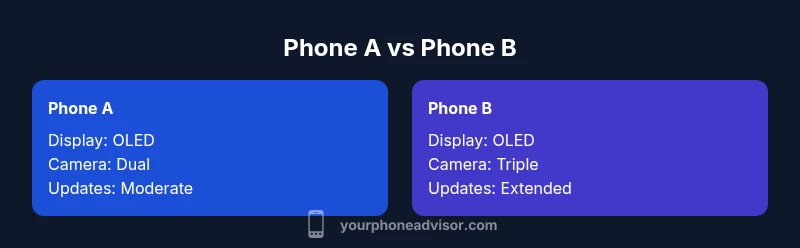
| Feature | Phone A | Phone B |
|---|---|---|
| Display size | 6.1-inch | 6.7-inch |
| Display quality | OLED, high nits | OLED, high nits with better brightness |
| Processor performance | Mid-range chip | Flagship-tier chip |
| Camera system | Dual-camera setup | Triple-camera with better zoom |
| Battery life | Moderate, typical day | Excellent endurance |
| Software updates | Average cadence | Extended support (5+ years) |
| Security features | Standard protections | Advanced biometric options |
| Price range | $300-$500 | $700-$1000 |
The Good
- Clarifies total cost of ownership across two devices
- Spotlights OS longevity and security updates
- Reveals ecosystem and accessory compatibility
- Balances performance with price
Drawbacks
- Can oversimplify hardware nuances
- Requires time and hands-on testing
- Subjective user preference can skew results
Phone A tends to offer better software updates and privacy controls for most users, while Phone B shines with flagship hardware.
For mainstream users, prioritize software support and privacy. For enthusiasts, hardware excellence may justify a higher price.
Got Questions?
What does a phone vs phone comparison actually evaluate?
It evaluates two phones across OS updates, privacy features, performance, battery life, display/camera quality, ecosystem, and price. The goal is to surface which device delivers higher value over time, not just raw specs.
It compares two phones on updates, privacy, performance, battery, display and price to show which offers better long-term value.
How should I weigh privacy when choosing between two phones?
Prioritize devices with transparent permission controls, robust on-device protections, and timely security updates. Privacy is a long-term cost saver when mismanaged data access is avoided.
Look for strong privacy controls and fast security updates; they protect you over the long term.
Is price always the best predictor of value?
Not always. A higher upfront price can be justified by longer updates, better security, and ecosystem benefits that reduce total ownership costs over years.
Price isn't everything—long-term support and ecosystem can make a more expensive option a better value.
Do OS updates affect daily security and performance?
Yes. Regular OS updates fix vulnerabilities, improve stability, and extend the usable life of the device by keeping apps compatible.
Updates matter for security and longevity; they keep your phone safer and faster over time.
What factors most influence battery life in practice?
Display technology, processor efficiency, software optimization, and charging speed all play key roles. Real-world use often differs from lab tests.
Battery life comes down to how bright you use the screen, the chip efficiency, and software tweaks.
How long should I expect updates and support to last?
Most mainstream devices offer reliable updates for several years, but length varies by brand and model. Your plan should factor in expected support duration.
Look for brands with longer update commitments; that matters for resale value and security.
What to Remember
- Define your top priority: updates/privacy vs hardware/camera
- Consider total cost of ownership, not just sticker price
- Software updates drive long-term security
- Check ecosystem compatibility and accessory support
- Test hands-on or rely on trusted reviews to gauge real-world performance