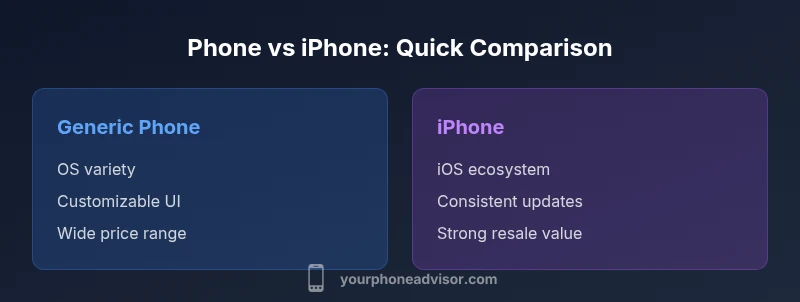
Difference Between a Phone and an iPhone: Key Distinctions
Explore how a generic phone differs from an iPhone across ecosystem, updates, hardware, privacy, and cost. Practical guidance helps you decide which path fits your needs and budget in 2026.


A phone is any mobile device that makes calls, texts, and runs apps, while an iPhone is Apple’s specific smartphone that runs iOS with Apple's ecosystem, services, and policies. The core differences lie in the operating system, app ecosystem, software updates, hardware design, and total cost of ownership. According to Your Phone Advisor, choosing between them hinges on ecosystem preference, update longevity, and whether you value hardware variety or streamlined integration.
What Defines a Phone vs an iPhone?
A phone is a broad term that encompasses any mobile device capable of voice calls, texting, and running apps. It may operate on Android, a range of Linux-based systems, or other proprietary platforms depending on the manufacturer. An iPhone, by contrast, is a specific device produced by Apple that runs iOS and is built to work within Apple's tightly controlled ecosystem. This distinction matters for app availability, update cadence, privacy defaults, and how seamlessly devices and services synchronize across your everyday life. For most users, the decision comes down to ecosystem alignment, openness, and desired level of control over settings and features. Understanding these fundamentals prevents buyers from conflating brand prestige with system parity and helps set realistic expectations about support, repairs, and future software directions.
Operating System and App Ecosystem
The operating system is the backbone of how you interact with a device. Generic phones may run Android, one of several Linux-based variants, or other platforms. Android offers broad hardware variety, deeper customization, and a wider range of price points. An iPhone runs iOS, which is a closed, tightly integrated system developed by Apple. The App Store tends to curate apps for safety and performance, and developers often optimize for a consistent hardware-software environment. This difference affects app availability, update frequency, and how quickly new features reach users. If you value customization and flexibility, a generic phone may suit you; if you prefer consistency and a curated experience, the iPhone is typically more appealing.
Hardware and Design Philosophy
Hardware choices reflect each platform’s philosophy. Generic phones span a spectrum of materials, cameras, and build quality, with design decisions driven by price points and market segments. Apple phones emphasize premium materials, a unified design language, and tight integration with peripherals and services. This integration often translates into smoother performance for core tasks, but it can limit repair options and require brand-specific accessories. When evaluating hardware, consider durability, screen quality, camera performance, and how quickly the device feels outdated compared with your expectations for software support.
Software Updates and Longevity
Software updates are a major differentiator. Apple typically provides longer, more consistent updates across devices within its lineup, extending the useful life of the device and sustaining security and privacy protections. In contrast, generic phone brands rely on external partners for OS updates; the cadence and duration vary by model, carrier, and region. This variability means some devices receive timely updates for several years, while others may lag or stop receiving new features sooner. If staying current with software and security is important to you, factor update policies into your ownership plan.
Privacy, Security, and Data Handling
Privacy controls and data handling differ markedly. iPhone users often encounter strong on-device processing, clear permission prompts, and centralized privacy dashboards within iOS. Apple positions privacy as a core pillar of its platform, though real-world experiences vary by usage. Generic phones provide a broad range of privacy practices, depending on the manufacturer, OS, and installed apps. Google’s ecosystem, for instance, emphasizes cloud-first features and account-based controls. If privacy is non-negotiable, compare default protections, data minimization, and app permission models across devices before deciding.
Cost, Pricing, and Total Cost of Ownership
Pricing dynamics diverge sharply. Generic phones span a wide price range, from budget to premium devices, making initial costs more flexible. iPhones generally fall into premium pricing tiers, which can lead to higher upfront costs and longer replacement cycles. However, total cost of ownership also depends on software updates, resale value, repairs, and accessory ecosystems. Evaluate not just sticker price but ongoing expenses such as accessories, storage upgrades, and service plans. In many cases, the higher initial price of an iPhone is offset by longer software support and stronger resale value, while a generic phone may lower upfront cost but incur higher maintenance or faster depreciation.
Repairability, Servicing, and Support
Repairability varies by model and brand. Generic phones often allow more modularity and a broader array of third-party repair options, sometimes at lower labor costs. iPhones, while featuring known build quality, tend to have more standardized repair channels and can incur higher costs for screen, battery, or component replacements. AppleCare and official service centers provide predictable support paths, but availability and pricing differ by region. When considering repairs, assess your tolerance for downtime, the availability of local technicians, and whether extended service plans make sense for your usage pattern.
Camera, Multimedia, and User Experience
Camera performance and media capabilities depend on the hardware-pipeline synergy of each platform. Generic phones offer varied camera systems, sensors, and software algorithms, which can result in a wider range of image styles and performance. iPhones are known for consistent image processing, color science, and seamless video features across models, aided by tight software integration with hardware. If photography or video is a priority, review sample galleries and video modes for the devices you’re considering, rather than relying solely on brand reputations.
Accessibility and Use Case Scenarios
Accessibility features matter for users with vision or hearing needs. iOS includes a robust set of built-in accessibility options, with ongoing refinement across updates. Android and other platforms also offer comprehensive accessibility tools, which can vary by device and app. Consider specific needs—screen reading, magnification, voice control, or captioning—and verify how well each platform supports those features on the devices you’re evaluating.
Practical Scenarios: When a Generic Phone Makes Sense vs When an iPhone Shines
If you require broad hardware choices, frequent price promotions, or regional availability for certain models, a generic phone may deliver more flexibility. It also suits users who want deep customization and a wide app ecosystem at lower entry costs. On the other hand, if you value a consistent user experience, long-term software support, robust privacy defaults, and a ready-made ecosystem of services and accessories, an iPhone tends to offer a more frictionless path. Your decision should reflect personal priorities like ecosystem loyalty, repair options, and how important it is to you to have a device that ages gracefully with software updates.
How to Decide: A Quick Decision Framework
Create a simple checklist: 1) Is ecosystem integration a top priority? 2) Do you want extended software support or budget-friendly upfront costs? 3) How important are accessories, privacy controls, and app quality? 4) Do you anticipate frequent device upgrades or longer ownership? Answering these questions helps you map your needs to a platform, ensuring your choice aligns with your daily routines and long-term goals.
Comparison
| Feature | Generic smartphone (any brand) | iPhone |
|---|---|---|
| Operating System | Android or other OEM variants | iOS |
| App Ecosystem | Broad, platform-varied app stores | Curated App Store with Apple-optimized apps |
| Software Updates | Varies by manufacturer; update cadence inconsistent | Longer, more consistent updates across devices |
| Hardware Design | Wide range of materials and configurations | Premium build with tight integration to software/services |
| Pricing & Value | Wide price range from budget to flagship | Premium pricing with strong resale value |
| Privacy & Security | Privacy controls vary by OEM; security updates depend on vendor | Strong, centralized privacy controls and timely security updates |
| Repairability & Service | Repair options vary by model; third-party availability broad | Official service and AppleCare channels with consistent support |
The Good
- Flexible ecosystem with broad hardware choices
- Lower upfront costs on average for many models
- Extensive customization options and local repair options
- Wider device variety to fit niche use cases
Drawbacks
- Update cadence and longevity vary by brand
- Total cost of ownership can be higher for premium devices
- App quality and optimization can be uneven across platforms
- Repair costs can be higher on certain models
iPhone often wins on longevity and ecosystem cohesion; generic phones excel on price flexibility and hardware variety
Choose iPhone for sustained updates and a seamless ecosystem. Opt for a generic phone if upfront cost, customization, or device variety matters more to you.
Got Questions?
What is the main difference between a phone and an iPhone?
A phone is any mobile device capable of calls and apps, across multiple brands and OS. An iPhone is Apple's specific device running iOS with a controlled ecosystem. The choice hinges on ecosystem preference, update longevity, and access to apps and services.
A phone is any mobile device with calls and apps; an iPhone is Apple’s version running iOS with a curated ecosystem.
Are generic phones easier to customize than iPhones?
Generic phones typically offer more customization options at the OS and UI level. You can change default apps, launchers, and many settings. iPhones keep customization to a narrower scope to preserve a consistent experience.
Yes, generic phones usually offer more customization; iPhones focus on a consistent, controlled experience.
Do iPhones receive updates as long as Android devices?
iPhones generally receive longer and more uniform software updates across many years. Android devices’ update longevity varies by manufacturer and model, so some will lag or drop support sooner.
iPhones typically get longer, more consistent updates; Android devices vary by maker.
Is the App Store better than Google Play for most users?
Both stores offer a vast selection, but the App Store tends to have stricter quality control and optimization for iOS devices, while Google Play emphasizes broader compatibility across many devices. The best choice depends on your app needs and platform.
Both stores are large, but the iOS App Store is more curated; Google Play is broader in device support.
Can I switch from iPhone to Android easily later?
Switching is feasible but requires planning: data transfer, app reinstallation, and some account reconfigurations. Some apps are cross-platform, but others may lock features to one ecosystem.
Switching is possible but may require data transfers and reconfigurations.
What privacy considerations matter when choosing between a phone and an iPhone?
Privacy controls differ by platform. iPhones emphasize on-device processing and transparent permissions, while other platforms vary by manufacturer. Consider data collection, cloud sync, and app permissions when deciding.
Privacy is platform-dependent; consider data sharing, permissions, and on-device processing.
What to Remember
- Identify your ecosystem preference early in the process
- Prioritize update longevity and privacy based on how you use your phone
- Evaluate total cost of ownership, not just upfront price
- Consider repairability and accessory compatibility before buying