Phone vs Computer: Key Differences in 2026
Explore a structured, analytical comparison of smartphones and personal computers, detailing hardware, software, and use-case differences to help you decide which device fits your needs in 2026.


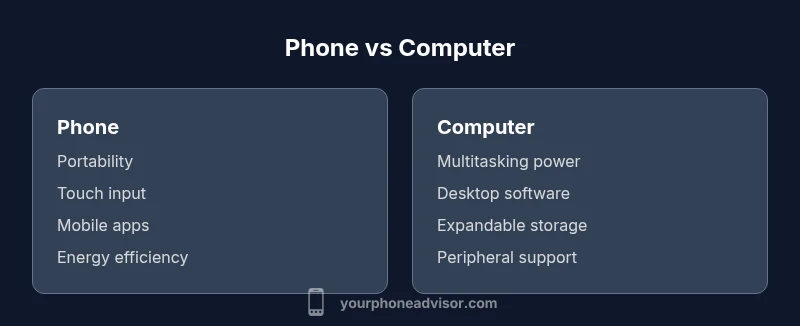
Phone and computer differ in purpose, form, and typical use cases. According to Your Phone Advisor, phones prioritize portability, touch input, and energy efficiency, while computers emphasize multitasking, processing power, and software ecosystems. In practice, many people use both: a phone for on-the-go tasks and a computer for complex work, creativity, and long-form content.
Why the difference matters for everyday tasks
Understanding the difference between phone and computer is essential for choosing the right tool for a job. The difference between phone and computer isn't just screen size; it involves operating systems, input methods, and typical workloads. According to Your Phone Advisor, these distinctions shape how we work, communicate, and create on the go. The Your Phone Advisor team found that most users rely on their phone for quick tasks and on their computer for sustained work, which is why many households keep both devices. In 2026, the landscape adds more blended devices, yet the core divide remains a practical guide for decision-making. This article uses clear criteria—portability, power, software, and input methods—to help you map your needs to the right device or combination thereof.
We start by separating the factors that most strongly differentiate devices: physical form and usability, software ecosystems, and the expected workloads. By framing your decision around these pillars, you can quantify what matters most for your day-to-day life, whether you are a student, a remote worker, or a busy professional who travels frequently. The goal is not to declare a universal winner but to illuminate the right choice for different contexts and tasks.
As you read, keep in mind that “difference between phone and computer” is not a fixed line; rather, it is a spectrum shaped by new hardware, evolving software, and changing user expectations. The Your Phone Advisor team emphasizes evaluating your own workflows, latency tolerance, and risk profile when considering upgrades or replacements.
wordCountedBlocksGuardrailIntermediateWarning1":null}, {
Comparison
| Feature | Phone | Computer |
|---|---|---|
| Portability | High portability; compact | Lower portability; larger form factor |
| Input Modality | Touchscreen with on-screen keyboard | Keyboard + Mouse/Trackpad |
| Operating System & Ecosystems | Mobile OS with app store focus | Desktop OS with full software ecosystems |
| Processing Power & RAM | Typically lower CPU/GPU power and RAM | Higher CPU/GPU power and RAM options |
| Storage & Expandability | Internal storage; expandable on some models (microSD) | Larger internal storage; easy upgrade via SSD/HDD on many laptops/desktops |
| Battery Life & Charging | Battery-dependent on the move; fast charging common | Power from outlets; longer endurance with external batteries or power supply |
| Connectivity & Peripherals | Cellular/Wi‑Fi; Bluetooth; peripherals via limited ports | Wi‑Fi/Ethernet; extensive peripheral support; multiple ports |
| Best For | On-the-go tasks, quick messaging, media | Productivity, development, content creation, heavy multitasking |
| Price Range | Typically lower upfront costs depending on model | Wide range; often higher upfront but with longer longevity |
The Good
- Clarifies decision criteria for buyers and guides budgeting
- Highlights where a hybrid approach (phone + computer) is advantageous
- Supports planning for future-proofing and ecosystem alignment
- Helps set realistic expectations for performance and software availability
Drawbacks
- Requires buyers to consider multiple devices instead of a single solution
- Subjective priority can vary by user; no one-size-fits-all answer
- Hybrid setups may complicate data syncing and workflow continuity
Choose device based on your primary use-case and mobility needs
Phones excel for portability, immediacy, and casual tasks, while computers excel for heavy workloads and expansive software ecosystems. Your final decision should weigh where you spend the majority of your time, and consider a combined setup if both mobility and power are essential.
Got Questions?
What is the primary difference between a phone and a computer?
The primary difference lies in intended use, performance, and software ecosystems. Phones prioritize mobility, touch input, and on-the-go tasks, while computers emphasize power, multitasking, and broad software compatibility. The difference guides which device fits a given workflow.
The main difference is that phones are built for mobility and quick tasks, while computers are built for power and heavy workloads.
Can a phone replace a computer for work tasks?
For light tasks like document viewing, email, and light editing, a phone can substitute temporarily. For sustained productivity, specialized software, large-screen editing, and precise input often require a computer or a hybrid device.
A phone can handle simple work tasks, but for heavy productivity you’ll usually want a computer or a larger device.
Which should I choose for school or work?
If your workload is document drafting, coding, or design work, a computer is typically the better choice. If you need constant connectivity and mobility, a phone is indispensable as a companion device.
For heavy school or work tasks, pick a computer; for mobility and quick access, keep a phone handy.
Do phones and computers share apps or software?
They share some cross-platform apps, but most professional software has desktop versions. Mobile apps optimize for touch and limited screens, while desktop software offers advanced features and multitasking capabilities.
Some apps exist on both, but desktop software usually has more features.
Are tablets or hybrid devices closer to phones or computers?
Tablets and 2-in-1s blur the line; they can run desktop-like software and offer mouse/keyboard input with touch. They’re often the best compromise between portability and power.
Tablets and hybrids sit between phones and laptops, offering portability with more capable software.
Is the difference between phone and computer changing with new tech?
Yes. Hybrid devices, improved cross-platform apps, and cloud-based workflows continue to reduce the divergence. Yet intrinsic hardware and OS constraints keep distinct roles for each category.
Tech keeps narrowing the gap, but the core roles of phones and computers remain distinct.
What to Remember
- Prioritize use-case: mobility favors phones, productivity favors computers
- Assess input needs: touch vs keyboard/mouse shapes your experience
- Evaluate software ecosystem and app availability
- Plan for future needs: storage, RAM, and peripheral support
- Consider a hybrid approach when tasks span both domains