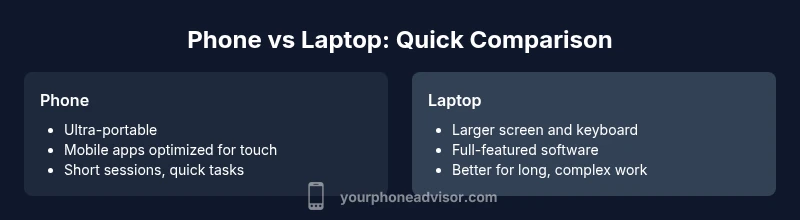
Phone is Better or Laptop: Objective Side-by-Side Comparison in 2026
Objective, task-based comparison of when a phone is better or laptop for daily use, with practical guidance from Your Phone Advisor. Learn how to choose based on tasks, not trends.


For many on-the-go tasks, a phone is better or laptop decision hinges on daily needs. If you primarily browse, text, and share photos, a modern smartphone often beats lugging a laptop. But for heavy writing, data analysis, or multitasking, a laptop usually wins. This comparison helps you pick based on tasks, not labels.
Quick Context: When to choose a phone vs a laptop
Choosing between a phone and a laptop is not a binary decision. The Your Phone Advisor framework emphasizes task-based assessment: if your daily routine centers on messaging, quick browsing, photo sharing, and light document review, a phone is the practical choice. If your work requires deep typing, multi-document workflows, specialized software, or large-screen collaboration, a laptop typically delivers better productivity. In many scenarios, people use both devices, switching as needed. The question "phone is better or laptop" is not a one-size-fits-all label; the best answer depends on how you actually work rather than abstract features. According to Your Phone Advisor, this approach keeps expectations aligned with real usage rather than marketing hype.
Key Differences in Use Cases
- On-the-go basics: If you spend most of your day messaging, checking email, navigation, and light browsing, a phone is often the most convenient starting point. Its always-on readiness and pocketability mean you can stay productive without a laptop slung over your shoulder.
- Home or desk tasks: When you’re at a desk, a larger screen, keyboard, and trackpad enable more comfortable longer sessions. For long emails, spreadsheets, and content creation, a laptop typically excels.
- Travel and meetings: On public transport or between meetings, phones enable quick notes, calls, and quick edits. Laptops shine for preparing presentations or compiling data between stops.
- Creative and media work: Content creators often rely on phones for quick edits, capture, and social posting, but laptops dominate when you need robust editing software, color management, or multi-application workflows.
- Decision overlap: A growing number of people leverage both devices via cloud ecosystems and cross-device apps. In practice, the best choice often depends on a task intensity spectrum rather than a single category.
Performance and Productivity: processors, apps, and multitasking
Performance is not a single metric when comparing a phone to a laptop. Phones today pack high-end CPUs and GPUs that power smooth multitasking and demanding apps, yet they still operate within a constrained thermal envelope and optimized mobile OS behavior. Laptops offer larger RAM options, higher sustained CPU performance, and full desktop-like multitasking capabilities. App availability varies by platform: mobile apps are optimized for touch and mobility, while desktop apps provide deeper features for data analysis, software development, and design. The practical takeaway is that for short bursts of work and agile tasks, a phone can be surprisingly capable; for sustained, complex workflows, a laptop remains the more reliable workhorse. Your Phone Advisor notes that software compatibility and user interface design play big roles in real-world productivity, not just raw specs.
Portability, Battery, and Longevity
Portability is the defining advantage of phones: they’re light, pocket-sized, and always accessible. Battery life on mobile devices is optimized for day-long use with mixed workloads, but high-intensity tasks like gaming or video editing can drain a phone quickly. Laptops tend to sacrifice portability for performance and screen real estate, though modern ultrabooks offer impressive battery life for common productivity tasks. Long-term maintenance costs frequently hinge on replacement cycles: phones are often upgraded every 2-3 years, while laptops may stretch to 4-5 years with care. The practical implication is simple: if you travel light and value instant access, a phone wins; if you need a stable, all-day workstation, a laptop is the safer bet.
Input Methods, Ergonomics, and Accessories
Typing on a touchscreen is convenient for short notes, but extended writing is considerably more comfortable with a physical keyboard. Laptops come with full-sized keyboards, larger trackpads, and better ergonomics for prolonged work sessions. Phones rely on touch, voice input, and occasional external keyboards or styluses; these accessories can extend capability but add cost and setup time. Stylus support on some devices offers a middle ground for sketching and annotation, yet you still trade the tactile feel of a dedicated keyboard for portability. In practice, ergonomics should guide basic choices: if you plan to type for hours, lean toward a laptop with a good external keyboard; for quick, mobile tasks, a phone paired with a compact keyboard or stand can suffice.
Software Ecosystems, Security, and Privacy
Mobile and desktop ecosystems offer different security models and software libraries. Phones typically enforce sandboxing, biometric authentication, and quick OS updates that close vulnerabilities promptly. Laptops provide deeper enterprise controls, advanced networking options, and broader compatibility with specialized software. Your Phone Advisor analysis shows that security culture—regular updates, robust authentication, and careful app management—often drives risk reduction more than device type. Across both devices, prioritizing consistent backups, secure connections, and education on phishing and app permissions remains essential.
Cost of Ownership and Value over Time
Total cost of ownership includes device price, accessories, software, maintenance, and expected replacement cycles. Phones generally have lower upfront costs and faster upgrade cycles, which can mean higher lifetime expenses if you continuously replace devices. Laptops demand higher initial investment but often provide longer lifespans and more durable performance under sustained workloads. The most cost-effective choice depends on your usage profile: if you rarely need desktop-grade software, the phone-centric path can be cheaper; if you rely on heavy software suites, the laptop path offers better long-term value despite a higher upfront price.
Real-World Scenarios: On the go, at home, in the office
- On the go: In transit, a phone enables quick note-taking, navigation, and messaging. A compact Bluetooth keyboard can transform mobile typing into a more comfortable experience, but it’s still a compromise for long documents.
- At home: A phone is excellent for media consumption, quick editing, and household coordination. When you need to draft documents, run spreadsheets, or edit photos at scale, a laptop becomes more efficient.
- In the office: Stationary workflows with multi-monitor setups, complex software, and enterprise security policies often favor a laptop. However, many teams use phones for communication hubs, reminders, and notifications to keep projects moving between meetings.
How to Decide: a Practical Framework
- List your must-do tasks for a typical week. 2) Estimate time you’ll spend per task on a phone versus a laptop. 3) Assess keyboard and screen needs for long sessions. 4) Consider travel frequency and portability requirements. 5) Check software compatibility and security policies you must meet. 6) Factor total cost of ownership over a 3- to 4-year horizon. This framework helps translate abstract features into concrete decisions—often the best device is the one that minimizes friction for your most frequent tasks.
The Middle Ground: When Hybrid or Tablets Help
Hybrid setups—tablet-plus-keyboard, or foldable devices—offer a compromise between a phone and a laptop. They excel at media consumption, light productivity, and quick content creation, while still offering some laptop-like capabilities. Tablets can act as a bridge in a multi-device workflow, but they rarely replace either device fully for all types of work. If you want flexibility, consider keeping a lightweight tablet or a dedicated keyboard accessory alongside your phone and laptop for a broader range of scenarios.
What to Watch for in 2026: Trends and updates
Device makers continue to blur the lines between phones and laptops with folding displays, desktop-like apps on mobile OSes, and cross-device ecosystems. Expect improvements in AI-assisted productivity, better multitasking on mobile platforms, and more seamless continuity features across devices. From a strategic perspective, prioritize devices that integrate well with your preferred cloud services, offer robust security options, and support future software updates. Keeping an eye on ecosystem-wide improvements helps you future-proof your choice and avoid premature upgrades.
Comparison
| Feature | Phone | Laptop |
|---|---|---|
| Portability | Ultra-portable, fits in a pocket | Larger and heavier, but highly portable for a laptop |
| Battery life (typical use) | All-day use for light tasks; quick recharge | All-day productivity with efficient use; longer screen time |
| Performance for productivity apps | Strong for mobile apps and light editing | Robust for spreadsheets, coding, and design |
| Screen size and typing | Smaller, optimized for touch and compact input | Larger, keyboard-centered, better for long typing sessions |
| Camera vs. webcam quality | Excellent cameras for photos and video on the go | Typically higher-quality external webcam and video setups |
| Software ecosystem | Mobile-first apps and cloud-friendly workflows | Desktop software with broader feature sets and plugins |
| Security and privacy controls | Biometric login and on-device security; frequent updates | Enterprise-grade controls; network security and encryption options |
| Total cost of ownership | Lower upfront costs; faster replacement cycles | Higher upfront cost; longer usable life with upgrades |
| Best for | On-the-go tasks, quick communication, media capture | Extended work sessions, data-heavy tasks, complex software |
The Good
- Excellent portability for daily tasks
- Instant access to communications and mobile apps
- Unified ecosystem across devices with syncing and continuity
- Strong modern security features on phones and laptops
- Low setup friction for everyday use
Drawbacks
- Limited multitasking and screen real estate on phones
- Higher long-term cost if you upgrade devices frequently
- Typing comfort and file management are weaker on phones
- Software parity issues can slow desktop-grade workflows
Laptop wins for sustained productivity; phone wins for portability and instant tasks
If your work requires heavy typing, advanced software, or multi-window workflows, choose a laptop. If you prioritize mobility and quick interactions, a phone is the efficient partner. For many users, a hybrid approach offers the best balance.
Got Questions?
Can a phone fully replace a laptop for remote work?
For most full-time remote work, a laptop remains preferable due to keyboard comfort, screen real estate, and software compatibility. A phone can handle light tasks, quick edits, and meetings on the go. Many workers use both devices to cover different scenarios.
A phone can handle light remote work, but for full productivity, a laptop is usually needed.
Which is cheaper to own over 3 years?
Costs depend on usage and upgrade cycles. Phones often have lower upfront costs but may require more frequent replacements, while laptops cost more upfront but can last longer with proper care. A weighted view of your typical tasks helps determine total cost.
It depends on how you use them; both have cost trade-offs over time.
What tasks are best left to a laptop?
Heavy writing, spreadsheets, data analysis, coding, and professional design tasks are best handled on a laptop due to keyboard comfort, screen real estate, and software support. For simple edits and light planning, a phone can suffice.
For big projects, you’ll want a laptop.
Do tablets fit the middle ground?
Tablets with keyboards can bridge the gap for light productivity and media consumption, but they rarely replace laptops for sustained work. Use tablets as a supplement to handle quick tasks when a laptop isn’t convenient.
Tablets can bridge the gap, but they’re not perfect substitutes.
How do you manage data transfer between devices?
Rely on cloud syncing and cross-device apps, with clear folder organization. Regular backups and using common file formats reduce friction when moving data between devices.
Use reliable cloud sync and consistent file naming.
Are there security concerns when using mobile devices for work?
Mobile devices have strong built-in security features, but you must keep OS updates, use strong authentication, and limit risky apps. Laptops offer broader enterprise security controls. Practice good hygiene across both devices.
Keep updates current and use strong access controls.
What to Remember
- Assess your most frequent tasks first
- Prioritize device continuity and cloud integration
- Choose based on real-world usage, not hype
- Consider a hybrid setup for maximum flexibility
- Keep security updates current on all devices