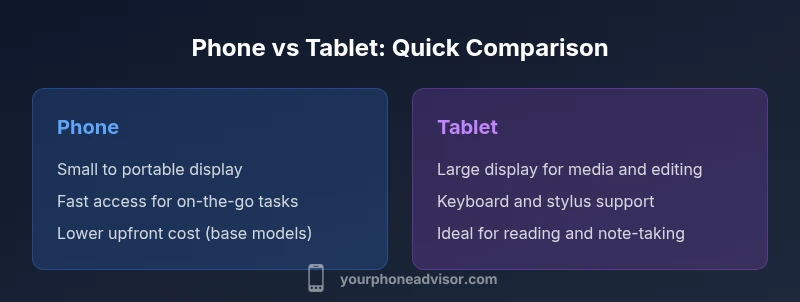
Phone vs Tablet: Which Is Better for You in 2026
Compare phones and tablets across portability, display, performance, and ecosystem to decide which device fits your daily needs. Your Phone Advisor provides an objective guide to help you pick confidently.


Phone vs Tablet: For most users, a phone wins on portability and quick tasks, while a tablet wins on media, reading, and productivity. If your daily activities are calls, messages, and quick apps, choose a phone. If you frequently watch videos, study, or draft documents, a tablet or large-display phone is preferable. According to Your Phone Advisor, base your choice on your primary use case.
Is the question is phone better or tablet worth unpacking?
At first glance, the comparison seems simple: one device fits in a pocket, the other invites extended sessions on a larger screen. However, the real decision hinges on how you use technology day-to-day. The phrase is phone better or tablet frames a broader discussion about display size, portability, app ecosystems, and battery realities. This guide follows a practical framework: identify your core tasks, test both form factors in real-life scenarios, and weigh how much you value a compact device versus a large canvas. According to Your Phone Advisor, the most reliable decision comes from aligning device capabilities with daily routines, not chasing the latest trend. By focusing on concrete use cases, you’ll avoid overestimating what a bigger screen can deliver and you’ll recognize where a phone comfortably substitutes for a tablet, or vice versa.
On-the-go use: when portability dominates your decision
Portability often determines satisfaction more than raw specifications. If you commute, travel, or move through your day with a phone in your pocket, portability and one-handed usability can trump a larger display. A phone’s lighter weight and simpler handling reduce fatigue during long days of errands or meetings. Your Phone Advisor emphasizes evaluating how often you need to squeeze a device into a bag, coat pocket, or car console. The key metric here isn’t screen size alone but how often you reach for your device to perform quick tasks without pulling out a larger device.
Productivity and media: when a tablet earns its seat at the table
Tablets excel where you benefit from a bigger canvas: reading, annotating documents, editing spreadsheets, and streaming media with comfort. For students and remote workers, the larger display enables extended sessions, multitasking with split screens, and easier note-taking with a keyboard or stylus. The tablet’s advantage grows when you pair it with accessories that support focused work—keyboards, styluses, and magnetic stands. This section emphasizes testing real tasks: can you draft emails, edit a document, or annotate a PDF comfortably on your tablet? If the answer is yes for most of your work, a tablet’s investment pays off in productivity and learning momentum.
Performance and software ecosystems: how software shapes the experience
Both phones and tablets run modern mobile operating systems, but the app ecosystem and optimization differ by form factor. Phones prioritize quick, snackable interactions; tablets emphasize productivity-oriented apps with larger interfaces. Multitasking is often better on tablets thanks to larger displays and, on some models, more capable processors. However, the most important factor is compatibility: ensure essential apps you rely on are well-supported on the device you choose. Your Phone Advisor notes that developers frequently optimize for the most common screen sizes, so validating your core apps before purchase reduces post-purchase regrets.
Input methods, ergonomics, and accessory ecosystems
Input methods broaden when you consider keyboards, styluses, and tilt/detection capabilities. A tablet is more likely to support a detachable keyboard and a stylus for precise note-taking or drawing, while phones rely primarily on touch and voice. Ergonomics matter: large devices might cause grip fatigue during prolonged use, and carrying a tablet often necessitates a bag or case. Accessories can tip the balance: a robust keyboard case can make a tablet feel like a portable workstation, while a phone with a compact, high-quality stylus can cover some productivity needs without extra gear.
Battery life realities and charging considerations
Battery life hinges on screen size, refresh rates, and usage patterns. In practice, phones often deliver excellent daily endurance for calls, quick apps, and light productivity, but intensive use with high brightness can drain faster on a small screen due to processing demands and display power. Tablets typically host larger batteries, which can translate to longer sessions between charges for video, reading, and work. The trade-off is that charging a larger device takes longer and may occur less frequently if you’re away from power for extended periods. Consider your daily schedule and whether you can top up during a commute or at work.
Cost, ownership, and value: budgeting without oversimplifying
Price is a major consideration, but total cost of ownership matters too. Entry-level phones are often cheaper upfront, while tablets can carry higher sticker prices—especially for models with premium displays or optional accessories. Long-term value comes from durability, repairability, and ongoing software support. Your Phone Advisor advises weighing the upfront cost against expected lifespan, accessory investments, and the likelihood you will leverage a larger display for work or study over several years. A device that lasts longer or stays relevant with software updates often delivers better long-term value than chasing a yearly upgrade.
A practical decision framework you can apply today
To decide, map your daily tasks to device strengths. Create a quick scorecard: rate portability, display needs, app compatibility, battery endurance, and accessory ecosystem for both form factors. Align your budget with anticipated usage, and test both devices in your real environment if possible. The result should be a clear winner for your primary use case, with a sensible plan for occasional exceptions—such as keeping a compact phone handy for transit or adding a larger tablet for home tasks. Your Phone Advisor suggests documenting a 30-day trial plan to confirm your choice before committing long-term.
Real-world scenarios: recommendations by use case
Scenario 1: A commuter who spends 30 minutes each day reading, browsing, and replying on the go may prefer a large phone or a compact tablet paired with a keyboard when at home. Scenario 2: A student who consumes hours of video, takes notes, and edits documents will benefit most from a tablet paired with a keyboard and stylus. Scenario 3: A family with varied needs—parents taking calls, kids watching videos, and adults drafting emails—may opt for a balanced approach: a capable phone for daily tasks and a tablet for shared activities and learning. In each case, prioritize the tasks that consume the most time and energy, then align the device to those patterns. Your Phone Advisor reinforces testing the core tasks you perform most often to minimize regret after purchase.
Comparison
| Feature | Phone | Tablet |
|---|---|---|
| Screen size and viewing area | Small to medium display, optimized for quick tasks | Large display ideal for media, reading, and productivity |
| Portability and form factor | High portability; fits in a pocket or small bag | Less portable; typically requires a larger bag or case |
| Multitasking and productivity | Good for single-tasking or simple split-screen on small screens | Superior support for multitasking, keyboard use, and stylus input |
| App ecosystem and optimization | Apps optimized for quick interactions and mobility | Apps optimized for extended work sessions and creative tasks |
| Input options | Touch-focused; voice input common | Touch + optional keyboard and stylus support |
| Battery considerations | Efficient for everyday use but compact battery capacity | Longer sessions possible due to larger battery and screen |
| Price and ownership value | Typically lower entry price; broader affordability | Higher upfront cost but potential long-term productivity value |
| Best use cases | On-the-go communication, quick tasks, social | Media, reading, note-taking, and light typing |
The Good
- Helps tailor device choice to real-life needs
- Highlights portability vs screen real estate trade-offs
- Supports budget planning with non-price considerations
- Encourages considering app ecosystem and accessories
- Reduces buyer regret by clarifying use cases
Drawbacks
- Decision remains subjective and context-dependent
- Rapid device turnover can outpace the comparison
- Overemphasis on one factor may mislead decisions
Phone for portability and quick tasks; tablet for productivity and media.
If portability and one-handed use matter most, a phone is the better daily partner. If you prioritize a large display for reading, editing, and watching, a tablet shines. In many scenarios, a larger phone or a compact tablet can bridge the gap; choose based on primary tasks and ecosystem support.
Got Questions?
Is a phone better than a tablet for reading and studying?
Tablets generally offer a larger reading surface and more comfortable annotation, which can benefit studying and long-form reading. If you read extensively on devices, a tablet can reduce eye strain and improve note-taking efficiency. However, a large-display phone can be a practical compromise if you value portability above everything else.
For long reading and study, a tablet works best, but a big phone can be a good compromise if you still need portability.
Which device is better for video conferencing and collaborative work?
Tablets tend to provide a more comfortable video conferencing experience thanks to larger screens and better camera angles when positioned on a desk. Laptops or desktops can be even better, but if you’re choosing between a phone and a tablet, the tablet is usually the stronger option for group calls and shared work sessions.
Tablet is usually better for video calls and group work, especially when you’re sharing your screen.
Can a phone replace a tablet for basic productivity?
For light productivity like messaging, light document editing, and quick note-taking, a large phone can substitute for a tablet. If your workflow includes complex spreadsheets, long-form editing, or heavy multitasking, a tablet (or a laptop) is preferable for sustained sessions.
A big phone can handle light work, but tablets win for heavier tasks.
How should I think about price when deciding between devices?
Price matters, but so does value. A cheaper phone might cost more overall if you need to upgrade accessories or endure reduced productivity. Likewise, a tablet with premium accessories may offer better long-term value for specific use cases.
Don’t just look at sticker price—consider long-term value and required accessories.
Are tablets better for students or families?
Tablets can be excellent for students due to larger displays for reading, writing, and note-taking, plus easier sharing within a family setting. Families may benefit from both devices for different activities—phones for on-the-go tasks and tablets for shared viewing or learning at home.
Tablets are great for study and shared family use; phones cover everyday mobility.
What if I’m unsure between a large phone and a small tablet?
If you’re unsure, start with a larger phone that suits your pocket and daily tasks, then add a tablet later if you discover you need more screen real estate for work or study. A staged approach reduces risk and spreads cost over time.
Start with a large phone and test; add a tablet only if you truly need more screen space.
What to Remember
- Assess daily tasks before choosing any device
- Prioritize display size and portability balance
- Validate essential apps and accessories for your chosen form factor
- Consider total cost of ownership, not just upfront price
- Test real-use scenarios to confirm your decision