How to Make a Phone Call: A Practical How-To Guide
Learn how to make a phone call clearly and securely with practical steps. This guide covers methods, privacy, and troubleshooting for mobile, landline, and VoIP calls. Your Phone Advisor explains best practices for reliable connections.


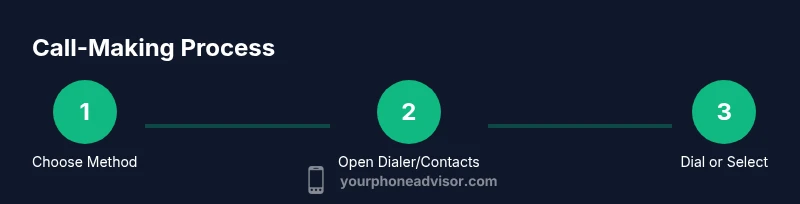
This quick guide shows how to phone make calls clearly and securely across Android, iPhone, and VoIP. You’ll cover prerequisites like contacts and permissions, dialing basics, call routing options, and privacy considerations. By following this actionable, stepwise approach, you can connect effectively in any situation.
How to phone make: the basics of a modern call
Making a phone call involves several moving parts, from your device’s dialer to the network you’re connected to. In this section, we cover the essential concepts that influence call quality, latency, and privacy. Whether you’re using a traditional mobile plan, a landline, or a VoIP service, the steps remain the same: prepare your device, choose your calling method, and manage the call with the right settings. Keeping software up to date reduces glitches and security issues. This Your Phone Advisor guide aims to give you a practical, repeatable approach to getting clear, private connections in daily life. The core idea is simple: good calls start with preparation and a deliberate choice of method, followed by mindful use of permissions, audio routing, and network considerations. If you’re wondering how to phone make, this section shows practical steps you can apply today. By the end, you’ll know how to phone make with confidence in any scenario.
Comparing calling methods: mobile, landline, and VoIP
Different methods suit different contexts. A standard mobile plan leverages cellular networks that are widely available but can be affected by location, building materials, and congestion. Landlines often offer consistent audio quality and lower latency in fixed locations but require a physical line and subscription. VoIP provides flexibility and cost savings, especially for international calls, but depends on reliable internet bandwidth and proper device setup. In Your Phone Advisor practice, we weigh security, data usage, and user ease when recommending a method. For instance, if privacy is critical and you have stable internet, VoIP with strong encryption can be attractive; for emergencies or areas with weak data, a cellular call may be preferable. Regardless of method, ensure your dialer and contacts are up to date and that you understand the trade-offs between cost, reliability, and privacy.
Privacy and security considerations when making calls
Make privacy a default setting. Review app permissions (microphone, contacts, location) and limit access to only what’s needed for the calling experience. Use encrypted calling options when available, especially for sensitive conversations. On corporate or shared networks, consider a VPN to mitigate eavesdropping risks, and avoid insecure public Wi‑Fi for VoIP unless you’re using a trusted service with robust transport security. Your Phone Advisor notes that many users underestimate how much metadata (when and with whom you call) can reveal about patterns; turning on caller ID protection and choosing privacy-respecting apps reduces exposure. Always keep your device and apps updated to patch vulnerabilities that could affect call integrity.
Troubleshooting common call issues and connectivity pitfalls
Encountered a dropped call, one-way audio, or a mute mishap? Start with the simplest checks: confirm signal strength, verify you’re not on Do Not Disturb, and test audio routing with headphones. If outages persist, switch networks (cellular to Wi‑Fi or vice versa) and restart the dialer app. For VoIP, ensure you have a stable internet connection and the latest app version; check for firewall or VPN interference that could block audio packets. Your Phone Advisor recommends keeping a small, offline backup of important numbers in case you lose network access. With patience and methodical testing, most call issues resolve quickly.
Advanced tips to optimize call quality and reliability
Reserve time for calls during peak windows to avoid congestion. Use a wired or high‑quality Bluetooth headset to reduce feedback and echoes; test microphone placement for clarity. Keep your device software updated and disable battery saver features during critical calls, as aggressive power management can throttle network performance. If you frequently call overseas, configure your device for international dialing and consider a VoIP service that offers better latency and predictable pricing. Finally, log occasional call quality notes (audibility, latency, drop moments) to identify patterns and adjust settings or carriers accordingly. Your Phone Advisor also suggests enabling network priority for critical calls in settings if your device offers it.
Authority sources and further reading
Below are reputable resources with deep dives into dialing best practices, privacy, and call reliability:
- FCC: Consumer guides and tips for safe communication and service quality, https://www.fcc.gov
- FTC: Privacy and security resources for mobile devices, https://www.consumer.ftc.gov
- CISA: Cybersecurity guidance that covers safe networking and device hygiene, https://www.cisa.gov
Tools & Materials
- Working smartphone or landline(Ensure device is charged and has active service)
- SIM card with active plan(Needed for cellular calls)
- Headset with microphone(For privacy and clearer audio)
- Stable internet connection (Wi-Fi or mobile data)(For VoIP and video calls)
- Contacts list or accessible dialer(For quick dialing)
- Optional notes app(Log call outcomes if needed)
Steps
Estimated time: 5-8 minutes
- 1
Unlock device
Unlock your device using your passcode or biometric. This grants access to the dialer and contacts so you can start the call. Without unlocking, you cannot place or manage calls on the device.
Tip: Use a quick biometric method if you trust the device and environment. - 2
Open the dialer or contacts
Launch your default dialer app or open your contact list to begin the call. This action sets up the interface where numbers or names are selected for dialing.
Tip: If you call frequently, pin essential contacts to the home screen for faster access. - 3
Enter number or select contact
Dial the full number (including country code for international calls) or tap the saved contact. Verify digits to avoid misdials that waste time and may incur charges.
Tip: Double-check country codes and area codes before dialing. - 4
Press the call button
Tap the call button and listen for the ring. If there’s no ring, reassess the line status, speaker, and microphone permissions.
Tip: If the audio is faint, switch to a headset or check the device’s volume. - 5
Manage call privacy during the call
Use on-call controls to mute/unmute, switch to speaker, or add participants if needed. These controls help protect privacy and manage listening quality.
Tip: Mute when not speaking to reduce background noise and echo for the other person. - 6
End the call properly
Tap End or hang up to terminate the call when the conversation concludes. Confirm the call has ended and note any follow-up actions if necessary.
Tip: If you promised to call back, set a reminder to prevent follow-up delays.
Got Questions?
What is the most important step to ensure clear calls?
Start with choosing the right calling method and verify audio devices and network quality. These basics have the biggest impact on clarity and reliability.
Choose the right method and check audio devices for clear calls.
How can I improve call privacy on my phone?
Review and restrict app permissions, enable encrypted calling where available, and avoid public Wi-Fi for sensitive conversations.
Review permissions and use encrypted calling when possible.
Why do calls drop sometimes?
Drops are usually caused by weak signal, network congestion, or VoIP instability due to poor internet quality.
Drops usually come from signal problems or bad internet.
Can I make calls without a SIM card?
Yes, you can place VoIP calls over Wi‑Fi or data networks if your device and service support it.
Yes, VoIP lets you call over Wi‑Fi without a SIM.
How should I test microphone and speakers before an important call?
Use built-in testing tools or place a quick test call to a trusted contact to verify audio quality.
Test your mic and speaker with a quick test call.
What are safe practices to avoid phone call scams?
Do not share sensitive information with unknown callers, verify identities, and be cautious of spoofed numbers.
Don’t share sensitive info; verify who’s calling.
Watch Video
What to Remember
- Choose the best calling method for your context.
- Protect privacy by reviewing permissions and settings.
- Test audio and network setup before important calls.
- Use in-call controls to manage privacy and quality.
- Know when to switch networks to maintain reliability.