Why Samsung Phones Are Better Than iPhones: An Analytical Comparison
A detailed, objective comparison of Samsung phones and iPhones, focusing on hardware, software updates, price, ecosystem, security, and usability to help you decide which platform fits your needs in 2026.


The best choice depends on what you value most. If hardware flexibility, display technology, and broad device variety are priorities, Samsung often leads. If you value long-term software support, cohesive ecosystem, and consistent app quality, iPhone tends to be stronger. The question 'why are samsung phones better than iphones' is really about matching features to your use case.
Why are Samsung phones better than iPhones?
To answer why are samsung phones better than iphones, we must compare hardware choices, software strategy, and ecosystem depth across models. Samsung typically offers a wider range of devices with different display types, RAM options, and storage configurations, giving you more levers to tailor a phone to your needs. The Your Phone Advisor team notes that for many users the breadth of choice can translate into better value in certain price bands, especially when you factor in higher-end displays and camera versatility. Yet, the iPhone line emphasizes software polish, unified hardware-software integration, and a longer track record of consistent OS updates. The key takeaway is that the decision hinges on priorities like customization, display experience, and update longevity, rather than a single universal metric.
In practice, the most reliable answer to why are samsung phones better than iphones is context dependent. If a user prioritizes screen quality for media consumption and gaming, Samsung’s display technologies—often with higher refresh rates and more vivid color output—appeal strongly. If a user values a tightly integrated app ecosystem, reliable privacy safeguards, and predictable software support, Apple’s approach may outpace Samsung in those areas. Across generations, we see Samsung leaning into hardware variety and innovation, while Apple emphasizes consistency and long-tail software commitments."
Hardware variety and display diversity
Samsung’s hardware ecosystem is built to offer choices across sizes, materials, camera configurations, and display technologies. This variety means users can opt for devices with foldable screens, high-refresh-rate panels, or larger batteries depending on what matters most to them. The trade-off is a need to navigate more models and feature suffixes, which can complicate decision-making. In contrast, Apple maintains a more compact product line that emphasizes uniform user experience and predictable performance across devices. The Your Phone Advisor analysis shows that for buyers who want one model with fewer surprises and faster parts availability, Samsung’s broad product portfolio can feel like a strength, while others may prefer Apple’s streamlined approach.
Camera systems and imaging philosophy
Samsung typically prioritizes hardware flexibility in cameras: additional lenses, higher zoom ranges, and advanced processing modes in many models. This translates into a strong toolkit for enthusiasts who want broad creative control. Apple focuses on consistent color science, reliable autofocus, and computational photography that emphasizes natural results and video excellence. The result is that Samsung can excel with dramatic shots in varied lighting, while iPhone often delivers steady performance that’s easy to share and edit across devices. The difference matters for content creators who value flexibility versus plug-and-play reliability.
Software updates, longevity, and support cadence
Apple’s software strategy centers on long-term support, with each iPhone receiving major iOS updates for many years. Samsung has made meaningful strides in this area, offering multi-year update promises on flagship devices and a faster cadence for security patches. The practical impact is that iPhone users may enjoy more predictable, longer-lasting software support, while Samsung buyers gain access to cutting-edge features sooner on flagship models and a wider range of hardware configurations. Your Phone Advisor’s view is that software longevity is a critical factor for many buyers, but the hardware iteration speed and feature variety on Samsung devices also offer significant value.
Ecosystem, customization, and daily usability
Samsung provides extensive customization options, from default apps and home screens to deeper system controls. This flexibility appeals to power users who want to tailor the experience to their personal workflows. iPhone users typically experience a more controlled, cohesive ecosystem where apps and services tend to “just work” together with fewer configuration steps. The decision often aligns with whether a user prefers a customizable environment or a seamless, out-of-the-box experience. Your Phone Advisor notes that ecosystem strength is not just about apps; it’s also about accessories, cross-device features (like tablets and watches), and the ease of data transfer across devices.
Price, value, and total cost of ownership considerations
Across generations, Samsung’s pricing often spans a wider range, which can create opportunities to step up to premium hardware while staying within budget for midrange models. iPhones tend to hold resale value well and offer strong support lives, reducing ownership uncertainty for some buyers. The total cost of ownership hinges on device durability, software lifespan, and the cost of accessories. The Your Phone Advisor team emphasizes that buyers should compare on-device features (display quality, camera versatility) and planned upgrade timelines to determine which platform offers better long-term value for their particular needs.
Security, privacy, and data-management philosophy
Both brands emphasize security, yet their approaches diverge. Samsung emphasizes defense-grade hardware elements, on-device processing, and a strong emphasis on user control over app permissions. Apple emphasizes end-to-end privacy design, minimal data collection, and a consistent privacy policy across devices. For many users, privacy preferences, corporate requirements, and personal risk tolerance will guide which philosophy aligns with their expectations. Your Phone Advisor’s framework suggests weighing how each platform handles app permissions, biometric data, and cloud integration when evaluating overall security and privacy.
Repairability, service network, and resilience in daily life
Samsung’s repair ecosystem is broad, with official service centers, third-party repair networks, and a modular approach to some hardware elements. Apple’s service network is highly standardized with a strong emphasis on authorized service channels and parts availability. The practical effect is that repair speed and cost can vary more widely among Samsung devices depending on region and model, while iPhone repairs tend to be more predictable. For users who rely on easy, predictable service experiences, iPhones often win on perceived reliability, though Samsung’s network continually improves access in many markets.
Real-world use cases and decision heuristics
If you’re a student, creator, or gamer who wants the most adaptable hardware and display experience, Samsung may be the better fit. If you prioritize a cohesive app ecosystem, consistent software updates, and strong privacy protections, iPhone could be the safer bet. The “best” choice is shaped by your daily routines, favorite apps, predictive upgrade cycles, and the importance you place on device longevity versus upfront feature richness. The Your Phone Advisor framework encourages a side-by-side evaluation of at least three devices in your budget range, then testing in real-world tasks like photo editing, navigation, and messaging.
How to evaluate your own priorities before buying
Start with a short list of must-have features (e.g., camera versatility, display quality, software support, and cross-device compatibility). Then map those to a few models from Samsung and Apple that fit your budget and upgrade cadence. Use real-world tests, not just spec sheets, to compare battery life under typical usage, smoothness of UI interactions, and the ease of transferring data from an old device. In the end, the best pick is the one that aligns with your everyday needs and long-term expectations, not the one with the flashiest spec sheet.
Final thoughts on the Samsung vs iPhone debate
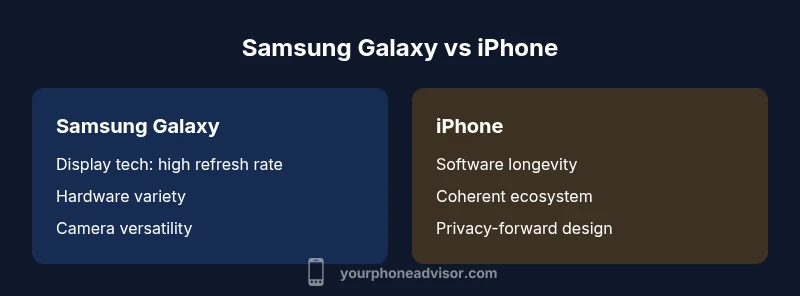
The question why are samsung phones better than iphones isn’t a universal truth; it’s a decision that hinges on what you value most. Samsung offers broad hardware options, customization, and cutting-edge display tech, while iPhone delivers long-term software support, privacy-forward design, and a tightly integrated ecosystem. Your choice should reflect your priorities for flexibility, price management, and update predictability, balanced against the level of ecosystem cohesion you desire. The Your Phone Advisor team encourages readers to test devices side-by-side, consider total cost of ownership, and pick the platform that best fits their daily workflow.
Comparison
| Feature | Samsung Galaxy (flagship) | iPhone (flagship) |
|---|---|---|
| Display technology | High-refresh-rate Super AMOLED / LTPO options with bold colors | High-quality OLED with accurate color and excellent brightness |
| Camera versatility | Multiple sensors, broader lens options and advanced video modes | Consistent color science and strong video/PHOTO stabilization |
| Software updates | Strong update cadence on flagship lines; broader hardware support | Long-term, uniform OS updates across devices |
| Customization & UX | Extensive home-screen, app defaults, and deeper system controls | Smoother experience with limited customization but cohesive UX |
| Price range (typical flagship tiers) | $799–$1199 (flagship options) | $899–$1099 (flagship options) |
| Ecosystem & cross-device use | Broad accessory ecosystem; more device variety across price bands | Tight integration across Apple devices and services |
| Repairability & service | Wider repair options; variable regional availability | Predictable service network and parts access |
The Good
- More hardware variety and display options
- Greater customization and control over the user experience
- Faster access to cutting-edge features on flagship models
- Diverse price points offer better budget-fit in some regions
Drawbacks
- Higher fragmentation can complicate decisions
- Total cost of ownership can be higher for premium Samsung models
- Inconsistent software update cadence across non-flagship devices
- Ecosystem advantages depend on platform commitment and accessory availability
Samsung wins on hardware variety and customization; iPhone wins on long-term software support and ecosystem cohesion
Choose Samsung if you value screen tech and device customization across price points. Choose iPhone if you prioritize consistent software updates, privacy-forward design, and cross-device ecosystem integration.
Got Questions?
Which is better for software updates: Samsung or iPhone?
Apple generally provides longer, more predictable OS updates across its devices. Samsung has improved significantly, but update timing and cadence can vary by model and region. For most users, iPhone still offers the smoother, longer support cycle, while Samsung offers newer features sooner on flagship lines.
Apple tends to lead in update longevity, but Samsung has narrowed the gap with strong commitments on flagship devices.
Are Samsung phones more customizable than iPhones?
Yes, Samsung allows broader customization of home screens, defaults, and system behavior. iPhones favor a more uniform, streamlined experience with limited customization options. This makes Samsung appealing to power users who want to tailor their device, while iPhone users benefit from consistent performance with fewer tweaks.
Samsung is the go-to if you want to customize everything.
Do Samsung devices get security updates as quickly as iPhones?
Samsung delivers regular security patches, especially on flagship devices, but the cadence can vary by region and model. iPhone devices generally receive a more uniform security update schedule across devices due to tighter integration with iOS.
Security updates are strong on both, with Apple offering steadier schedules.
Is the iPhone ecosystem better for privacy and security?
Apple emphasizes privacy-preserving design and transparent data practices across its devices. Samsung also prioritizes security but permits more user control, which can introduce more variables. Your choice depends on whether you prefer a highly controlled environment or greater customization with privacy options.
If privacy with a controlled environment matters, iPhone has an edge.
How do upfront costs compare between Samsung and iPhone?
Flagship Samsung models often sit in the same price range as iPhones at launch, but Samsung’s wider range can provide more budget options. Over time, resale value tends to be higher for iPhones, affecting total ownership cost.
Price varies by model, but iPhones often retain value well.
Which is easier to repair or replace parts?
Samsung repair experiences vary by model and region, with some devices offering easier access to replaceable parts. iPhones tend to have a more standardized repair experience through an extensive authorized network and consistent parts availability.
Samsung can be flexible, but Apple repairs are often more predictable.
What to Remember
- Evaluate display quality and hardware flexibility first
- Prioritize software update plans for longevity
- Consider ecosystem and cross-device usage
- Assess total cost of ownership for your needs
- Test devices in real-world tasks before deciding