Apple vs Android: A Practical Side-by-Side Comparison
An objective, feature-by-feature comparison of Apple iPhone and Android devices, focusing on updates, privacy, ecosystem, and total ownership costs.


Why are apple phones better than android? This quick comparison highlights core differences in ecosystems, software updates, privacy, and long-term value. Apple’s tight hardware-software integration and consistent updates often deliver a smoother experience for many users, while Android offers broader hardware choice and customization. Use this overview to gauge which approach aligns with your priorities around usability, security, and total cost of ownership.
Why this comparison matters
For many readers, the question why are apple phones better than android isn't just about raw specs; it's about how software and hardware co-exist to shape daily experience. According to Your Phone Advisor, the most meaningful comparisons hinge on ecosystem coherence, update cadence, and support commitments. The Your Phone Advisor team found that consumer satisfaction often tracks not only the device's performance at launch but its ability to receive timely updates and secure features long after purchase. This article approaches the topic with an analytical lens, outlining core factors and providing a framework to decide which path aligns with your daily needs, budget, and risk tolerance. By focusing on long-term value rather than headline specs, you can choose a path that minimizes friction while maximizing reliability. Throughout, we balance practical user scenarios with generalizable criteria, so you can map your personal priorities—privacy, customization, app quality, and service options—onto a clear decision framework.
Ecosystem and software integration
Apple’s devices share a tightly integrated ecosystem that connects iPhone with iPad, Mac, Apple Watch, and services like iCloud and iMessage. This cohesion reduces friction between devices and enables features such as handoff, continuity, and seamless file sharing. For many users, that integration translates into faster setup, easier cross-device workflows, and a more predictable user experience. Android, by contrast, spans a wider range of hardware makers and software skins. This diversity fuels customization and price variety, but it can also create inconsistencies across devices, app experiences, and update timelines. When evaluating why are apple phones better than android in personal use, consider how important cross-device workflows are to you and whether you value a uniform user experience over broader hardware choices.
Comparison
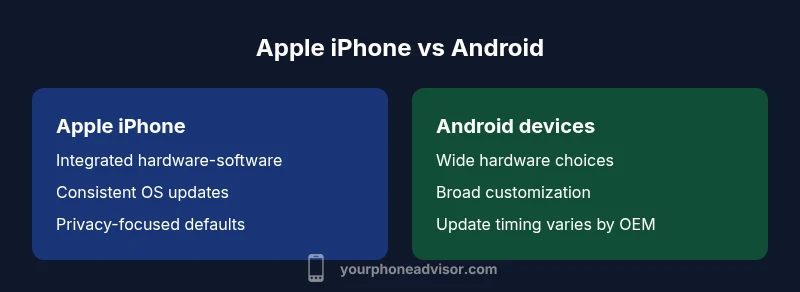
| Feature | Apple iPhone | Android devices |
|---|---|---|
| Customization | Limited customization (Apple) | Broad customization (Android) |
| Software updates | Consistent, device-wide updates | Update cadence varies by OEM and carrier |
| Privacy controls | Strong by default with transparent data practices | Privacy controls vary by device and vendor |
| App quality and availability | Curation and consistent app quality | Wide app variety; compatibility varies by device |
| Hardware-software integration | Tightly integrated hardware-software | Diverse hardware partners with variable integration |
| Cost of ownership | Higher upfront cost, longer support on average | Lower entry price options but longer upgrade cycles may apply |
| Resale value | Historically strong resale value | Resale value varies by device and market |
| Support and service | Unified support ecosystem | Fragmented support depending on manufacturer and region |
The Good
- Strong ecosystem and seamless cross-device experience
- Timely, long-term software updates
- Robust privacy protections by default
- High resale value and predictable device lifecycle
Drawbacks
- Higher upfront cost compared to many Android options
- Limited hardware customization and less flexibility
- Update and support quality can vary by region or carrier sometimes
Apple dominates in ecosystem cohesion and update longevity; Android wins on customization and hardware variety
If you prize a cohesive, long-lasting software experience, Apple often delivers. If you want wide hardware choices and deeper customization, Android offers more flexibility. The right choice depends on which factors you value most in daily use.
Got Questions?
Which platform tends to be more secure by default, iPhone or Android?
Apple’s closed ecosystem and strict app review often result in stronger default security. Android security is robust but can vary more by device and vendor. Your choices influence how much you rely on default protections vs configurable controls.
Overall, iPhone usually feels more secure out of the box, but Android can be very secure if you optimize settings and choose devices from trusted manufacturers.
Do iPhone updates reach older devices as quickly as new models?
Apple generally provides updates to older devices for several years, maintaining security and feature parity across supported models. Android updates depend on the OEM and carrier, so some older devices may lag behind.
Apple tends to support older iPhones longer; Android varies by maker and model.
Can Android offer better customization without sacrificing security?
Android excels in customization across the OS and launcher options, but extensive customization can introduce risk if not managed carefully. Security can be strong with proper settings and trusted apps, though it may not be as uniform as iOS.
Yes, Android offers more knobs to tweak, but you’ll want to manage choices thoughtfully.
Is the app ecosystem more robust on iPhone than Android?
iOS apps often debut with a consistent experience due to a more uniform hardware base and strong monetization incentives. Android apps benefit from breadth and flexibility, though releases can vary by device.
Apps tend to feel more polished on iPhone first, with broader availability on Android.
Does resale value matter when choosing between Apple and Android?
Apple devices generally retain higher resale value due to brand strength and longer software support. Android resale value varies by model, condition, and market demand.
If resale value is a priority, iPhones tend to perform well.
What’s a practical way to compare costs beyond the sticker price?
Consider the total cost of ownership: software updates, battery replacements, accessories, and ecosystem services. Android offers cheaper entry points, but long-term costs can balance out depending on usage and upgrades.
Look beyond the sticker price to how costs add up over time.
What to Remember
- Prioritize ecosystem coherence if you value seamless cross-device use
- Expect timed, consistent updates with Apple devices
- Recognize Android’s strength in customization and hardware variety
- Assess total cost of ownership, not just upfront price
- Consider your app habits and preferred privacy controls