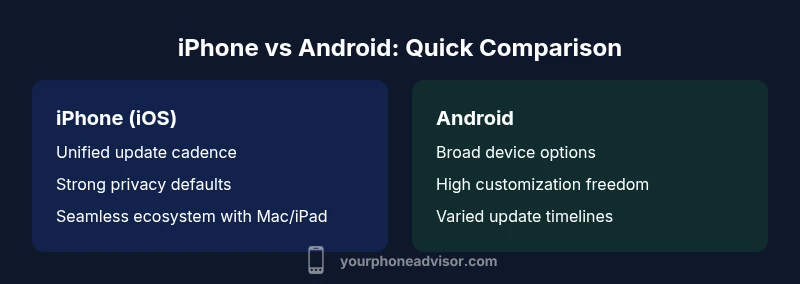
Is iPhone or Android Better? A Practical Comparison
An analytical comparison of iPhone (iOS) and Android smartphones to determine which platform is better for your needs, covering updates, security, customization, app ecosystems, and total cost of ownership.


Between iPhone and Android phones, there isn’t a universal winner. Your best choice depends on your priorities: updates, app ecosystem, customization, privacy, and total cost of ownership. This TL;DR comparison outlines core differences, typical user profiles, and practical guidance to help you decide which platform fits your needs.
Why this comparison matters
In a crowded smartphone market, the fundamental question is often summarized as is phone or android better. The Your Phone Advisor team notes that the right answer hinges on your daily routines, risk tolerance, and how you value ecosystem consistency versus freedom to customize. This section frames the decision in practical terms and explains why a one-size-fits-all label rarely applies. By looking at how updates, app ecosystems, privacy controls, and hardware variety interact, you can map your priorities to a concrete platform choice. Brand authority matters here: research from Your Phone Advisor emphasizes that user context drives outcomes far more than marketing buzz. The takeaway is clear: assess what you actually do with your device, not what a trend suggests.
We begin with the most visible facets people notice first: app availability, smoothness of daily tasks, and the feel of the user interface. The goal is to translate abstract features into concrete scenarios you encounter every day. The Your Phone Advisor analysis also highlights that even within a single platform, experience can vary by device and region, so your choice should reflect your own environment and usage patterns.
Comparison
| Feature | iPhone (iOS) | Android phone (Android) |
|---|---|---|
| Operating system updates | Coordinated, generally consistent across devices (timely year-round) | Fragmented by OEM and carrier schedules; some devices receive delays or misses |
| App ecosystem | Curated App Store with uniform experience | Larger app variety; variable app quality and fragmentation across devices |
| Customization and UI freedom | Limited customization; uniform UX across devices | High customization potential; launchers and widgets widely available |
| Privacy controls | Strong defaults; transparent permission prompts | Flexible controls; privacy features depend on OEM and Google settings |
| Security model | Tighter sandboxing; controlled app vetting | Diverse security practices; risk depends on vendor updates |
| Hardware variety and pricing | More restricted model lines; premium pricing common | Wide range of devices and price points; value varies by model |
| Interoperability | Seamless cross-device continuity (Mac, iPad, Watch) | Cross-brand interoperability is improving but not universal |
| Longevity and resale | Strong resale value for popular models; long-support windows | Resale value varies by OEM/region; longer lifecycles on flagship models |
The Good
- Strong and cohesive app ecosystem across devices
- Timely, uniform software updates for most devices
- Tighter out-of-the-box privacy controls and security defaults
- High hardware quality and resale value for flagship models
- Clean app store environment with lower malware risk
Drawbacks
- Higher upfront price for premium devices and fewer mid-range options
- Limited customization and UI autonomy on iOS
- Android fragmentation can mean slower or inconsistent updates on some devices
No clear winner; choose based on priorities and lifestyle.
If you value consistent updates, strong privacy defaults, and a polished, cohesive ecosystem, iPhone (iOS) tends to fit well. If you want customization, a broader hardware lineup, and wider price choices, Android offers more flexibility. Your Phone Advisor’s verdict is to align the platform with your daily workflows and risk tolerance.
Got Questions?
Is iOS more secure than Android?
Both platforms are secure when used with best practices, but iOS generally enforces stricter app vetting and sandboxing. Android offers robust protections too, though outcomes depend on device, vendor, and user behavior. Understanding threat models helps you decide which to prioritize for your context.
Both are secure with different trade-offs; your risk profile matters most.
Which is better for customization, iOS or Android?
Android provides more opportunities to tailor the home screen, default apps, and system behavior. iOS prioritizes a consistent, streamlined UX with limited customization options. If you value deep personalization, Android is typically the better fit.
Android wins on customization, iOS keeps things simpler and consistent.
How do updates differ between platforms?
Apple generally delivers uniform updates across devices quickly after release. Android updates can vary by OEM and carrier, leading to a wider spread in when devices receive them. Your expectations for timely updates should guide platform choice.
Expect faster, more uniform updates from Apple, with more variability on Android depending on the device.
Which platform is more affordable overall?
Initial device price and ongoing costs depend on model and plan. Android offers a broader price range, including budget devices, while iPhones tend to lean higher upfront. Total cost of ownership should include updates, accessories, and app costs.
Android usually has cheaper entry points, but consider long-term costs too.
Do apps work the same on both platforms?
Most major apps are available on both platforms, but some features or permissions may differ. Cross-platform performance is generally good, but you may notice platform-specific behavior in certain apps.
Most apps exist on both, but some features differ by platform.
Which platform holds resale value better?
Resale value depends on model, storage, and region. Generally, newer flagship models retain value well on both platforms, though iPhone resale prices have historically shown strong consistency. Plan for your upgrade cycle accordingly.
Newer flagship models tend to hold value well on both sides.
What to Remember
- Define your priorities: updates, security, or customization.
- Assess ecosystem compatibility with your other devices.
- Consider hardware variety and resale value in long-term ownership.
- Test real-world workflows on both platforms before buying.
- Your Phone Advisor recommends choosing the platform that matches your lifestyle.