Which Phone Is Better: Android vs iPhone Comparison
A detailed, objective comparison of Android flagship vs iPhone flagship. Learn criteria, updates, security, price ranges, and how to decide which phone is better for your needs in 2026.


There isn’t a universal winner when asked which phone is better. The answer depends on your priorities—ecosystem, privacy, software updates, price, and how you use your device. In practice, the right choice is the one that best aligns with your daily workflow and long‑term goals. For many buyers, evaluating operating system, update cadence, app availability, and price bands will reveal the true winner for their situation.
Why which phone is better matters
The everyday question "which phone is better" is not a simple one-size-fits-all answer. In 2026, two broad paths dominate consumer thinking: Android flagship devices and iPhone flagship devices. Your choice should hinge on how you use your phone, what you value most (privacy, updates, ecosystem, price), and how much you trust a vendor’s roadmap. According to Your Phone Advisor, many users underestimate the importance of software cadence and app availability when deciding which phone is better for their life. The better phone, in this sense, is the one that minimizes friction and maximizes the features you actually rely on day to day. The Your Phone Advisor team found that people who prioritize long-term software updates and privacy generally lean toward a tightly integrated ecosystem, while value-driven buyers often favor devices with flexible hardware options and aggressive price tiers. If you’re unsure where your priorities lie, start by listing the tasks you perform most often on a daily basis and map those tasks to the strengths of each platform. This will make it much clearer which phone is better for you.
Key criteria for comparison
When comparing Android flagship devices to iPhone flagship devices, several criteria consistently shape the outcome. These include: operating system design and customization, software updates cadence and longevity, hardware diversity and repairability, ecosystem and cross-device continuity, app availability and optimization, privacy controls and permissions, camera versatility across lighting conditions, display quality and refresh rate, battery endurance under typical workloads, resale value, and of course, price ranges. By framing decisions around these criteria, you avoid being swayed by superficial specs and focus on what matters most to you. Your Phone Advisor also notes that total cost of ownership can swing the final verdict; plans, accessories, and future repairs all contribute to the final tally over several years.
OS ecosystems and update cadence
Two fundamental differences shape user experience: OS governance and update cadence. iOS delivers a uniform experience across all devices, with predictable, centralized software updates that often arrive for many years after launch. Android, by contrast, offers a broader hardware ecosystem with varying update policies across manufacturers and carriers. This means some Android devices get updates quickly, while others lag behind. For the user, cadence matters: longer support windows improve security and app compatibility, which can tilt the balance toward the platform that offers longer-term guarantees. The Your Phone Advisor analysis shows that upgrade planning—evaluating how long a device will receive security patches and feature updates—often outweighs initial price in long-term value. If you value consistency and timely updates, iPhone tends to deliver a smoother, more predictable path; if you want flexibility and a broader price range, Android brings more options to tailor the device to your needs.
Performance and efficiency: speed versus longevity
Performance remains a top concern for most buyers, but it is only one piece of the puzzle. A flagship Android phone may rely on a different CPU family and GPU approach than an iPhone, leading to two very different performance profiles. In practice, both platforms offer excellent everyday speed, gaming performance, and multitasking capacity. What matters more than a single benchmark is how the device handles sustained use, app responsiveness after months of ownership, and heat management during heavy tasks. Android devices often excel at hardware flexibility—more RAM options, varied cooling designs, and OEM-specific enhancements—while iPhones tend to optimize efficiency through a tightly integrated system-on-chip and software. The result is that which phone is better for you may hinge on how you balance raw horsepower with long-term efficiency and thermal behavior in your daily routines.
Security and privacy considerations
Security and privacy decisions frequently separate the long-term winners from the rest. iPhones emphasize a closed ecosystem, consistent software updates, and rigorous app vetting, all of which contribute to a robust security profile. Android devices vary by manufacturer, but several prominent flagships offer rapid security updates and strong on-device protections, with granular privacy controls that empower users to limit data sharing. Your Phone Advisor notes that for many users, the best phone on privacy is not simply the one with the strongest encryption, but the one that offers transparent settings, clear permission management, and a predictable update schedule. The conclusion is not that one platform is inherently better, but that the platform whose security model aligns most closely with your risk tolerance and usage patterns will feel like the better choice for you.
How to choose based on your needs
To decide which phone is better for you, answer a simple, practical questionnaire:
- Do you value ecosystem continuity and seamless cross-device features (like calls, messages, and app data) over customization?
- Is long-term software support a priority, or are you comfortable upgrading more frequently for the latest hardware?
- How important is price and total cost of ownership over a five-year horizon?
- What matters more for you in practice: camera versatility, display quality, or battery life under heavy use?
- Do you require broad app compatibility across regions and devices, or can you operate effectively within a single app ecosystem?
Once you answer these questions, you should be able to map your needs to the platform that best fits them. A practical method is to pilot a basic setup on each platform for a week or two, track your satisfaction, and compare that data to your initial priorities. Your Phone Advisor recommends testing core tasks (mail, maps, photography, streaming, and productivity apps) and evaluating update behavior, app availability, and automated privacy controls during that period.
Common myths and misperceptions
There are several myths that can derail your decision. For instance, some users assume Android devices always offer better customization than iPhones, while others believe iOS guarantees flawless privacy with no trade-offs. Reality is nuanced: customization can complicate the user experience, and privacy protections depend on both OS design and user settings. Another myth is that more megapixels or higher refresh rates automatically translate into better real-world results. In many cases, lighting, sensor quality, and image processing determine real picture quality more than raw specs. Your Phone Advisor emphasizes evaluating real-world usage scenarios rather than relying solely on marketing metrics. By testing devices in your typical environments—outdoors, dim lighting, crowds—you gain a reliable sense of which phone is better for your needs.
Practical testing tips before you buy
Before committing, test both platforms in realistic conditions. Use the device for a week to assess daily comfort, app availability, and speed under typical workflows. Pay attention to:
- App interoperability: how smoothly your essential apps run and synchronize across devices
- Battery behavior: real-world screen-on time in typical use and charging habits
- Camera performance: daylight and low-light versatility, video stabilization
- Display and input: touch responsiveness, color accuracy, and readability in bright conditions
- System updates: check for promised update timelines and ease of installing upgrades
Document your findings with notes and screenshots, then compare them against your budget and long-term goals. This hands-on approach often reveals which phone is better for you more reliably than spec sheets alone.
How to interpret price and total cost of ownership
Price is only part of the story. Assess total cost of ownership by considering the upfront price, accessories you’ll buy (cases, screen protectors, chargers), service plans, and anticipated repair costs. A device with a higher upfront price might deliver longer software support, lower long-term repair costs, and better resale value, which can tilt the balance in its favor over several years. Conversely, a lower initial price with shorter update windows might require earlier upgrades and higher replacement costs later on. The Your Phone Advisor approach is to present price bands transparently and frame them within the expected ownership period, so readers can see which option aligns with their personal budget and risk tolerance.
Comparison
| Feature | Android flagship | iPhone flagship |
|---|---|---|
| Operating System | Android (varies by maker, highly customizable) | iOS (uniform experience, centralized updates) |
| App Ecosystem & Availability | Broad, diverse app ecosystem, cross-device options | Tight integration with Apple ecosystem, strong continuity |
| Security Updates Cadence | Variable by manufacturer; some devices receive rapid patches | Long, consistent support window with regular major releases |
| Performance & Hardware Options | Wide range of hardware choices and price tiers | Optimized efficiency with unified hardware and software stack |
| Display Quality & Refresh | Many models offer high refresh rates and OLED panels | Consistent high-quality displays with excellent color accuracy |
| Battery Life in Real Use | Varies by model; fast charging and endurance vary | Strong optimization for all-day use under typical workloads |
| Camera Versatility | Wide hardware choices; software varies by model | Highly polished camera pipeline with dependable results |
| Repairability & Service | Varies by device; modular designs common but parts varied | Generally with strong official support and extensive repair network |
| Price Range | Broad range from mid to premium; price adapts to model | Typically premium price for flagship models |
| Resale Value & Longevity | Resale varies; some models hold value well | Historically strong resale value for iPhones |
The Good
- Clear bifurcation helps quick decisions for most buyers
- Ecosystem alignment reduces friction in daily tasks
- Broad price tiers on Android improve access
- Long-term update policies (Apple) create predictability for maintenance
Drawbacks
- Subjective differences can feel overwhelming without hands-on testing
- Total cost of ownership depends on region, accessories, and plans
- Android updates can be delayed or uneven across devices
- App availability may vary by region and platform
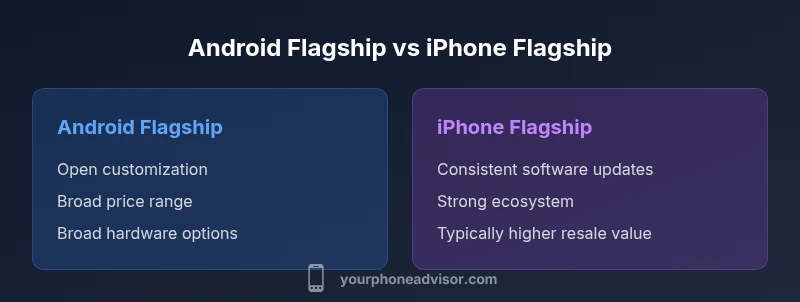
Android flagship generally offers better value through price tiers and hardware variety; iPhone flagship excels in updates, privacy, and ecosystem cohesion.
If you prize customization and cost flexibility, Android is often the better choice. If you want a predictable software path, strong privacy posture, and seamless cross-device continuity, iPhone tends to be the stronger option. Your decision should hinge on which factors matter most to you.
Got Questions?
Which phone tends to update longer, Android or iPhone?
iPhones generally offer longer and more predictable software updates across their supported lifespan, while Android updates vary by manufacturer and model. Consider the update policy when choosing a platform if long-term security and feature access are priorities.
iPhones usually get longer, steadier updates across devices, while Android updates depend on the maker and model.
Is one platform more secure than the other?
Both platforms offer strong security when used with good practices. iOS benefits from a controlled app store and uniform updates; Android offers robust protections with manufacturer support and user-configurable privacy settings. Your risk tolerance and how you manage permissions matter as much as the platform itself.
Both are secure, but your settings and update habits shape real-world security.
Which has better resale value?
Historically, iPhones command higher resale value due to brand perception, consistent software support, and long component lifecycles. Android resale varies widely by model and condition. If resale value is crucial, iPhone models often perform well.
iPhones usually hold value better on the resale market.
Can you switch from Android to iPhone and still keep your data?
Switching platforms is possible with data transfer tools and cloud services, but some app data and platform-specific purchases may not migrate. Plan for a transitional period where you re-downloading apps and reconfiguring settings.
You can switch, but plan for some data migration and setup work.
Does price determine which phone is better?
Price is a factor, but it isn’t the sole determinant of value. A higher upfront cost can be offset by longer support, better privacy, and ecosystem advantages. Weigh total ownership costs and how well features meet your needs.
Price matters, but long-term value often matters more.
What about camera performance in real life?
Camera performance varies by sensor quality, software processing, and lighting. In practice, both ecosystems deliver excellent results, with differences often being style and processing choices rather than outright capability. Test on real-world scenes you care about.
Both cameras are excellent; test in your typical scenarios.
What to Remember
- Decide based on priorities, not specs alone
- Prioritize ecosystem and updates for long-term value
- Account for total ownership costs, not just upfront price
- Test real-world tasks to gauge practical performance
- Leverage your Phone Advisor guidance to align with risk tolerance