What Phone Is Better: iPhone vs Android? An Objective Comparison
An analytical comparison of iPhone versus Android, weighing ecosystems, updates, privacy, customization, and value to help you decide which phone best fits your needs.


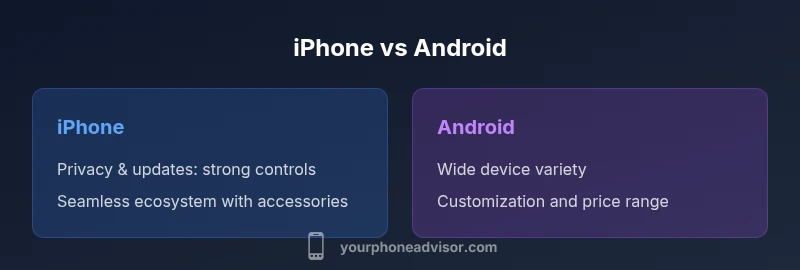
When deciding what phone is better iphone or android, the best answer depends on your priorities. Both ecosystems offer strong devices, but iPhone emphasizes a cohesive experience and timely updates, while Android provides broad hardware choice and customization. Use your priorities to guide the decision. This quick take helps frame the deeper comparison you'll find below.
Why the question matters in 2026
In a world where smartphones are more than pocket computers, the simple question of what phone is better iphone or android carries real consequences for daily life. The Your Phone Advisor team notes that choosing a phone is not just about specs; it's about ecosystem commitments, software updates, privacy models, and long-term value. For many readers, the decision hinges on whether a cohesive, curated experience (iPhone) or a flexible, customizable platform (Android) better supports their routines, security practices, and budget. This article uses a structured, evidence-based approach to unpack the trade-offs, compare core criteria, and provide decision-ready guidance. By analyzing ecosystems, hardware options, software updates, and real-world use scenarios, we help you avoid marketing hype and make a choice you can stand by. The goal is to give you a clear framework for evaluating phones against your everyday needs and preferences.
The analysis reflects current market dynamics in 2026 and considers how updates, privacy controls, and app ecosystems influence daily use. Readers who already rely on a single ecosystem will find value in a balanced lens that respects both sides of the debate. The Your Phone Advisor team emphasizes practical decision-making over hype, focusing on what matters to real users.
Ecosystems: how iPhone and Android shape daily life
Ecosystems are more than software stacks; they define how you interact with your device every day. iPhone users benefit from a tightly integrated environment where hardware, apps, and services are designed to work together seamlessly. From continuity features like Handoff to access to exclusive services, the Apple ecosystem creates a cohesive user journey. Android, by contrast, offers a broader palette of devices, manufacturers, and services. This diversity translates into more choices for screen sizes, camera configurations, and price points, but it can also introduce variability in app experiences and updates. The Your Phone Advisor analysis shows that the strength of a phone often aligns with how well a user’s other devices and services are already integrated into their life. If you rely on Google services, smart home products, or a mix of brands, Android’s flexibility may deliver greater convenience. If you prize a uniform experience across devices, iPhone is typically the smoother path.
When evaluating what phone is better iphone or android, consider your current tech stack: laptops, wearables, in-car systems, and cloud storage. Compatibility across these touchpoints can save time and reduce friction. A strong ecosystem can also influence resale value and long-term satisfaction, because the software and services you rely on are designed to continue working together as you upgrade hardware. Your decision should reflect how deeply you want to invest in a single brand’s world versus a broad, open platform with diverse hardware options. The balance between predictability and customization often marks the key difference in user happiness.
What factors determine what phone is better iphone or android?
Choosing between iPhone and Android hinges on several core criteria that matter most to real-world use. First is ecosystem alignment: if you already own a Mac, iPad, or Apple Watch, an iPhone can offer a more cohesive experience, with features like iCloud, AirDrop, and Continuity that feel native and effortless. On the Android side, the open platform fosters interoperability with a wide array of devices, services, and brands. Second, software updates play a pivotal role in longevity and security. iPhone devices generally receive timely, uniform updates for many years, while Android updates can vary by device and carrier, potentially creating a staggered upgrade path. Third, customization and flexibility are central for many users. Android allows deeper customization of the home screen, default apps, and settings, while iPhone keeps a stronger emphasis on consistency and simple onboarding. Understanding your tolerance for change, as well as your need for control, will guide your decision. Finally, cost of ownership and resale value influence long-term satisfaction. Android devices range from budget to premium, offering price points that can undercut iPhone. However, iPhones often retain resale value and software support longer, shaping long-term value differently depending on your priorities.
If you ask what factors determine what phone is better iphone or android, the answer is that no single feature determines superiority. It is the aggregation of ecosystem fit, update cadence, customization flexibility, device variety, and total ownership costs that defines the better choice for you.
Updates, security, and longevity: value over time
Updates, security, and longevity are often the deciding factors for serious buyers. iPhone updates tend to be rolled out simultaneously to a broad user base and supported for many years, ensuring new features, performance improvements, and security patches arrive promptly. This consistency reduces fragmentation and contributes to a longer overall hardware lifespan. Android updates, by contrast, can vary significantly by device, manufacturer, and carrier. Some high-end Android devices receive rapid updates, while mid-range and budget devices may experience slower or irregular upgrade cadences. The trade-off is that Android often extends longer-term hardware support through bootloader unlocks, developer communities, and a wider selection of devices that can remain relevant even if official updates slow down. When evaluating what phone is better iphone or android from a longevity perspective, think about how you value secure software, timely protections, and the flexibility to repurpose a device beyond the manufacturer’s lifecycle.
Privacy and security expectations also shape perceived longevity. Apple tends to emphasize privacy-preserving defaults and controlled app ecosystems, reducing some risk vectors for average users. Android security approaches vary by vendor; some manufacturers implement robust protection, while others may permit broader customization at the expense of simpler security defaults. In practical terms, longevity is about how well a device remains usable and secure long after the initial purchase, not just the latest flagship specs.
Hardware variety and device strategies
Hardware variety is one of Android’s greatest strengths but also a source of complexity. The Android ecosystem spans countless manufacturers, screen sizes, camera systems, processors, and price bands. This creates abundant choice for consumers who want to optimize for specific features or budgets. You can pick a compact device, a gaming-focused model, or a camera-centric phone with minimal compromises elsewhere. The downside is the risk of inconsistent software experiences, delayed updates on certain models, and variability in build quality across brands. iPhone, by contrast, offers a tightly controlled hardware lineup. Apple’s devices are designed to work together, ensuring consistent performance and a predictable user experience. For some users, this predictability is a major advantage; for others, it means fewer options outside a premium tier. When deciding what phone is better iphone or android, reflect on how much you value variety versus a unified engineering approach.
Battery life, charging speeds, and thermal management become practical discriminators when comparing models. Android devices often shuffle through a broad range of battery capacities and charging standards, giving buyers the chance to select a phone that matches their daily use. iPhone battery performance remains strong across generations, with consistent optimization that preserves energy efficiency across hardware and software. Your choice should consider how you use your phone daily, including gaming, streaming, and productivity tasks, as well as whether you want fast charging or longer-lasting endurance in a single device.
Software experience, app quality, and performance
Software experience is central to how enjoyable a phone is to use. iPhone offers a tightly curated experience with App Store guidelines that emphasize quality control and a refined user interface. The result is often buttery-smooth performance, predictable behavior across apps, and strong integration with other Apple services. Android provides flexibility and breadth in app choices, launcher customization, widgets, and system level tweaks. This can translate into a richer personalization experience but also introduces potential variability in performance and app behavior depending on the device and software skin. Performance parity has increased in both ecosystems as hardware has caught up, but the day-to-day feel of your device still depends on how aggressively the software is optimized for your hardware. When deciding what phone is better iphone or android, consider how much you value polish and predictability versus customization and control. Also reflect on your app expectations, as some premium apps are optimized for iOS but also available on Android with varying feature parity.
App quality is influenced by the store model and developer tools. Apple’s controlled environment often yields higher consistency in app updates and privacy controls, while Android’s open ecosystem can encourage rapid experimentation and broader feature sets but may come at the cost of resource fragmentation. The practical impact for most users is straightforward: if you value a calm, uniform experience with fewer surprises, iPhone tends to deliver; if you want the freedom to tailor features, shortcuts, and default apps, Android offers more creative possibilities.
Customization vs. simplicity: user interface choices
Customization vs. simplicity represents a fundamental design choice. Android users often enjoy deep customization: changing default apps, home screen layouts, widgets, and system gestures. This can improve productivity for power users who want shortcuts and personalized workflows but may require more setup and ongoing maintenance. iPhone emphasizes a streamlined experience with consistent navigation, predictable app behavior, and an emphasis on accessibility and ease of use. The interface remains approachable for new users, and updates are designed to minimize friction when adopting new features. The trade-off is that deep customization is harder to achieve on iOS, which prioritizes uniformity and a curated experience across devices. Your preference for control versus ease of use will guide the decision. If you want a tailored, flexible setup, Android is likely the better fit; if you want a simple, reliable daily driver with cohesive integration, iPhone is appealing.
If you rely on accessibility settings or have specific workflow needs, testing both platforms can reveal which interface better matches your habits. Consider how often you customize, how you organize apps, and whether you benefit from widgets and quick settings previews. Your choice should align with your comfort level for experimentation and your tolerance for maintenance tasks.
Privacy controls and data handling
Privacy has become a central concern for smartphone buyers. Apple’s approach emphasizes privacy-preserving defaults, transparent app tracking controls, and a focus on minimizing data collection where possible. This design philosophy helps reduce certain risk vectors for everyday users and can translate into greater confidence when using apps in public or shared networks. Android privacy depends heavily on the device manufacturer and the installed software. Some vendors implement strong permissions management, secure hardware modules, and clear data controls; others rely more on Google’s ecosystem with varying degrees of data minimization. When deciding what phone is better iphone or android from a privacy perspective, consider which level of control you require and how comfortable you are adjusting permissions, limiting ad tracking, and managing app data. In practice, both ecosystems offer meaningful privacy features; the choice comes down to how much you value defaults versus customization options that can introduce risks if not configured carefully.
Cost of ownership and total value
Total ownership cost encompasses the upfront price, ongoing maintenance, accessory costs, and resell value. Android devices provide a wide spectrum of price points, from budget to premium, allowing consumers to pick a device that fits their financial situation without sacrificing essential features. iPhone devices tend to command higher upfront costs and can retain resale value well, aided by durable hardware and strong software support. Over time, the value proposition depends on how long you plan to keep the device, how quickly you upgrade, and whether you rely on an ecosystem that encourages continued use of accessories and services. When evaluating what phone is better iphone or android, calculate the total cost of ownership across several years, including potential trade-ins, the cost of services, and the availability of affordable repair options in your region. In many cases, the lower initial price of some Android devices is attractive, but sustained value and ongoing software support can tilt the balance toward a longer-lived iPhone for certain buyers.
Use-case scenarios: family, business, photography
Different use cases reveal different strengths. Families may prioritize device compatibility, shared plans, and parental controls; Android often offers a wider array of family-friendly features and budget options to accommodate multiple lines. Businesses may favor security features, device management, and long-term support; both ecosystems provide enterprise tools, but iPhone’s uniform hardware and software updates can simplify management, while Android’s openness can offer flexible deployment for diverse teams. Photographers may weigh camera systems, image processing, and third-party app support; iPhone cameras consistently deliver reliable color science and video features across models, while Android leads with hardware variety and advanced computational photography from several manufacturers. To decide what phone is better iphone or android for your specific use case, map your top needs—security, cost, family sharing, or creative capabilities—and test representative devices in your daily routines. Your choice should reflect concrete use patterns rather than abstract claims.
How to evaluate for your personal needs
A practical evaluation starts with a two-step test. First, list your must-have features and rate their importance. Second, test a device in your daily routine for a week, paying attention to battery life, responsiveness, app reliability, and the smoothness of updates. Consider your current service plans, cloud storage habits, and how much you value ecosystem features like seamless app continuity or cross-device sharing. If you already own Apple devices or rely on iCloud, the incremental benefit of moving to an iPhone stacks up quickly in daily tasks. Conversely, if you depend on Google services, a wide hardware ecosystem, or customizable interfaces, Android devices may deliver faster payoffs. Finally, forecast practical costs: upfront price, accessories, repair options, and potential resale value. By anchoring your decision to real-world use and financial implications, you can determine what phone is better iphone or android for your life and budget, rather than based on marketing promises alone.
The Your Phone Advisor team recommends creating a short, personalized decision rubric and revisiting it after a trial period with a chosen device.
Authority sources and further reading
For readers seeking external validation and formal guidance, consider these sources:
- FCC: Smartphones guidance for consumers and safety considerations. https://www.fcc.gov/consumers/guides/smartphones
- FTC: How to choose a smartphone and compare options. https://www.ftc.gov/business-guidance/blog/how-choose-smartphone
- Official device ecosystems: Apple iPhone overview and support. https://www.apple.com/iphone/ and Android at https://www.android.com/
Additional independent analysis and industry coverage can help triangulate your decision: major tech publications regularly evaluate long-term performance, updates, and user experience across platforms. (Examples include The Verge and other established outlets.)
Myths and misperceptions about iPhone vs Android
Several common myths persist: that iPhones never slow down, that all Androids have identical update cadences, or that price always equals quality. In reality, performance depends on software optimization, hardware pairing, maintenance, and user behavior. Similarly, update cadence is improving across many Android devices but can still depend on the manufacturer and carrier. By challenging these myths with up-to-date facts and hands-on testing, you can avoid overgeneralizations and make a more accurate assessment of what phone is better iphone or android for your specific needs.
Practical testing tips before buying
If possible, arrange vendor demos or borrow devices from friends to test real-world tasks: messaging, camera performance in typical lighting, gaming, multitasking with multiple apps, and using memory-heavy tasks like video editing. Pay attention to the feel of the UI, load times, thermal behavior under load, and the ease of moving data from your current phone. Take notes on which features matter most to you, such as privacy controls, app parity, or cross-device syncing. A short, structured test helps you avoid buyer’s remorse and ensures your choice aligns with your daily workflow.
Comparison
| Feature | iPhone | Android |
|---|---|---|
| Ecosystem & device cohesion | Tightly integrated across iPhone, iPad, Mac, and Apple Watch | Broad interoperability across manufacturers and services |
| Software updates & longevity | Timely, widely available updates and long-term support | Update cadence varies by device and vendor; range of support expected |
| Customization & UX flexibility | Controlled, consistent user experience with fewer surprises | Deep customization options for home screens, defaults, and widgets |
| Hardware variety & price points | Limited models across a premium range | Huge device variety across price bands and configurations |
| App ecosystem & quality | Strong app quality with uniform expectations | Broad app selection; parity varies by platform and device |
| Privacy & security stance | Privacy-centric defaults with controlled app access | Vendor-dependent privacy implementations and settings |
| Total cost of ownership | Typically higher upfront cost but strong resale value | Wide range of prices; potential lower upfront cost but mixed resale value |
The Good
- Cohesive ecosystem with predictable updates for iPhone users
- Extensive device variety and customization for Android fans
- Strong resale value and long-term support for flagship devices
- Broad affordability spectrum on Android
Drawbacks
- Fragmentation in Android can affect update timing
- Deeper customization may require more maintenance and setup on Android
There is no universal winner; your priorities define the winner
If you value a seamless, consistent experience and long-term support, iPhone wins. If you prioritize hardware variety, customization, and budget flexibility, Android wins.
Got Questions?
Which phone has better app quality and consistency?
Both ecosystems host high-quality apps; iOS apps are often optimized for uniform hardware, while Android offers broader device support and customization. Practical differences usually matter most in how you use apps daily.
Both platforms have great apps; iPhone often feels more uniform, Android gives more customization options.
Do updates arrive faster on iPhone?
iPhone devices generally receive OS updates promptly and for many years. Android updates depend on device, manufacturer, and carrier and can be slower or staggered.
iPhones usually get updates quickly and stay current longer.
Is Android more customizable than iPhone?
Yes, Android supports deeper customization at system and home-screen levels, while iPhone emphasizes consistency and simplicity.
Android lets you customize more, but it can require more setup.
Which is better for privacy?
Apple emphasizes privacy-centric defaults and controls; Android privacy depends on device manufacturer and user settings.
Apple focuses on privacy; Android privacy depends on device and settings.
Which is more affordable to own long-term?
Android devices span a wide price range; flagship iPhones often retain higher resale value and longer software support.
Android can be cheaper upfront; iPhone often holds value longer.
If I already use Google services, which is better?
Android integrates more deeply with Google services and offers broader hardware compatibility; iPhone supports Google services well but with tighter ecosystem integration on Android.
If you live in Google services, Android offers tighter integration.
What to Remember
- Assess your ecosystem commitments before choosing
- Prioritize update cadence and security features
- Weigh customization against ease of use
- Consider total ownership costs and resale value
- Match the device to your daily workflows
- Test devices in real-life scenarios before buying