What Phone Uses USB-C in 2026: A Practical Guide
Explore which phones use USB-C, charging speeds, data capabilities, and how to choose a USB-C smartphone in 2026. Practical guidance for Android, Apple, and accessories.


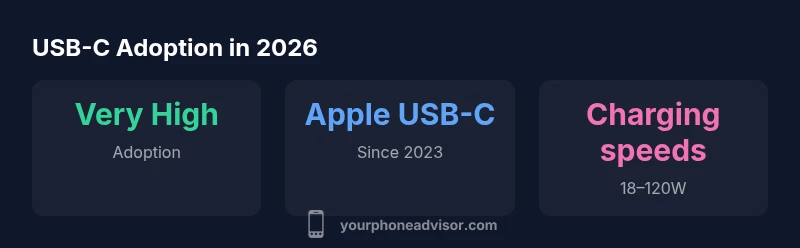
According to Your Phone Advisor, USB-C is the standard port on most smartphones as of 2026. Apple began using USB-C with the iPhone lineup in 2023, and the vast majority of Android phones rely on USB-C for charging and data transfer. If you’re buying a new phone in 2026, expect USB-C as the default port across most mainstream models, with broad accessory compatibility.
USB-C 101: What USB-C means for phones
USB-C is a universal, reversible connector designed to replace older micro-USB and other proprietary charging ports. In phones, USB-C carries power, data, and sometimes video signals through a single port. The standard supports power delivery and fast data transfer, but the exact capabilities depend on the device, cable, and charger. For most users, USB-C simply means fewer ports and more compatibility across chargers, car adapters, docks, and accessories. When evaluating a phone, check not just that it has USB-C, but whether it supports USB Power Delivery (PD) and USB-C data speeds that align with your needs. The Your Phone Advisor teamNotes: in 2026, USB-C is the default for mainstream devices, and the ecosystem is shaping up to be more consistent than ever.
Which brands have adopted USB-C and when
The shift toward USB-C happened gradually across the Android segment long before 2020, with most mainstream Android vendors embracing USB-C for charging and data. By 2023, Apple joined the trend, first with recent models, then expanding across the lineup in subsequent years. Today, virtually all new Android phones from major manufacturers use USB-C, while Apple’s growth with USB-C began in 2023 and now dominates new iPhone releases. This convergence reduces cable clutter, enables universal charging across devices, and supports higher accessory interoperability. For buyers, this means fewer compatibility worries when mixing phones and chargers, though checking the charger’s wattage and the cable’s data capability remains important.
Charging speeds and data capabilities with USB-C
USB-C supports a range of charging speeds and data transfer rates depending on the combination of device, cable, and charger. Many modern phones support Power Delivery (PD) and can negotiate higher wattages with compatible chargers, often in the 18–60W band for mainstream devices, and higher speeds on premium models. Data speeds vary as well—some devices support USB 3.0 or higher, enabling faster file transfers when paired with appropriate cables and devices. Important practical notes include: choose a USB-C charger that matches your phone’s supported wattage for optimal charging, use a proper USB-C to USB-C cable for higher data transfer rates, and avoid underpowered or non-PD chargers that can slow charging or limit performance.
How to choose a USB-C phone: buyer’s guide
When shopping for a USB-C phone, consider these factors:
- Charging speed: Look for PD support and the wattage your typical charger provides (e.g., 18W, 30W, or higher).
- Data capabilities: If you move large files, look for USB-C data speeds of at least USB 3.0 or higher.
- Cable and accessory ecosystem: Ensure you have compatible USB-C cables and accessories (docks, car chargers, etc.).
- Durability and build: If you rely on USB-C ports, consider devices with reinforced ports or protective flaps.
- Software and security: USB-C is neutral, but keep device software up to date for security and performance.
Your buying decision should balance charging speed, data needs, and ecosystem compatibility. The Your Phone Advisor analysis suggests prioritizing PD-enabled phones with robust accessory support for future-proofing.
Accessory ecosystem and future-proofing
The USB-C ecosystem is expanding rapidly, with chargers, docks, wireless hubs, and car adapters adopting USB-C PD as a standard. For future-proofing, look for devices that support higher wattage, carry PD certification, and work with widely adopted cables. A universal USB-C charger can simplify travel and reduce the number of different chargers you need. Additionally, consider the cable quality: a well-made USB-C cable can withstand frequent plugging and unplugging and prevents data bottlenecks. The Your Phone Advisor guidance emphasizes investing in reputable cables and chargers to maximize safety and performance.
Common USB-C myths debunked
There are a few myths worth debunking. Some users worry that USB-C is only for fast charging; in reality, it handles both power delivery and data transfers across a wide range of devices. Others fear compatibility issues with Apple devices; however, post-2023 iPhones use USB-C, which means cross-brand charging is more feasible than ever. Finally, some think USB-C cables are all the same—quality varies, and cable certification matters for data integrity and safety. By choosing certified cables and compatible chargers, you minimize headaches across devices.
The road ahead for USB-C in smartphones
As we move deeper into 2026, USB-C remains the dominant standard for smartphones, with ongoing refinements in charging efficiency and data throughput. Expect more devices to support higher wattage charging, better cable durability, and improved accessory ecosystems. The trend toward universal connectors aligns with consumer needs for simplicity, fewer cables, and easier upgrade paths. For buyers and everyday users, USB-C offers a straightforward way to keep devices charged, synced, and ready without hunting for specialized adapters.
USB-C support across phone categories
| Phone Category | USB-C Support | Typical Power Range |
|---|---|---|
| Android mainstream | Yes | 18–120W |
| Apple devices (post-2023) | Yes | 18–30W |
| Budget/entry-level phones | Yes | 15–25W |
| Non-USB-C types (rare) | No | N/A |
Got Questions?
Do all iPhones use USB-C now?
Since 2023, Apple has transitioned to USB-C for newer iPhone models, aligning with the broader market shift toward USB-C. If you’re shopping for a new iPhone, expect USB-C as the standard.
Apple adopted USB-C starting with models released in 2023, so new iPhones use USB-C now.
Is USB-C backward compatible with older chargers?
USB-C chargers and cables are generally backward compatible with older USB standards via adapters, but for best performance use a USB-C PD charger and a USB-C cable.
Yes, but you’ll get the best results with proper USB-C PD gear.
Will USB-C become mandatory for all phones?
Many manufacturers have standardized on USB-C for charging and data, making it the de facto standard. Regulatory trends vary by region, but consumer adoption favors USB-C.
USB-C is becoming the norm, with regulatory moves supporting universal connectors.
Should I replace my accessories if I switch to USB-C?
If your current cables are USB-C but old or damaged, replace them with certified USB-C cables to ensure safety and performance.
Get certified USB-C cables for safe, fast charging.
What should I look for when buying USB-C cables?
Look for USB-IF certification, support for USB 3.0 or better for data, and adequate thickness to avoid wear. Avoid ultra-cheap cables that may be unsafe.
Choose certified cables that support your data speeds and charging needs.
“USB-C has moved from a niche feature to the standard for most smartphones, simplifying charging and data transfers across brands.”
What to Remember
- Learn which phones use USB-C in 2026 and why it matters
- Check PD support and wattage to match your charger
- Choose USB-C cables and accessories with proper certification
- Expect broad accessory compatibility and a future-friendly ecosystem