Which Phone Uses USB-A? A 2026 Practical Guide to Chargers
Explore which phones still rely on USB-A charging, why USB-C dominates, and practical tips for adapters and compatibility in 2026 with Your Phone Advisor. Learn safe, effective ways to bridge legacy USB-A gear with modern devices.


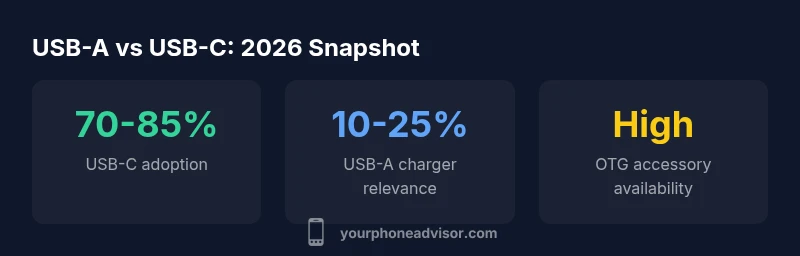
For the question what phone uses usb a, the simple truth is that USB-A ports are largely absent on modern smartphones. The USB-A plug appears on the charger cable or on accessories, not on the phone itself. Since around the mid-2010s, most manufacturers shifted to USB-C for charging and data transfer due to its reversible design, higher power delivery, and universal accessories. This shift accelerates with flagship models from major vendors and continues through mid-range devices. There are still niche exceptions: some budget or rugged phones released in 2024-2026 might include USB-C only but ship with a USB-A wall charger in the box; legacy devices may rely on micro-USB connectors combined with USB-A to micro-USB adapters. In daily life, USB-A's role is mostly related to adapters and third-party accessories rather than the phone itself. If you’re aiming to charge a modern phone at a hotel or airport, the odds are you’ll encounter USB-C outlets or USB-C PD chargers rather than pure USB-A sockets. This article explains what this means for charging, data transfer, and buying decisions.
USB-A in 2026: What it means for phones
For the question what phone uses usb a, the simple truth is that USB-A ports are largely absent on modern smartphones. The USB-A plug appears on the charger cable or on accessories, not on the phone itself. Since around the mid-2010s, most manufacturers shifted to USB-C for charging and data transfer due to its reversible design, higher power delivery, and universal accessories. This shift accelerates with flagship models from major vendors and continues through mid-range devices. There are still niche exceptions: some budget or rugged phones released in 2024-2026 might include USB-C only but ship with a USB-A wall charger in the box; legacy devices may rely on micro-USB connectors combined with USB-A to micro-USB adapters. In daily life, USB-A's role is mostly related to adapters and third-party accessories rather than the phone itself. If you’re aiming to charge a modern phone at a hotel or airport, the odds are you’ll encounter USB-C outlets or USB-C PD chargers rather than pure USB-A sockets. This article explains what this means for charging, data transfer, and buying decisions.
From a practical standpoint, what phone uses usb a is less about the phone and more about the charger or accessory you’re using. You won’t find USB-A on most new devices; you’ll encounter it on older chargers, car adapters, or budget-friendly accessories. If your current setup relies on USB-A, you’ll likely be using an adapter or a cable that converts USB-A to USB-C or micro-USB. Your overall experience hinges on the power rating of the adapter and the compatibility of the cable, not the phone itself.
The current connector landscape: USB-C dominates
Today’s smartphone market shows USB-C as the default charging and data port for new devices. USB-C delivers higher power, supports faster data transfer, and is reversible, which improves user experience. For many buyers, this shift means fewer USB-A ports in the wild and fewer USB-A cables included in box contents. Your Phone Advisor analysis indicates a widening mismatch between USB-A accessories and new devices, but USB-A remains common on older chargers, car adapters, and some legacy accessories. If you still own older devices, you’ll typically use USB-A on the charger side while the phone remains USB-C or micro-USB. For travelers and households with mixed devices, keep a small supply of USB-A to USB-C adapters handy, but don’t assume USB-A will remain standard on new phones.
Practically, if you’re buying a new phone today, expect USB-C to be the standard across brands and models. If you have an existing USB-A charger, an adapter or a cable that bridges USB-A to USB-C can bridge the gap without replacing your entire charging setup. This approach lets you stay flexible while you transition toward USB-C across your devices.
How to tell if your phone uses USB-A accessories (not the phone port)
The phone itself rarely has a USB-A port anymore; instead, USB-A materializes on cables, adapters, and peripherals. To determine whether your current ecosystem relies on USB-A, check these indicators:
- Look at your charger cable: if the plug on the wall side is a large rectangular Type-A connector, you’re dealing with USB-A on that end.
- Inspect adapters and hubs: USB-A male connectors are common on older hubs or car chargers and are designed to connect to USB-C devices via adapters.
- Identify your device port: most modern smartphones use USB-C or micro-USB on the phone end, not USB-A. If your phone port is USB-C and your charger or accessory uses USB-A, you’ll need an adapter to bridge the two.
- Verify power delivery: USB-C PD accessories support higher wattage; USB-A chargers often deliver lower power unless paired with a fast-charging protocol through an adapter. If you’re unsure, consult the product manuals or manufacturer specs. The core principle is simple: USB-A on a device means the device has a USB-A port, which is rare; USB-A on a charger or accessory means you’ll need an adapter to connect to a USB-C or micro-USB phone port.
Practical buying guide: cables, adapters, and safety
When buying USB-A accessories for today’s phones, prioritize compatibility and safety:
- Opt for certified adapters and cables from reputable brands to avoid power surges or data issues.
- Check the power rating of USB-A chargers. If your phone supports fast charging, using a low-wattage USB-A charger will slow down charging.
- Prefer adapters that clearly indicate compatibility with USB-C devices and support the correct USB standard (USB 2.0 vs 3.0).
- Avoid ultra-cheap adapters that lack proper insulation or overheating protection; these can damage devices or pose safety risks.
- If possible, consolidate by purchasing a USB-C charger with multiple ports (including USB-C) to future-proof your setup while keeping a USB-A to USB-C adapter handy for legacy accessories.
- For data transfers, use cables that explicitly state USB 2.0 or USB 3.0 support and verify the device throughput to avoid bottlenecks.
- Keep cables. Do not coil tightly; heat can degrade insulation over time, especially with high-wattage charging. In short, the safest path is to rely on reputable USB-C chargers for new devices while maintaining a small set of USB-A adapters for legacy gear.
Use cases where USB-A still helps
USB-A can still be practical in certain scenarios:
- Legacy ecosystems: If you have a legacy desktop computer, car charger, or old wall charger, USB-A cables and adapters can bridge devices without immediate replacement.
- Travel and shared spaces: Hotels, airports, and shared working spaces often stock USB-A charging hubs; carrying a USB-A to USB-C adapter keeps you flexible.
- Budget devices and accessories: Some budget smartphones or accessories may still ship with micro-USB ports or include USB-A charging cables in the box; this can make USB-A setups relevant in the short term.
- Data transfer with older peripherals: Some older accessories use USB-A for data transfer; having a bridge cable may simplify compatibility during a transition period. In these cases, USB-A remains useful as a bridging technology rather than a primary charging solution for new devices.
Safety, power, and quality considerations
Power delivery and safety are critical when mixing USB-A with modern devices. USB-A chargers vary widely in wattage; not all USB-A ports deliver the same power. Plugging a high-wPS device into a low-watt USB-A charger can result in slow charging or overheating. When shopping for adapters, look for items with established safety certifications, such as protections against overvoltage, overcurrent, and short-circuits. Use only USB-A cables that are rated for charging and data transfer; mismatched combinations can degrade performance, cause data errors, or harm batteries over time.
Keep in mind that adapters can introduce signaling delays or compatibility issues with certain devices. If you rely on USB-A for a critical workflow, test the kit with your phone: verify charging speed, confirm data transfer reliability, and inspect for heat during extended use. For most users, a modern USB-C charger paired with a USB-C to older-port adapter is the cleanest, safest route to maintain compatibility across a mixed device environment.
Data transfer and charging performance with USB-A adapters
Data transfer over USB-A adapters to modern phones is possible but often slower than USB-C direct connections, especially on higher data-rate tasks. If you need fast data transfer (photos, large files, etc.), USB-C or USB-C to USB-C connections are preferable. When charging via USB-A, the actual speed depends on both the charger’s output and the cable’s capabilities; a high-watt USB-A charger can still effectively power many devices, but you may not reach peak specified charging speeds without USB-C PD. Users should manage expectations about data throughput and charging times. If you frequently move large files or rely on rapid charging, consider gradually migrating to USB-C accessories and chargers to maximize efficiency. A small, well-chosen USB-A adapter can bridge the gap in the meantime without forcing a full device upgrade.
Common myths about USB-A and phones
There are several myths worth addressing:
- Myth: USB-A is dead and unusable with any phone. Reality: USB-A continues to bridge legacy gear and certain accessories, but phones predominantly use USB-C.
- Myth: USB-A cables always charge faster than USB-C. Reality: USB-A speed depends on the charger and cable quality; USB-C with PD typically offers faster charging.
- Myth: Buying USB-A accessories from any vendor is safe. Reality: Stick to reputable brands with safety certifications to avoid damage or safety risks.
- Myth: USB-A adapters degrade data integrity. Reality: Well-made adapters designed for data transfer minimize errors; cheap adapters can hurt performance. Addressing these myths helps users avoid overpaying for outdated solutions while preserving access to legacy gear when needed.
Quick decision tips: what to buy now
If you’re upgrading your setup in 2026, adopt a phased approach:
- Primary: Invest in a high-quality USB-C charger with PD support for all new devices.
- Bridge: Keep a small USB-A to USB-C adapter kit for legacy accessories and occasional travel.
- Verify: Always check the power rating and safety certifications before purchasing adapters or cables.
- Plan for the future: As USB-C becomes universal, gradually retire USB-A cables and focus on USB-C for new devices. If you must maintain USB-A compatibility, ensure you have a modern, well-protected adapter to minimize risks.
- Document: Label adapters and cables to avoid cross-compatibility confusion among family members or coworkers who use different devices.
Connector landscape across smartphone categories (phone port vs charger/adapter).
| Category | Port Type (Phone) | Typical Charger Connector | Notes |
|---|---|---|---|
| New flagship devices | USB-C | USB-C | USB-C is standard on most 2020s flagships |
| Mid-range/older models | USB-C or micro-USB | USB-C | Many mid-range devices migrated to USB-C; micro-USB diminishing |
| Phone connectors (port on device) | USB-C or micro-USB | N/A | Phones rarely expose USB-A ports on the device itself |
| Charging accessories | USB-A / USB-C | USB-C | Adapters and cables common for legacy gear |
Got Questions?
Do new smartphones still use USB-A connectors?
No. The vast majority of new smartphones use USB-C ports. USB-A appears mainly on chargers or accessories, not on the device itself.
New phones mostly use USB-C ports; USB-A is now mostly seen on chargers and adapters.
Can I charge a USB-C phone with a USB-A charger?
Yes, with a USB-A to USB-C cable or adapter. For optimal charging speed, ensure the adapter supports power levels compatible with your phone.
Yes—use a USB-A to USB-C cable or adapter, and match power levels for best results.
What about data transfer with USB-A adapters?
Data transfer is possible via USB-A adapters, but speeds depend on the adapter and cable. USB-C connections generally offer faster data rates.
You can transfer data with USB-A adapters, but USB-C is usually faster.
Are there phones that still ship with USB-A cables?
Rarely. Some budget or legacy devices may include USB-A cables, but most new phones do not. Consider upgrading to USB-C for future compatibility.
Very few new phones come with USB-A cables; USB-C is the standard now.
What should I consider when buying USB-A accessories?
Look for safety certifications, adequate power ratings, and respected brands. Avoid ultra-cheap options that could risk device safety and performance.
Check safety ratings and power, and choose reputable brands for USB-A accessories.
“USB-A remains relevant for legacy accessories, but smartphones largely use USB-C today. Adapters should be used with care to avoid damage.”
What to Remember
- USB-C dominates new smartphones
- USB-A remains for legacy accessories
- Adapters bridge USB-A to USB-C where needed
- Safety and power ratings matter for USB-A adapters