What Phone Uses Lightning Cable in 2026: A Practical Guide for Users
Learn which phones still use Lightning cables, why USB-C dominates today, and how to transition smoothly. Your Phone Advisor explains port types, charging speeds, adapters, and planning for future-proof charging.


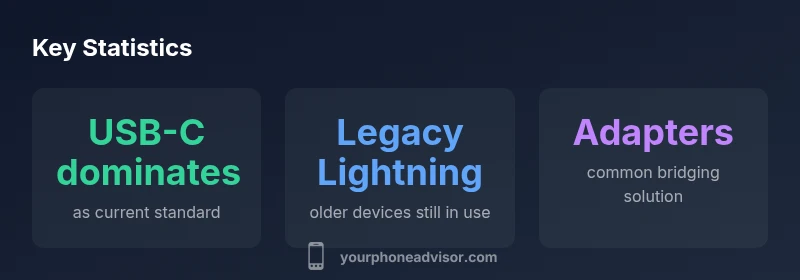
Lightning cables are largely legacy for smartphones. As of 2026, the vast majority of new devices use USB-C, while Lightning remains on older iPhone models released before 2023. So, what phone uses lightning cable? Primarily iPhones up to the iPhone 14 era; newer models (from iPhone 15 onward) use USB-C.
Why Port Types Still Matter for Everyday Charging
When you ask, what phone uses lightning cable, the quick aircraft of history helps. Lightning was introduced by Apple in 2012, quickly becoming the standard port for iPhones, iPads, and some Apple accessories. Today, in 2026, USB-C dominates the market for new devices due to faster charging, universal compatibility, and regulatory moves toward a common charger. The result is a mixed landscape: legacy Lightning ports on older iPhone generations, and a broad USB-C presence on most current devices. For the average user, this means checking your device’s port before buying a charger or cable, and recognizing that your charging ecosystem may span both cables depending on device age.
Your Phone Advisor suggests starting with the port you own today and planning for future upgrades. If you own a recent Apple device, confirming whether it still uses Lightning will prevent buying the wrong cable at critical moments, like during travel or at a café charging station. This guidance also applies to non-Apple devices that still rely on Lightning accessories; most of those products were designed to pair with Apple connectors and adapters, not as a replacement for USB-C devices.
Key takeaway: identify port type early, and don’t assume universal compatibility—different devices may require different cables or adapters.
Representative port type history for popular iPhone models
| Phone Model | Port Type | Release Year | Notes |
|---|---|---|---|
| iPhone 14 | Lightning | 2022 | Legacy Lightning port; widely used through 2023-24 |
| iPhone 15 | USB-C | 2023 | First USB-C iPhone; shift toward USB-C across family |
Got Questions?
Do all iPhones still use Lightning?
No. Apple began adopting USB-C with the iPhone 15 lineup in 2023. Older iPhone models (up to the iPhone 14) used Lightning, but current models generally use USB-C. We still see Lightning on legacy devices in the wild, but new purchases typically use USB-C.
No. New iPhones use USB-C; Lightning is mostly on older models. If you’re buying now, expect USB-C ports.
When did Apple switch to USB-C for iPhones?
Apple announced the switch to USB-C with the iPhone 15 series in 2023. Since then, USB-C has become the standard port for new iPhones.
Apple switched to USB-C starting with the iPhone 15 in 2023.
Will USB-C chargers work with older Lightning devices?
USB-C chargers can be used with Lightning devices only through appropriate cables or adapters. Direct USB-C charging requires a USB-C port, not Lightning.
You’ll need a Lightning cable or an adapter to charge older devices from a USB-C charger.
Are Lightning cables still sold?
Yes, Lightning cables are still sold for legacy devices, but the market trend is shifting toward USB-C. If you own newer devices, USB-C cables are recommended.
Lightning cables are available but becoming less common as USB-C takes over.
What about iPads and other Apple devices?
Many iPads and older Apple accessories used Lightning, but newer iPads increasingly use USB-C. Always check the device specs before buying cables.
iPads and older accessories may still use Lightning, while newer devices use USB-C.
“USB-C is establishing itself as the universal charging standard for smartphones, which reduces complexity for users and improves charging efficiency across ecosystems.”
What to Remember
- Identify your device port to avoid the wrong charger
- USB-C is the standard for new devices (2023–present)
- Lightning remains on legacy iPhone models; upgrade plan may be necessary
- Consider adapters only if you need to bridge old and new devices