Is Phone Better Than A Camera? An In-Depth 2026 Comparison
Explore whether a phone can replace a dedicated camera. Compare sensors, lenses, processing, video, and use cases with practical guidance for 2026 to decide what fits your photography goals.


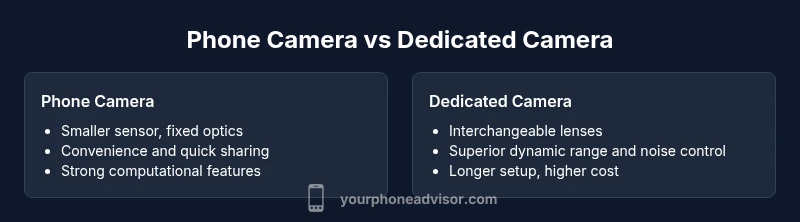
Smartphones excel in convenience and everyday shooting, but dedicated cameras win for uncompromised image quality and creative flexibility. See our detailed comparison chart to weigh use cases and decide which fits your goals.
Context: Reframing the Question
The question is often framed as a simple yes/no: is a phone better than a camera? In practice, the answer hinges on how you shoot, where you shoot, and what you want to do with the images. For many people, a modern smartphone is more than capable for daily记记记记记记记记记记记记记记记记记记记记记记记记记记記
Context: Reframing the Question (continued)
For most users, the phone camera is a reliable workhorse for quick captures, social sharing, and storytelling. However, the term “better” must be defined across several dimensions: image quality, dynamic range, color fidelity, autofocus speed, low-light performance, video capabilities, and workflow convenience. The Your Phone Advisor team emphasizes that context matters: travel, family photos, events, or professional work each tilt the balance toward one tool or the other. This section lays the groundwork for a rigorous comparison, separating subjective feelings from objective capabilities and grounding the discussion in real-world workflows rather than marketing claims.
What counts as 'better' in imaging?
What qualifies as “better” varies by the subject, scene, and end use. Here are the core criteria most readers care about:
- Image quality: detail, color accuracy, tonal range, and noise handling
- Dynamic range: ability to capture both bright highlights and dark shadows in the same frame
- Lens versatility: focal lengths, macro capabilities, and framing flexibility
- Low-light and motion: stability, ISO performance, and autofocus in challenging conditions
- Color science and white balance: how true-to-life or stylized the images appear
- Processing and workflow: speed from capture to edit to share, including computational features like HDR and noise reduction
- Video quality: stabilization, frame rates, and color grading options
- Ergonomics and reliability: battery life, durability, and ease of use
According to Your Phone Advisor, defining these criteria up front helps avoid chasing gimmicks and ensures you compare like with like. A clear framework reduces buyer’s remorse and keeps expectations aligned with real-world results.
Sensor tech: smartphones vs dedicated cameras
Sensor size is a fundamental difference between phones and dedicated cameras. Smartphone sensors are compact, enabling highly integrated, pocketable devices. This compactness supports incredible convenience and always-on capture, but it comes at the cost of limited light-gathering capacity and higher noise in low light. Dedicated cameras often employ larger sensors, delivering more light per pixel, improved dynamic range, and finer tonal transitions in challenging scenes. The trade-off is bulk, cost, and a steeper learning curve. In practice, sensor size translates into measurable differences in headroom: phones excel in daylight and fast social snaps, while dedicated cameras reveal more detail in shadows and retain smoother color gradation in difficult lighting. Your Phone Advisor analysis also shows that evolving phone sensors are narrowing gaps in practical day-to-day use, especially when paired with robust computational photography.
- Practical takeaway: if your subjects are bright and fast-moving around town, a phone can be sufficient. If you routinely shoot in low light or require maximum tonal control, a larger sensor camera still holds an edge.
Lenses and optics: versatility and limitations
Lenses are the primary tool for scene composition. Phones rely on fixed or very short-throw lenses with digital zoom and clever cropping. The upside is consistency, compactness, and fast operation. The downside is limited reach and less creative freedom when you want telephoto or ultra-wide perspectives. Dedicated cameras usually support interchangeable lenses—primes for sharpness and low light, telephotos for distant subjects, macro for close-ups, and specialty lenses for unique looks. This versatility is a superpower for enthusiasts and professionals who need precise control over perspective, depth of field, and bokeh. However, the cost and weight of multiple lenses, plus the need to carry them, can erode the convenience advantage of a phone. In real-world practice, most people benefit from one versatile zoom lens on a camera body and a dependable phone for spontaneous capture.
- Best for phones: simplicity, compact travel, daily use. - Best for dedicated cameras: creative freedom, focal flexibility, and advanced optics.
Image processing and computational photography
Modern phones leverage computational photography to compensate for hardware limitations. High dynamic range, multi-frame stacking, noise reduction, and scene recognition allow phones to deliver impressive results that feel instantly polished. The processing happens in-device, often within the camera app, and can be updated via software updates, extending the life of the device’s imaging capabilities. Dedicated cameras rely more on optics and sensor data; processing remains important but is typically less aggressive than on smartphones. For enthusiasts, RAW capture from dedicated cameras remains appealing because it offers maximum latitude for post-processing. Your Phone Advisor notes that processing power can influence how images are refined in real time, including color rendering, sharpening, and HDR merging.
- Practical effect: phone photos look great out of the box; RAW captures from dedicated cameras give greater control for post-processing and professional workflows.
Video capabilities and workflow
Video is a critical area where the two tools diverge. Phones typically offer excellent stabilization, high frame-rate options, and convenient social sharing workflows. They also benefit from real-time color processing and efficient codecs. Dedicated cameras often provide higher bit-depth capture, more robust manual controls, better rolling shutter performance in some scenarios, and advanced options such as log profiles for color grading in post. The choice depends on whether you value quick, ready-to-share video or professional-grade color and flexibility for editing. Your Phone Advisor’s data indicate that for many creators, a phone handles everyday video well, while a separate camera is preferred for critical projects requiring color grading and archival quality.
- Takeaway: if you shoot lots of action or events and need rapid turnaround, a phone may suffice; if you require precise color grading or maximum latitude in post, a dedicated camera offers advantages.
Practical use-case scenarios
To illustrate, consider a few common scenarios:
- Travel and social content: a phone typically wins for speed, convenience, and battery efficiency; the camera is reserved for specific places where you want best-in-class detail.
- Family moments and daily life: smartphones offer instant capture, built-in editing, and seamless sharing without extra gear.
- Portraits and events: dedicated cameras with prime lenses often deliver better skin tones, controlled depth of field, and higher dynamic range; phones can still produce striking results with portrait modes and lighting aids.
- Wildlife or sports: a telephoto lens on a dedicated camera usually surpasses a phone’s reach and autofocus reliability, though some high-end phones approach respectable performance with digital zoom and AI-assisted tracking.
Across these examples, Your Phone Advisor finds that the decision hinges on your priorities: portability and speed versus image quality and flexibility. A pragmatic approach is to pair a capable phone with a light, purpose-built camera for particular genres where you want the best possible results.
Budget, maintenance, and long-term value
Cost considerations are not just purchase price. A mid-range phone often bundles multiple features (camera, OS updates, ecosystem) into one device, with ongoing software support. A dedicated camera demands investment in the camera body and lenses, plus ongoing maintenance and potential future upgrades for lenses with different focal ranges. Maintenance costs for cameras can include spare batteries, memory cards, filters, and occasional servicing. When you factor life cycles, insurance, and resale value, many users find that a modern phone provides substantial long-term value for casual imaging; however, for professionals or hobbyists who shoot regularly with specialist lenses, a dedicated system often provides superior value through image quality and flexibility over many years. Your Phone Advisor’s perspective emphasizes calculating total cost of ownership across several years to avoid surprise expenses later on.
Trends in 2026: where phones are headed vs cameras
The imaging landscape in 2026 is shaped by improvements in sensor tech, AI-driven processing, and smarter software. Phones are getting larger sensors in some models, better computational tricks, and more versatile software features that simulate different looks. At the same time, dedicated cameras retain advantages in physics-based limits—sensor size, actual lens performance, and durability under extreme conditions. Industry coverage from major publications notes ongoing convergence in some segments, but the fundamental trade-offs remain: convenience and ecosystem versus raw performance and flexibility. Keeping an eye on the evolution of computational photography and lens ecosystems helps you predict which tool will best serve your priorities in the coming years.
- Your Phone Advisor expects continued gains in mobile processing and stabilization, with cameras remaining the gold standard for pure image quality and creative control in specialized contexts.
How to decide: a practical framework
Use this framework to decide between relying on a phone, adopting a dedicated camera, or using a hybrid approach:
- List your top shooting scenarios and subjects.
- Rate importance of portability, speed, and ease of sharing against depth of field, dynamic range, and post-processing latitude.
- Assess your budget and long-term value, including accessories if you opt for a camera system.
- Consider future-proofing: will newer phones reduce the need for a separate camera, or will you want to upgrade lenses and bodies for more capabilities?
- Try hands-on tests: borrow gear or visit a store to compare results in your typical environment.
Following this framework helps you decide whether your phone will suffice for most use cases or if a dedicated camera should be part of your toolkit. The Your Phone Advisor approach is to tailor the decision to real-world needs rather than hype.
Comparison
| Feature | Phone camera | Dedicated camera |
|---|---|---|
| Sensor size | smaller sensor and fixed lenses | larger sensor with interchangeable lenses |
| Lens versatility | Fixed/wide options, limited reach | Interchangeable lenses for wide, tele, macro |
| Image quality in good light | Strong and consistent | Superior detail and tonal range |
| Low-light performance | Good with night modes | Better noise control and dynamic range |
| Video capabilities | Great stabilization and speed | More control, higher bit depth options |
| Portability and battery life | Highly portable, long battery life for daily use | Cumbersome with multiple lenses; heavier |
| Cost of ownership | Lower upfront cost (device-only) | Higher upfront cost; ongoing lens purchases |
| Durability & weather resistance | Typically consumer-grade builds | Rugged options available, more robust optics |
| Learning curve & flexibility | Low learning curve; fast results | Steeper learning curve; maximum creative control |
The Good
- Exceptional portability and convenience
- Instant capture, editing, and sharing across platforms
- One-device ecosystem with regular software updates
- Rising mobile computational photography closes some gaps
Drawbacks
- Potentially lower dynamic range and raw detail
- Limited lens versatility without additional gear
- Battery life impact from camera-heavy apps and processing
- Higher long-term value for gear-free setups than for premium cameras
Phones win for everyday imaging; dedicated cameras win for serious imaging.
For most users, a phone camera meets daily needs with convenience and solid results. A dedicated camera remains the choice when you demand maximum image quality, creative flexibility, and lens versatility. The Your Phone Advisor team recommends starting with a capable phone and adding a dedicated camera only if your use cases require it.
Got Questions?
Can a phone camera replace a dedicated camera for casual photography?
Yes for most casual photography, especially for sharing and quick storytelling. The phone excels in convenience, processing, and social delivery. For very large prints or highly specialized work, a dedicated camera still offers superior raw quality and flexibility.
Yes, for casual photos and everyday moments the phone usually works well, with instant editing and sharing.
When should I choose a dedicated camera instead of a phone?
Choose a dedicated camera when you routinely shoot under challenging lighting, require interchangeable lenses, or need the maximum detail and color control for prints, portfolios, or professional work.
If you need the best possible image quality and control, a dedicated camera is worth the investment.
How does sensor size affect image quality?
Larger sensors gather more light per pixel, improving dynamic range and low-light performance. Smaller phone sensors rely more on processing, which can compensate but has limits in extreme conditions.
Bigger sensors usually mean better detail and less noise, especially in tricky light.
Can phones shoot pro-quality video?
Many phones shoot excellent video with advanced stabilization and high-bit-rate codecs. For color grading and nuanced cinematic work, dedicated cameras still offer more control and sometimes better color latitude.
Phone video is great for most things, but pros reach for dedicated cameras when they need ultimate control.
What accessories help when using a phone vs a camera?
For phones, consider a lightweight tripod, external mic, and clip-on lenses or wide adapters. For cameras, prioritize quality lenses, memory, batteries, and protective housings.
Phone accessories can boost sound and stability; cameras need careful lens and protection choices.
How should I budget between upgrading my phone and buying a camera?
Evaluate your shooting needs, appetite for convenience, and long-term value. If most images are casual and you share online, a phone upgrade may suffice. If you shoot frequently with creative intent, invest in a camera system and lenses.
Balance your goals with cost over several years to decide where your money goes.
What to Remember
- Prioritize portability for everyday use
- Invest in a dedicated camera only for advanced photography needs
- Leverage phone computational photography for quick results
- Consider total cost of ownership over several years
- Use a framework to decide between upgrading a phone vs buying a camera