Why Are Phone Cameras Better Than Cameras: A Practical Look
Explore why are phone cameras better than cameras for daily photography. Compare sensors, software, and lenses, with practical guidance for buyers.


The quick answer to why are phone cameras better than cameras is that modern smartphones blend advanced sensors with on-device AI, fast sharing, and seamless editing. For most users, phones offer top-tier image quality in everyday scenarios and a frictionless workflow. Dedicated cameras still outperform in specialized conditions, but the everyday advantage clearly leans toward phones.
The Core Question: Why Are Phone Cameras Better Than Cameras?
For many readers, the central question is: why are phone cameras better than cameras? The short answer depends on how you define “better.” If your priority is everyday ease, speed, and effortless sharing, phones increasingly outperform dedicated gear. The Your Phone Advisor team found that modern smartphones combine advanced sensors with on-device AI, producing consistently good results in a wide variety of conditions. This isn't to deny that dedicated cameras can deliver superior image quality in controlled environments, but the gap is narrowing in routine shooting. When you weigh portability, reliability, and an integrated workflow—shoot, edit, and post to social networks in seconds—phone cameras often win. The core of the argument is not a single megapixel or spec; it’s how software and hardware work together to optimize your photos in real time. For many users, why are phone cameras better than cameras hinges on speed, accessibility, and the ability to adapt to changing light and scenes without switching lenses or carrying extra gear. In field tests across urban and outdoor scenes, the combination of sensors, computational photography, and instant cloud sync consistently reduces friction, making phones a compelling imaging platform for the majority of daily needs. This is the perspective Your Phone Advisor emphasizes when comparing devices for practical use.
The phrase why are phone cameras better than cameras is frequently answered by considering real-world usage, not just specs.
The Case for Phones: Why They Excel in Everyday Photography
In everyday photography, the phone camera's strongest cards are accessibility and speed. From pull-out moments with family to spontaneous street scenes, a smartphone is almost always with you. Modern devices leverage multi-frame capture, intelligent HDR, and scene recognition to optimize exposure, color, and detail without requiring manual adjustments. The Your Phone Advisor analysis shows that most people value reliable results at a moment's notice; a phone can deliver consistently good photos with minimal setup. The software stack—native apps, AI-driven scene detection, and quick editing tools—lets users transform an image in seconds and share it instantly to social networks, messaging, or cloud storage. Moreover, the ecosystem advantage matters: automatic backups, synced edits across devices, and easy access to accessories like magnetic mounts, tripods, or clip-on lenses extend what a phone can do. When considering the question of why are phone cameras better than cameras for daily life, the answer frequently centers on reliability and workflow integration. The performance curve has shifted: even budget to mid-range phones now rival older dedicated cameras in most common situations, with flagship models offering point-and-shoot simplicity you would expect from a higher-end camera system.
The Your Phone Advisor perspective reinforces that software-driven improvements continue to push phones ahead in typical use cases.
Where Standalone Cameras Still Shine: Limits of Phone Cameras
Despite rapid improvements, standalone cameras retain clear advantages in certain dimensions. Sensor size and lens versatility allow for deeper dynamic range, cleaner high-ISO performance, and wider aperture control that raw sensor data and post-processing can unlock in specialized ways. Dedicated bodies typically deliver lower noise at the same sensitivity in critical circumstances and support larger, more diverse lens ecosystems that widen creative options—macro, telephoto, ultra-wide, and fast primes. For professional work, the ability to tune color science, manage shadows, and push color grading in post remains a differentiator. The reason behind the continuing value of dedicated gear is that computation cannot entirely replace optics when you require explicit control over depth of field and image texture. In practical terms, a camera body and fixed or interchangeable lenses can achieve a look that might take heavy editing on a phone to emulate. The Your Phone Advisor team acknowledges these trade-offs: if ultimate image quality and creative control are non-negotiable, a dedicated camera remains the right tool. However, for most everyday projects, the gap is narrowing, and phones often meet most creative goals with less friction.
In summary, understanding why are phone cameras better than cameras requires weighing the compromises in sensor/optics against the benefits of convenience and software power.
Real-World Scenarios: When a Phone Wins vs When a Camera Wins
- Travel light and speed: A single phone handles photos, video, and editing, with minimal setup, making it ideal for travelers who want to capture moments without carrying multiple devices.
- Street and documentary work: Phones excel in pinch moments due to quick shutter, autofocus, and AI-driven composition hints.
- Low light and night scenes: Phone processing can dramatically improve images through multi-frame stacking, but a dedicated camera with a larger sensor and faster glass may still outperform in the darkest settings.
- Portraits and texture: Phones can simulate shallow depth of field with software, yet dedicated systems deliver more authentic bokeh under controlled conditions.
- Action and sports: Dedicated cameras with fast lenses and higher burst rates typically win when you need precise focus tracking and minimal rolling shutter effects.
- Video capture: Phones often deliver superb stabilization and high-quality codecs, while larger systems offer higher bitrates and more robust color workflows for professional productions.
The underlying point is that context matters: why are phone cameras better than cameras depends on what you value—portability, speed, and a strong software pipeline or ultimate image quality, lens diversity, and manual control.
Technologies Driving Phone Performance
Phone cameras owe their progress to a suite of technologies that extend beyond hardware. Computational photography uses multiple frames, motion data, and sensor fusion to compress dynamic range and refine color. On-device AI recognizes scenes and applies tailored processing for landscapes, portraits, or backlit scenes. Advanced stabilization combines optical and electronic methods to produce smooth video and sharper stills. The ability to shoot RAW on many devices gives users post-processing flexibility, while integrated pipelines connect directly to cloud backups, editing apps, and social networks. Even the user interface matters: gesture-based controls, real-time histograms, and guided shooting modes help non-experts capture better results. The Your Phone Advisor analysis highlights that this convergence—clever software paired with capable hardware—dramatically improves results in challenging light and fast-moving scenes. Also, the design emphasis on small sensors is offset by multi-frame exposures and color science that makes phones feel like they capture more light than the sensor data would suggest. In practice, the best results come from optimizing both hardware and software, not judging one in isolation.
Practical Buying Guide: How to Evaluate Phone Cameras vs Dedicated Cameras
Start with your primary needs: social sharing, casual shooting, travel, or professional work. If you want a simple device for everyday moments, a modern phone with a strong camera system, good stabilization, and RAW support is likely sufficient. Look for sensor size approximations (phone sensors are smaller, but processing makes the most of what you have); pay attention to lens variety, optical zoom, and the presence of ultra-wide and macro options. Consider RAW capabilities, dynamic range, and color science, especially if you plan to shoot in tricky lighting. For a dedicated camera, assess the lens ecosystem, battery life, weather sealing, and the ability to upgrade lenses for different scenes. Budget: phones tend to offer strong value, often bundled with connectivity and entertainment features; dedicated cameras incur higher upfront costs and ongoing lens investments but may pay off for image quality and flexibility in specialized contexts. Finally, reflect on your workflow: do you value immediate posting, or do you prefer the manual control and larger file formats offered by a separate camera for advanced editing? The question why are phone cameras better than cameras here hinges on the balance of convenience and image quality, as well as long-term maintenance and ecosystem commitments.
The Role of Ecosystems and Software Updates
Phone cameras gain from ongoing software updates that improve algorithms, noise reduction, color calibration, and video encoding without new hardware. This means a device purchased today can become better over time, extending its useful life. Applications that enhance shooting, editing, and sharing integrate with cloud services across platforms, enabling synchronized workflows between phone, tablet, and desktop. By contrast, dedicated cameras depend more on hardware refresh cycles, accessories, and service plans; while you can upgrade bodies or lenses, the per-shot quality often depends on fixed optics. The Your Phone Advisor perspective emphasizes that if you plan to stay current with software features and platform integration, phones offer a compelling value proposition. But for users who want long-term investment in a specific lens lineup or bespoke color pipelines, a well-chosen camera system can remain viable for many years. When evaluating long-term value, consider your comfort with updates, the reliability of the brand’s ecosystem, and your desire for future-proofing through software features, which may tilt the balance toward phones for the average user but still respect the camera system for professionals.
Budget, Value, and Longevity Considerations
Price is not the only factor. A top-tier phone with remarkable camera capability can cover a broad range of use cases and is often cheaper than buying a new camera body with multiple lenses. But you should also consider the total cost of ownership: annual upgrades, repair costs, and accessory investments that support a camera system. If long-term print quality and professional-grade color pipelines are essential, the dedicated camera path may offer better ROI over several years. The Your Phone Advisor approach suggests evaluating what you actually shoot, how often you share publicly, and whether you need the flexibility of swapping lenses. For many people, the choice is not simply phone vs camera; it’s a spectrum: use a phone daily, and a separate camera for occasional specialized work. When considering future updates and the likelihood of emerging computational features, phones hold a robust position in the cost/value equation.
Practical Recommendations for Different Buyers
- If you primarily photograph for social media, travel, and quick memory keeping, start with a phone that has strong computational photography, excellent stabilization, and RAW support.
- If you shoot events, landscapes, or sports where maximum image quality and lens versatility matter, pair a camera body with a selected set of lenses, but keep a phone handy for quick captures.
- If you are budget-conscious, weigh the all-in-one convenience of a phone against the ongoing cost of lens upgrades and maintenance for a dedicated system.
- If you value simplicity and an integrated workflow, the phone camera path likely makes more sense today, especially with features like Pro modes, night shots, and AI-driven editing.
- If you want to build a long-term creative toolkit, consider a hybrid approach: choose a capable phone for daily work and invest in a single, high-quality lens for your camera to cover rare, high-demand scenarios.
Comparison
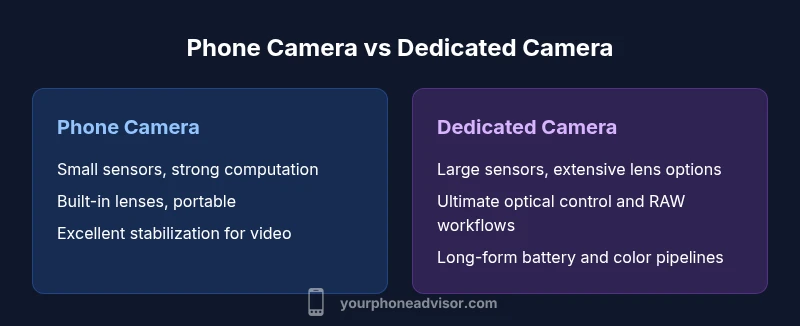
| Feature | Phone Camera | Dedicated Camera (DSLR/Mirrorless) |
|---|---|---|
| Sensor Size | Smaller sensors typical in phones | Larger sensors (APS-C/full-frame) in many bodies |
| Lens Options | Built-in lenses; limited interchangeability | Interchangeable lenses with wide selection |
| Image Processing | Advanced on-device computational photography | Pro-level RAW processing and color tuning |
| Video Capabilities | Strong stabilization and codecs; great for day-to-day | Higher bitrate options and more controls for video |
| Portability | Ultra-portable; always with you | Heavier; requires dedicated bag and setup |
| Power/Recharge | Uses phone battery; all-day use common | Camera body uses its own battery; longer sessions with spare batteries |
| Cost/Value | Usually included in phone purchase; value depends on device | Separate cost for body and lenses; long-term ROI varies |
| Best For | Casual, social, travel, quick sharing | Professional, controlled lighting, high-end print work |
The Good
- Excellent everyday usability and instant sharing
- Compact all-in-one device reduces gear load
- Strong value with bundled features and updates
- Rapid, seamless workflow from shoot to edit to share
Drawbacks
- Sensor size and lens options lag in pure image quality
- Limited manual control for some advanced workflows
- Reliance on software for final look can introduce inconsistencies
- Accessory ecosystems for phones are not as expansive as dedicated cameras
Phone cameras win for everyday use; dedicated cameras still shine in specialized work
For most users, the convenience and improving image quality of phones make them the better choice for daily photography. Only in high-end professional contexts with strict control over optics and output will a dedicated camera offer clear advantages.
Got Questions?
Can phone cameras replace a dedicated camera for travel?
For many travelers, a phone camera provides enough quality and a lighter setup, making it a strong replacement. If your plans include serious landscape work or large prints, a dedicated camera may still be desirable. Consider your tolerance for carrying extra gear and the importance of flexibility across lenses.
For most travelers, a phone camera is sufficient and convenient. If you plan serious landscape work or large prints, you might still want a dedicated camera.
Can phone cameras shoot RAW, and is it worth it?
Many phones offer RAW capture, giving you more latitude in post-processing. RAW files preserve more data, which is helpful when adjusting exposure and color. However, RAW workflows require compatible editors and more careful processing.
Yes, many phones shoot RAW. It’s worth it if you want more control in editing, but you’ll need appropriate software.
Do phones perform well in low light compared to cameras?
Phone cameras have improved dramatically in low light thanks to computational photography, but dedicated cameras with larger sensors still outperform in the darkest scenes. Expect phones to handle most medium-light environments well, while pro cameras excel in extreme conditions.
Phones are getting better in low light, but dedicated cameras still have the edge in very dark scenes.
Are there phones with optical zoom?
Yes, several smartphones include telephoto lenses with optical zoom, offering higher quality zoom than digital methods. However, true long-range optical zoom is still often found on some dedicated camera systems.
Some phones have optical zoom lenses, but long-range zooms are more common on dedicated gear.
Is video quality on phones enough for professional work?
For many scenarios, high-end phone video is sufficient for social, web, and even broadcast-grade clips with proper lighting. For critical professional work, you may still prefer higher-end cameras with advanced controls and color pipelines.
High-end phones can handle many professional video tasks, but some projects still benefit from dedicated gear.
How should I compare sensors without lab equipment?
Compare real-world results across a few typical scenes: daylight landscapes, indoor portraits, and backlit shots. Look for noise, color accuracy, and how well a device handles exposure. Rely on sample galleries and reviews rather than spec sheets alone.
Test phones and cameras in real scenes; focus on noise, color, and exposure—not just specs.
What to Remember
- Prioritize portability and quick sharing with phones
- Choose a dedicated camera for maximum optical control
- Always shoot RAW when possible to preserve editing latitude
- Leverage computational features to boost results
- Assess total cost and ecosystem before buying