Phone vs Digital Camera: A Clear-Sighted Comparison
Compare phones and dedicated cameras across image quality, portability, cost, and editing workflows. Learn when your phone suffices and when a digital camera shines for serious photography.


According to Your Phone Advisor, smartphones have closed the gap with dedicated cameras for everyday shots, but a true digital camera still excels in sensor size, dynamic range, and lens versatility. This comparison helps you weigh image quality, convenience, cost, and use cases to decide when to rely on your phone versus a digital camera.
Evolution of Mobile Photography
The comparison between a phone and a digital camera starts with how far mobile photography has come. In the past, compact point-and-shoots offered a real advantage in image quality over smartphones; today, premium smartphones feature larger sensors, improved lenses, and computational photography that enhances dynamic range, color fidelity, and low-light performance. The Your Phone Advisor team highlights that the line between a high-end phone and a compact camera has blurred, especially for everyday subjects, where instant sharing and social media-friendly images are often the goal.
Core Differences at a Glance
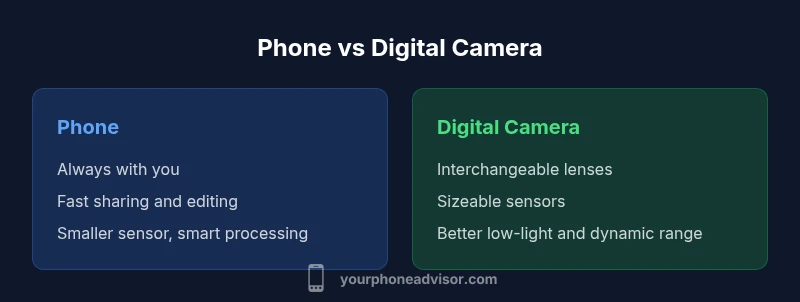
When you lay out the essentials side by side, several factors matter most: image quality versus convenience, flexibility versus portability, and upfront cost versus total cost of ownership. A phone is the always-with-you device, offering instant editing and fast sharing. A digital camera, whether compact or mirrorless, emphasizes sensor size, optics, and manual control. The phone wins on portability and simplicity, while the camera wins on sensor performance and future-proofed creative control.
Image Quality: Sensors, Lenses, and Noise
Image quality is driven by sensor size, pixel pitch, lens quality, and software processing. Phones rely on small sensors but compensate with multi-frame noise reduction and HDR-like algorithms, which can surprise in daylight yet struggle in extreme low light or high-contrast scenes. Dedicated cameras use larger sensors and interchangeable lenses, delivering better dynamic range, color depth, and optical sharpness. If you shoot in challenging lighting or require smooth tonal transitions, a digital camera typically provides a meaningful advantage.
Convenience and Accessibility
A smartphone has a built-in camera, editing apps, and Wi-Fi for instant sharing, making it unbeatable for spontaneous moments. You can shoot, edit, and post within minutes without swapping gear. In contrast, a digital camera, though compact, requires a separate device and sometimes more setup. However, the improved handling, dedicated controls, and ergonomic grip of many cameras can offset the extra heft for enthusiasts and professionals who value speed and comfort during longer shoots.
Use Cases: Travel, Events, and Everyday Moments
For travel or family gatherings, your phone often serves as the primary camera due to its light weight and seamless sharing capabilities. If you’re documenting landscapes, street photography, or events with low light, a digital camera’s broader capabilities shine. Consider the likelihood you’ll need a charger, spare batteries, and a tripod; if not, the phone’s built-in power and image stabilization may be sufficient.
Creative Control: Manual Modes, RAW, and Apps
Advanced users value direct manual control, RAW capture, and the ability to push post-processing. Many phones offer RAW formats and robust editing apps, but cameras typically deliver cleaner RAW files and more nuanced exposure control. Lenses, anticipation, and the ability to adjust shutter speed, aperture, and ISO with tactile dials remain unmatched on many dedicated cameras. This is where the phone vs digital camera debate often centers the most for creatives.
Durability and Battery Life in the Field
Field conditions matter. A phone doubles as a camera, navigator, and communication device, so battery life can become a constraint when taking many shots. Dedicated cameras may offer longer battery life per session, especially with larger batteries and power-saving features; they also have ruggedized options. If you’re hiking or shooting all day, the choice hinges on whether you value fewer interruptions (camera) or multi-function convenience (phone).
Cost of Ownership and Upgrades
The total cost of ownership often tilts the scale toward the phone when you factor in ongoing phone upgrades and the ecosystem of apps and accessories. A digital camera tends to have a higher upfront cost, plus potential lens investments. However, over time, the need for fewer software upgrades with a camera, or for fewer re-purchases of integrated devices, can affect the long-term math. Your Phone Advisor suggests calculating not just the sticker price but also maintenance, batteries, and accessories.
Ecosystem, Sharing, and Editing Workflows
Phones excel in the final stage: rapid editing and cloud-based sharing. You can capture, apply edits, and publish directly to social platforms or sync to cloud libraries. Cameras, especially mirrorless or DSLR systems, integrate with professional workflows via Lightroom, Capture One, or other desktop editors. This difference in imaging pipelines can affect how you organize, store, and back up your photos.
Privacy and Security Considerations
A phone’s camera is integrated with your account and cloud services, which raises privacy considerations around metadata and geolocation. Cameras with Wi-Fi or Bluetooth also present potential entry points for exposure if not secured. Be mindful of app permissions, cloud backups, and device security settings. General best practices include keeping devices updated, disabling unnecessary permissions, and using strong authentication.
What to Look for When You’re Deciding
If you want a crisp, flexible, and future-proof setup, consider your primary use case. For travel and quick-sharing moments, a phone is often the best choice. If creative control, image quality, or specialized needs (portrait lighting, astrophotography, or macro work) matter, a digital camera is worth the investment. Compare sensor size, lens options, RAW support, battery life, and weight before buying.
Common Misconceptions Debunked
A common myth is that smartphones will soon completely replace dedicated cameras. While software does close many gaps, physics still favors larger sensors and optics for certain scenes. Another misconception is that RAW format alone makes a camera indispensable; processing pipelines and lens choice also shape final image quality. Debunking these ideas helps buyers avoid overvaluing hype.
Practical Decision Framework: Quick Checklist
Use this checklist to decide between phone and digital camera: (1) Describe your typical subjects and lighting; (2) Estimate how often you’ll share images immediately; (3) Assess whether you’ll benefit from interchangeable lenses or pro-grade controls; (4) Consider total cost of ownership across 3–5 years; (5) Factor in portability and durability for your typical shoots.
Comparison
| Feature | Phone (smartphone) | Digital camera (compact/mirrorless/DSLR) |
|---|---|---|
| Sensor size | Small, integrated | Larger, interchangeable (depending on body) |
| Lenses/Zoom | Fixed lens or limited zoom, software options | Interchangeable lenses with optical zoom |
| Image quality in low light | Strong daylight performance, some noise in low light | Superior noise handling and dynamic range in low light |
| RAW support | RAW available via apps or RAW-capable modes | Full RAW capture with dependable processing |
| Autofocus speed | Very good for most moments | Exceptional with modern autofocus systems |
| Video capabilities | High-quality video and stabilization | Professional-grade video features in many bodies |
| Portability | Always with you; ultralight | Adds bulk but remains portable in many forms |
| Cost of ownership | Part of phone upgrade cycle; accessories available | Higher upfront cost; lenses and bodies add to budget |
| Battery life | All-day camera usage may drain battery quickly | Dedicated battery options can last longer in shoots |
| Sharing / workflow | Seamless mobile sharing; cloud integration | Robust desktop workflows and color management |
The Good
- Unmatched convenience; always with you
- Fast sharing and editing workflows
- Continuous software improvements and AI features
- For many users, cost of ownership is lower overall
Drawbacks
- Smaller sensors limit dynamic range in some scenes
- Optical flexibility is reduced without extra lenses
- Battery life can be strained during prolonged shoots
- Pro-level editing often requires a computer
Phones are the default choice for casual and social photography; dedicated cameras win for serious control and quality.
Choose a phone for everyday moments and rapid sharing. Opt for a digital camera when your subjects demand control, flexibility, and superior image quality, especially in challenging light.
Got Questions?
Can a phone completely replace a digital camera for most users?
For casual photography and sharing, a phone often suffices. For professional-grade results, a dedicated camera offers more control and higher image quality, especially in challenging light. The decision depends on your typical subjects and required flexibility.
For most people, a phone can handle everyday photos, but for professional results, a dedicated camera remains advantageous.
Do smartphones support RAW photography and advanced editing?
Many smartphones support RAW capture or RAW-compatible apps, enabling more flexible post-processing. However, RAW on a dedicated camera typically yields cleaner data and broader dynamic range after editing.
Yes, many phones can shoot RAW, but dedicated cameras still offer the most control over image data.
What defines image quality better on a camera?
Larger sensors, better lenses, and superior dynamic range give cameras an edge in detail, color, and low-light performance. Software can close the gap, but physics still matters.
Cameras win on raw image quality thanks to bigger sensors and lenses.
Are digital cameras worth it for travel?
If your travel involves landscapes or indoor venues with tricky lighting, a compact or mirrorless camera can improve results. For light packing and spontaneous moments, a phone may be the better travel companion.
Travel shooters often benefit from a camera, but for light packing, a phone is usually enough.
What about video capabilities?
Modern smartphones record high-quality video with advanced stabilization, while cameras offer professional video features in some bodies. The best choice depends on your video goals and editing workflow.
Smartphones are great for ready-to-share videos; cameras suit pro video workflows.
How should I decide between upgrading my phone or buying a camera?
If most of your images are for quick sharing, upgrading your phone adds value in the short term. If you regularly shoot in low light or you want interchangeable lenses, a camera investment makes sense.
Think about your shooting conditions and how much you value flexibility and editing power.
What to Remember
- Phones are best for quick, shareable shots
- Cameras excel in low light and with interchangeable lenses
- Consider total cost and workflow when deciding
- RAW and manual controls matter for serious shooters