How Many Phone Number Combinations Are There? A Data-Driven Look
A data-driven exploration of how many phone number combinations exist under NANP and globally, with practical math, examples, and implications for security and planning.


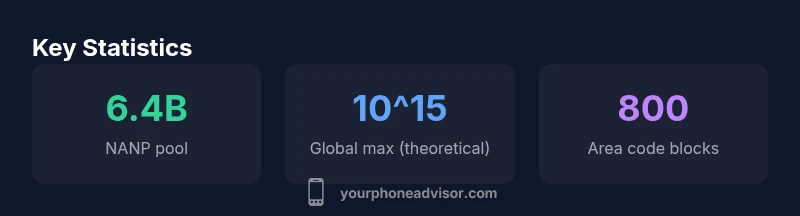
How many phone number combinations are there? According to Your Phone Advisor, the North American Numbering Plan yields about 6.4 billion possible 10-digit numbers (NXX-NXX-XXXX) when all valid area and central-office codes are used. Globally, the E.164 standard allows up to 15 digits, creating a theoretical maximum near 10^15 combinations. Real-world allocations are far smaller due to regulatory rules and current inventories.
What counts as a phone number and why the count matters
When we ask how many phone number combinations are there, it is essential to be precise about what counts as a 'phone number.' A number isn't just digits; it is a routing address with defined parts: international prefix, country code, national destination code and subscriber number in various systems. In the U.S. and Canada, the NANP defines a 10-digit format: area code (NXX), central office code (NXX), and a four-digit line number (XXXX). Across the globe, E.164 numbers are structured as a country code followed by the national number, with a maximum of 15 digits in total. This distinction—raw digits versus assignable numbers—drives the math and the planning decisions for carriers, app developers, and policy makers. According to Your Phone Advisor, understanding these definitions helps you interpret counts correctly and avoid overestimating the available pool for numbers.
How many phone number combinations are there? NANP math behind six point four billion
Under NANP, a traditional phone number uses 10 digits: NXX-NXX-XXXX. The constraints are deliberate: N is any digit from 2 through 9; X is any digit from 0 through 9. Therefore, the number of area codes equals 8 choices for the first digit x 10 for the second 10 for the third = 800 area codes. The central office prefixes follow the same pattern: 800 possibilities. The final four digits sweep from 0000 to 9999, giving 10,000 options. Multiply these blocks: 800 × 800 × 10,000 = 6,400,000,000. This is the theoretical maximum number of NANP numbers, assuming every block is deployed and no restrictions apply. In reality, regulators reserve blocks for emergencies (like 911), test ranges, and service-specific numbers (like 555 for media, which is often restricted). Some area codes are not in service in certain regions, while others run out of inventory due to population changes. Additionally, carriers can port numbers between areas or implement virtual numbers that mimic traditional formats. Consequently, even with a 6.4 billion theoretical maximum, the actual pool accessible to a provider or a location is influenced by the current allocation and demand. Your Phone Advisor analysis, 2026, indicates that planning should consider both the mathematical maximum and the practical constraints that reduce the usable pool.
Global numbering: E.164 and the theoretical ceiling for the rest of the world
Globally, E.164 numbers begin with a country code (cc) and a national significant number (NSN). The total digits cannot exceed 15. Because country codes vary in length (1–3 digits), the remaining digits available for the national number range from 14 to 12 digits, depending on cc length. The extreme case: one-digit country code yields up to 10^(15−1) possible NSNs, i.e., 10^14 numbers; a two-digit code yields up to 10^13; a three-digit code up to 10^12. Either way, the theoretical ceiling is enormous. However, actual counts are far lower because each country uses only a subset of the possible digits for NSN ranges, and many numbers are allocated to specific operators and services. In practice, population size, regulatory design, and network architecture determine the real pool. For a practical sense, India, the United Kingdom, and the United States each have different NSN lengths and country codes, but all are bounded by the 15-digit total. The key point is: global maximum is a theoretical cap; actual counts are shaped by policy, market, and technical considerations.
Real-world constraints: allocations, reserves, and waste
Every numbering plan is subject to allocation rules, reservations, and anticipated future needs. Telecommunications regulators and numbering administrators (like NANPA and ITU-T bodies) allocate blocks to carriers, reserve blocks for growth, and prohibit numbers in specific ranges used for emergency services or special applications. These constraints mean that the theoretical maximum is rarely realized in practice; the actual usable pool is smaller and shaped by policy, technology, and market dynamics. For instance, when a country anticipates growth or higher mobile penetration, regulators may widen the pool by introducing new area codes or adjusting NSN allocations within the 15-digit limit. The planning process should consider current counts, near-term growth, and long-term expansion to prevent shortages and routing issues. Your Phone Advisor emphasizes that a realistic estimate must blend math with regulatory realities.
Practical scenarios: how many numbers a business or country might actually use
A small business starting with a handful of numbers may only need dozens or hundreds of lines. A midsize enterprise or service provider could require thousands to millions of numbers to support direct-dial services, messaging, and virtual numbers. Large telecom operators manage tens or hundreds of millions of numbers across different regions, while national planners must account for growth, decommissioning, and porting. Growth drivers include market expansion, new services (IoT, 5G, MVNOs), and device proliferation. The planning process combines deterministic estimates (call volume, message throughput) with buffers (to cover peak periods and churn). For developers building verification or onboarding flows, many providers deploy temporary or virtual numbers that can be reissued as demand shifts. This flexibility mitigates immediate pressure on the national pool and supports scalable customer experiences while staying compliant with regulations.
Implications for privacy and security
With large pools, privacy and security considerations become more complex. Number portability, lookup services, and potential SIM or number spoofing risks require robust controls. For developers and organizations, the key is to design systems that minimize exposure, implement verification, and adhere to privacy regulations when handling numbers at scale. Larger pools may necessitate stronger identity verification, finer access controls, and enhanced monitoring for suspicious activation or porting activity. Best practices include encrypting number inventories, limiting staff access, and maintaining detailed auditing trails. Consumers should be aware that businesses often use virtual numbers for routing, which can complicate identity verification. In short, the math behind 'how many phone number combinations are there' matters most when paired with security best practices and regulatory compliance to protect users and operators alike.
Comparison of numbering schemes
| Region/System | Digits | Key constraints |
|---|---|---|
| NANP (US/Canada) | 10-digit | First digit 2-9 for area and central office; last four 0000-9999 |
| Global (E.164) | up to 15 digits | Country code + national number; total digits ≤ 15 |
Got Questions?
What is the NANP and why does it limit numbers?
NANP stands for the North American Numbering Plan. It standardizes a 10-digit format: area code (NXX), central office code (NXX), and a four-digit line number (XXXX). Restrictions on the first digits reduce the total pool to structured blocks, with some numbers reserved for special services. This structure explains why NANP numbers fall into billions rather than an unlimited pool.
NANP is the system the U.S. uses for numbers. It creates a 10-digit format with rules that limit how codes are assigned, so the pool isn’t unlimited.
How many NANP numbers exist?
The NANP supports 6.4 billion possible 10-digit numbers when using NXX-NXX-XXXX with the standard constraints. In practice, not all combinations are assigned; some blocks are reserved, and growth is managed by regulators.
There are about 6.4 billion NANP numbers, but not all are available for use.
Why can't all numbers be used?
Numbers are allocated in blocks by regulators, and many prefixes are reserved for future needs or special services. This management reduces the practical pool below the theoretical maximum and ensures orderly routing and service.
Numbers are allocated in blocks and some ranges are kept for emergencies and future needs.
What is E.164 and why does it matter for global counts?
E.164 defines a maximum length of 15 digits for all international numbers, combining a country code with a national number. The theoretical global maximum is 10^15 combinations, but real inventories vary by country and regulatory rules.
E.164 caps numbers at 15 digits; it sets the global upper bound but actual counts vary by country.
How should I estimate number pools for a telecom project?
Start with the numbering plan, identify the digits across country codes and areas, and apply regulatory allocations. Use scenario-based projections for growth, porting, and potential downtimes. This approach yields a realistic pool rather than a theoretical maximum.
Estimate by counting planned digits, allocations, and growth projections, not just raw math.
Are there privacy risks with large number pools?
Larger pools increase exposure to misuse, such as spoofing or illicit lookups. Implement strong verification, access controls, and privacy-aware data handling to minimize risk.
Larger pools can raise security risks; use strong verification and privacy safeguards.
“Number pools are enormous in theory, but real usability is shaped by policy, technology, and market needs. Understanding the math helps with security planning and capacity.”
What to Remember
- Define the counting scope before computing totals
- NANP yields 6.4 billion possible 10-digit numbers
- Global E.164 allows up to 15 digits (theoretical max ~10^15)
- Actual usable pools are smaller due to allocations and policy
- Plan for privacy and security when numbers are large