How Many Phone Numbers Are There? A Guide to the Global Number Space
Explore the theoretical capacity of phone numbers under E.164, why live counts vary by region, and what this means for security, privacy, and planning.


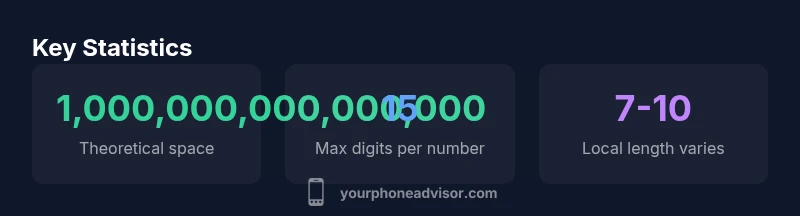
The number of possible phone numbers under the international E.164 system is up to 15 digits, yielding a theoretical maximum of 1,000,000,000,000,000 unique numbers. In practice, only a fraction of that space is allocated, and live numbers depend on national numbering plans and carrier assignments. So, there isn’t a single global count—numbers exist as a capacity, not a fixed inventory.
Theoretical maximums under international numbering systems
Under the ITU-T E.164 standard, a complete international number consists of a country code plus a national significant number, with a maximum of 15 digits in total. That means a theoretical ceiling of 10^15 possible numeric combinations, i.e., one quadrillion. In practice, many sequences are unused or invalid due to regulatory and technical constraints, reserved prefixes, and number pooling rules. The capacity exists as a ceiling, not a literal inventory; regulators and operators allocate subsets of this space to meet demand. For individuals, this distinction matters when considering how many numbers you might realistically manage, or when designing services that assign phone numbers at scale.
How E.164 shapes capacity and numbering plans
The E.164 framework defines the structure and maximum length of numbers, with country codes typically 1–3 digits and the total length capped at 15. This yields a vast space but also layers of control: national numbering plans carve the space into areas, mobile vs landline services, and reserved ranges. Each country negotiates its own pool of numbers with regulators, while carriers manage assignment and routing. Because numbers must be dialable internationally, certain sequences are avoided or restricted to prevent abuse, spam, or misdialing. The practical upshot is that capacity exists but actual allocations depend on policy, population density, and technological adoption. For developers designing multi-number apps, the lesson is to design around pooling, reuse, and lifecycle management rather than assuming a fixed count.
Why live counts are not fixed or universal
There is no single global tally of active numbers. Countries report different metrics: allocated numbers, in-use MSISDNs, and active SIMs. Some regions recycle numbers when plans change, others reserve ranges for future growth. The same number can be reassigned or deactivated, which means the live count fluctuates with market dynamics, regulatory changes, and technology shifts such as eSIM adoption. Consequently, “how many numbers exist” is a moving target that depends on the counting method, not just the math of digits. This nuance matters for security planners who must consider overlap, reuse, and potential spoofing risks.
Regions and numbering patterns: NANP, E.164 variations
In the North American Numbering Plan (NANP), numbers are dialed with a fixed format of 10 digits plus a '1' country code, totaling 11 digits, while the world follows E.164's flexible digit limit. Other regions vary: some countries use shorter national numbers, others longer; island nations might have small pools, while populous nations allocate vast blocks to mobile networks. These regional patterns shape not just how many numbers exist, but how easily consumers dial them and how providers route calls. When estimating totals for planning, it's essential to compare apples to apples: national pools, international routing, and active service lines.
What counts as a 'phone number' in counting conversations?
A key nuance is what exactly is being counted. MSISDN numbers identify subscribers, but SIP addresses or VoIP identifiers may also be treated as 'numbers' in some analyses. Some people own multiple SIMs across devices; others count mobile subscriptions rather than unique numbers. In addition, eSIM and number portability can blur boundaries between numbers and devices. For a practical sense of scale, distinguish between allocated digit space and actual active identifiers to avoid overestimating or underestimating the footprint.
Practical counts in practice: an illustrative view
Suppose you map the E.164 capacity to a region with 100 million potential subscribers. Even with conservative lending of digits to mobile and landline, that region could host tens of millions of active numbers without exhausting the space. In reality, factors such as number portability, number pooling, regulatory pools, and market saturation limit how many are in use at any moment. This demonstrates that the theoretical space dwarfs real-world usage, and most planners work with projections, churn rates, and lifecycle models rather than a fixed inventory.
Privacy and security implications of multiple numbers
Having multiple numbers can improve privacy by compartmentalizing identity, but it also increases surface area for phishing, SIM swapping, and bad actors who exploit number portability. Best practices include using distinct numbers for different domains (work, personal, IoT), enabling multi-factor authentication on all accounts, and monitoring for unusual activity across numbers. Consider virtual numbers or disposable numbers for short-term needs, and keep records secure with strong device and SIM protections.
Managing your own numbers: tips and best practices
- Inventory: list all active numbers and the services tied to them.
- Security: enable PINs, passcodes, and two-factor authentication.
- Privacy: regulate sharing of your numbers, use privacy settings in messaging apps, and review app permissions.
- Lifecycle: decommission old numbers properly to avoid SIM swaps and identity leaks.
- Tools: use number-management apps or carrier portals to track expiry, porting, and reassignments.
This practical framework helps individuals and small teams manage numbers responsibly, without losing track of who can reach you or how your numbers are used.
Numbering space overview
| Scheme | Max digits | Notes |
|---|---|---|
| E.164 | 15 | Total digits including country code |
| NANP | 11 | Country code + 10-digit national number |
| Local number | 7-10 | Length without country code varies by country |
| Region examples | 7-15 | Varies by national numbering plan |
Got Questions?
What is the E.164 standard and why does it matter for counting numbers?
E.164 defines the structure and maximum length of international numbers, setting a ceiling of up to 15 digits. This standard matters because it governs how many distinct numbers could theoretically exist and how they are formatted and dialed globally.
E.164 sets the rules for international numbers, including length and formatting, which defines the space we’re counting.
Why can't there be a single global count of phone numbers?
Numbers are allocated regionally by regulators and carriers, and many ranges are reserved or recycled. As plans change and technology evolves (e.g., eSIM), the active total fluctuates by region rather than following a single global tally.
There isn’t one global tally because allocations are regional and ever-changing.
How many digits are in a typical international phone number today?
Most international numbers use up to 15 digits in total, including the country code and the national number, but actual lengths vary by country.
Usually up to 15 digits in total, though exact length depends on the country.
Are there more numbers now than before?
Yes, as mobile adoption expands and new regions allocate numbers, total allocations grow, but the rate is tempered by number pooling, portability, and regulatory controls.
Numbers increase with mobile growth, but are limited by pooling and rules.
How can I protect my privacy when using multiple numbers?
Use separate numbers for different needs, enable strong authentication, and limit sharing. Consider virtual or disposable numbers for short-term use and monitor for suspicious activity.
Use distinct numbers for different roles and enable strong security across accounts.
“Understanding the number space helps people grasp scalability and privacy risks when managing multiple numbers.”
What to Remember
- Recognize the theoretical maximum is 15 digits per number.
- Different regions use different lengths for the national part.
- Actual live numbers are far fewer than the theoretical max.
- Treat numbers as capacity, not a fixed inventory.
- Consider privacy and security when managing multiple numbers.