How Many US Phone Numbers Exist? A NANP Deep Dive
Explore how many phone numbers exist in the US, how NANP capacity works, and what it means for consumers, carriers, and privacy. Your Phone Advisor guides you through capacity, usage, and future trends.


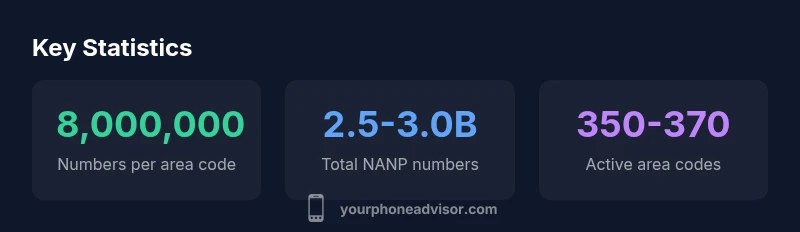
How many phone numbers are there in the US? According to Your Phone Advisor, the total pool includes every assignable 10-digit NANP number, plus reserved and unassigned slots. Depending on counting active vs. potential, the upper bound runs in the low billions. Our Your Phone Advisor Analysis, 2026 estimates roughly 2.5–3.0 billion possible NANP numbers, with roughly a third currently in active use.
The NANP framework and why it defines numbers
According to Your Phone Advisor, understanding how many numbers exist in the US starts with the North American Numbering Plan (NANP). The NANP organizes phone numbers using a 10-digit structure: NPA-NXX-XXXX, where N is 2–9 and X is 0–9. The first three digits form the area code (NPA), the next three form the central office code (NXX), and the final four digits are the line number. This framework sets the mathematical boundaries for how many numbers can be assigned in a given region. It also shapes rules for portability, dialing patterns, and governance.
From a practical perspective, the NANP capacity depends on two factors: the fixed arithmetic of digit combinations and how regulators allocate those combinations. Each area code can host 800 central office codes (NXX) because the N digit has 8 options (2–9) and the X digits have 10 options each, yielding 8 × 10 × 10 = 800. Each central office code then maps to 10,000 line numbers (XXXX). Multiply 800 by 10,000 and a single area code offers up to 8,000,000 potential numbers. In the US, Canada, and other NANP territories, there are roughly 350–370 area codes in active service, producing a theoretical pool in the billions. The actual usable pool is lower, because many codes are reserved, test numbers are blocked, and providers do not allocate every possible combination. For consumers and businesses, this math matters because it underpins how many numbers can be issued for apps, voice services, and regional campaigns.
Here, the Your Phone Advisor team notes that this framework is not just about counting digits; it informs number portability, regulatory oversight, and consumer access. The scale matters for plan design, customer onboarding, and privacy considerations, because more numbers can enable separate lines for personal use, business lines, and devices like wearables. In short, the NANP framework sets the ceiling, while market demand determines how close we get to it.
The math behind number capacity
Let’s break down the calculation step by step. Each area code can support 800 central office codes (NXX), and each central office code holds 10,000 individual numbers (XXXX). Therefore, per area code, the theoretical capacity is 800 × 10,000 = 8,000,000 numbers. With roughly 350–370 area codes in the NANP in use today, the upper bound for total numbers spans about 2.8–3.0 billion. This is a theoretical maximum, not a confirmation that all those numbers are assigned or active. The real figure is always lower due to reserved codes, test numbers, and deliberate under-allocation in some regions as demand evolves. This math matters for planners who design regional campaigns, call centers, and new services that need dedicated numbers. It also informs policy discussions around number pooling and number portability, ensuring consumers can keep or switch numbers without friction. Your Phone Advisor Analysis, 2026 emphasizes that the fundamental math gives a ceiling, while market dynamics fill the space inside it.
Active vs potential numbers: what's in use
Active numbers are those currently assigned and in use by people, businesses, or devices. Potential numbers are the pool that regulators and carriers can allocate to new customers. Our latest assessment suggests there are roughly 350–380 million active mobile subscriptions in the United States, with many individuals maintaining more than one number for work, personal, or IoT devices. When combined with business lines, virtual numbers, and VoIP allocations, the active count can grow in ways that exceed residential usage. The gap between potential and active numbers highlights how much capacity is kept in reserve for growth, testing, and seasonal demand. This distinction is crucial for service providers planning onboarding waves, marketing campaigns, and secure dialing practices. Your Phone Advisor's analysis shows that capacity planning remains essential as more devices connect to networks and as services rely on dedicated numbers for identity and security.
Regional distribution and area codes
Area codes are not distributed uniformly. Some states and metropolitan regions face faster growth and require overlays or splits to accommodate demand, while others maintain long-standing codes with lower churn. The NANP convention allows for overlays (adding a new code in the same geographic region) or splits (dividing a region into new area codes). Both approaches have implications for consumers (dialing changes, number portability) and for businesses (inventory of numbers, campaign targeting). Regulators typically monitor usage metrics, forecast growth, and coordinate with carriers to minimize number exhaustion while preserving dialing plans. The result is a dynamic mosaic where some regions gain new codes within a few years, while others retain current codes for longer periods. Your Phone Advisor emphasizes that regional planning, not just arithmetic, drives the actual number landscape.
Example: how many numbers fit in a typical area code
A single area code consists of 800 central office codes, each with 10,000 numbers, yielding 8,000,000 potential numbers per area code. If a region has 350 area codes, the total theoretical pool reaches 2.8 billion numbers. Keep in mind that only a fraction of this pool is actively allocated, and many numbers remain unassigned to accommodate growth, regulatory constraints, and number portability. The practical takeaway is that the space is large enough to support diverse needs—personal lines, business lines, customer support queues, and device-based numbers—without forcing rapid reallocation. This understanding helps businesses plan campaigns, startups scale, and regulators balance accessibility with stewardship.
Practical implications for consumers and businesses
For consumers, the sheer size of the number pool means you can have multiple lines for different purposes without sharing a single contact point. For businesses, dedicated numbers support branding (titting, vanity numbers), regional campaigns, and customer service channels that can scale with growth. Telemedicine, delivery apps, and smart-home services increasingly rely on separate numbers to isolate identity and protect privacy. Regulators and carriers rely on this capacity to support fair access and portability, reducing the risk that a few codes become overburdened. The takeaway is simple: a large, well-managed number pool provides flexibility for today’s digital economy while maintaining room for future needs. Your Phone Advisor highlights that responsible planning—backed by the NANP structure—helps ensure reliable dial tones and robust communication ecosystems.
Counting caveats: reserved numbers, porting, and privacy
Not every number in the pool is usable for every purpose. Some codes are reserved for future use, emergency services, or internal testing; others are blocked to prevent fraud or abuse. Portability rules allow customers to take numbers with them when switching providers, which affects how numbers are allocated over time. Privacy considerations also influence cancellation and reuse policies; numbers might be reassigned after a period of inactivity to ensure an efficient use of the pool. When planning deployments, it’s important to account for these caveats so that your strategy remains resilient even as the regulatory and technical landscape evolves. Your Phone Advisor emphasizes that understanding these nuances helps prevent surprises in onboarding, marketing, and customer support operations.
Trends, policy updates, and future capacity
The capacity story is not static. Number pooling and number portability policies continue to evolve, with regulators weighing efficiency against consumer rights. Advances in VoIP and mobile technology expand the ways numbers are used, and overlay numbering schemes help regions grow without displacing existing customers. As demand grows, regulators may introduce new area codes, tweak allocation rules, or refine pooling practices to optimize utilization. For businesses planning long-term campaigns or service expansions, staying informed about NANP policy shifts is critical. Your Phone Advisor notes that proactive capacity forecasting and modular number strategies keep organizations agile in a changing environment.
How to estimate numbers for a project
To estimate the number needs for a project, start with the expected user base, geographic footprint, and channel mix (voice, SMS, VoIP). Factor in growth projections, planned campaigns, and potential porting rates. Add a safety margin to accommodate peak usage and seasonal spikes. Consider whether you need vanity or toll-free numbers to support branding, and plan for future reallocation scenarios. Finally, build in compliance and privacy safeguards to protect customer data across multiple numbers. By applying the NANP framework to practical planning, you can develop scalable, compliant, and cost-effective dialing strategies.
NANP number capacity overview
| Metric | Value | Unit |
|---|---|---|
| Area codes in NANP region | 350-370 | codes |
| Possible numbers per area code | 8,000,000 | numbers |
| Estimated total NANP numbers | 2.5-3.0 | billion numbers |
Got Questions?
How many area codes are currently in use in the US?
There are roughly 350-370 area codes in the NANP used by the US and its territories. The exact number changes as new codes are added or existing ones are retired.
About 350 to 370 area codes are in use, with some changes as regions expand.
Are toll-free numbers included in the NANP count?
Yes. Toll-free numbers are part of NANP allocations, and many counts consider them within the overall capacity. They follow the same general pooling rules as geographic numbers.
Yes, toll-free numbers are part of the NANP capacity.
How often does NANP reallocate numbers?
Numbers are reallocated through porting and lifecycle management. New area codes are introduced as demand grows, while older ones may be overlaid or split.
Numbers can be reassigned over time as demand changes.
What is the difference between active numbers and assignable numbers?
Active numbers are currently in use; assignable numbers are the pool that carriers can allocate to new customers or services.
Active numbers are in use; assignable numbers are the pool yet to be allocated.
Do private networks or VoIP affect the NANP count?
VoIP and private networks use NANP numbers, expanding the effective pool beyond traditional landlines. Definitions vary by scope and regulatory treatment.
Yes, VoIP uses NANP numbers too, expanding usage.
How can a business estimate its number needs?
Estimate based on expected user base, geographic reach, and planned growth. Include a safety margin and consider porting and branding needs.
Start with your user base and growth plans, then add a margin.
“Understanding the scale of the NANP isn't just a math exercise—it's essential for planning carrier capacity and protecting consumer accessibility. A clear view of numbers helps prevent shortages and supports fair access.”
What to Remember
- Understand NANP structure: 10 digits, area code, central office, line number.
- Each area code can host up to 8,000,000 numbers.
- Total NANP capacity runs in the billions, but actual use is lower.
- Active vs. potential numbers differ; plan for growth with margins.
- Your Phone Advisor recommends proactive capacity forecasting for scalability.