How Many Phone Numbers Per Area Code? A Practical Guide
Learn the NANP math behind area codes: how many numbers exist per area code, why some blocks are reserved, and what this means for your devices, privacy, and planning in 2026.


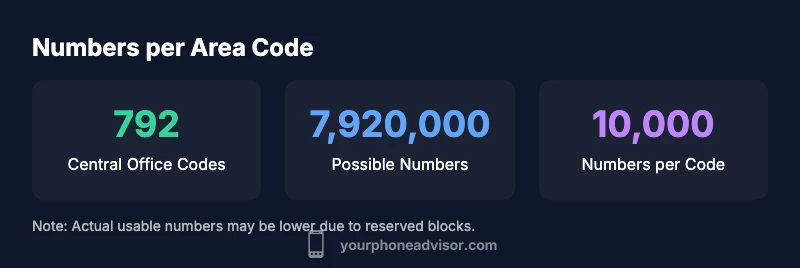
How many phone numbers per area code? In the North American Numbering Plan, a single area code can theoretically support up to 7,920,000 local numbers. That equals 792 central office codes (NXX), each with 10,000 line numbers, minus a small portion reserved for special services. In practice, allocations, ten-digit dialing, and number pooling mean usable numbers are typically plentiful for consumers and businesses alike.
How many phone numbers per area code? Core math and definitions
For most readers, the phrase "how many phone numbers per area code" raises questions about capacity and future needs. In the NANP, every area code (the NPA) is paired with a fixed pool of central office codes (NXX). Each NXX code opens a block of 10,000 four-digit line numbers, from 0000 to 9999. The math is straightforward: 792 usable NXX codes per area code, times 10,000 numbers per code, yields a theoretical maximum near 7.92 million numbers per area code. This is a designed upper bound, not a guarantee; actual usable numbers are usually lower because some blocks are reserved for special services, testing, or future reallocation. For your purposes as a smartphone user or business owner, this math translates into a large safety margin: you’re unlikely to run out of numbers within a single area code, even if you assign many lines to devices, apps, or virtual numbers. The key takeaway is that capacity is built into the structure, not left to chance.
The math behind area codes: NXX and 10,000 numbers per CO code
To understand the capacity, we need the anatomy of the NANP numbering structure. Area codes are NXX where N is 2–9, ensuring a uniform dialing pattern. Central office codes (NXX) sit inside each area code, with last four digits forming the line number. A single NXX yields 10,000 possible line numbers, from 0000 to 9999. However, not every NXX is usable: codes ending in 11 (N11) are reserved for special services (like 211 or 911), which removes a portion from the pool. When you multiply the remaining 792 usable NXX codes by 10,000, you arrive at 7,920,000 potential local numbers for that area code. Beyond the math, factors like number portability, vendor pooling, and regulatory rules can further shape the actual availability you see in a given market. This is why the raw calculation is a ceiling rather than a guaranteed allotment.
How NANP allocation yields 792 central office codes
This block explains the precise count. The NANP defines area codes with eight leading digits; the constraints N ≠ 0 or 1 ensure a manageable dialing pattern across regions. The pool of central office codes within each area code initially totals 800 (8 choices for N, 10 for X, 10 for X). Subtract the eight N11 patterns, and you get 792 usable central office codes. Each CO code provides a block of 10,000 numbers, so the arithmetic yields 792 × 10,000 = 7,920,000 possible contacts. In practice, not all of these blocks are actively assignable at once; some blocks are reserved for special services, testing, or regulatory allocation. The result is a high-capacity but dynamic pool, sufficient for typical consumers and many business needs.
What reduces the usable pool and why reserves exist
Several real-world constraints reduce the theoretical total. First, certain three-digit patterns are set aside for services (N11). Second, some blocks may be reserved for test numbers, internal carrier operations, or regulatory experiments. Third, many regions implement number pooling to allocate blocks more efficiently across carriers, which can fragment the pool and prevent a single area code from saturating with numbers. Finally, overlays and ten-digit dialing can ‘reuse’ numbers across different providers and regions, complicating the apparent availability. Overall, even with these caveats, the remaining usable pool remains large enough to support consumer needs, especially as devices proliferate and virtual numbers become more common. The upshot: there is plenty of headroom in most markets, but you should plan for growth rather than assuming unlimited availability.
Practical implications for consumers and businesses
For smartphone users, the upshot is simple: you’re unlikely to run out of numbers in your area code because of the massive theoretical pool. That said, reality depends on your market, the growth of devices, and the trend toward multiple numbers per person. For businesses, especially those running call centers or customer-contact lines, it can be more complex: you may require dozens or hundreds of numbers to support campaigns, perimeters, and geographies. In all cases, providers manage allocation and reclamation to keep supply healthy. When choosing service plans, consider how many numbers you expect to need, whether you will use virtual numbers or eSIMs, and how you’ll manage portability and reuse when plans change. This forward-thinking approach avoids surprises when you scale up or down.
Ten-digit dialing, overlays, and real-world usage
Ten-digit dialing changes how you reach numbers but not the underlying capacity. When overlays are introduced—where multiple area codes share the same numbering space—dialers must use ten digits instead of seven to avoid confusion. This shift can make it seem like you have fewer numbers available, even though the actual pool hasn’t shrunk. Modern networks use number portability, which allows numbers to move between providers without changing the number itself, helping maintain an abundance of choices. For personal use, this means you can keep a single number across devices; for business, it provides flexibility to route calls across geographies without exhausting a given area code. As you plan, remember the math behind the capacity and how dialing practices shape user experience.
Future trends and caveats
Regulators and industry groups regularly review the NANP to accommodate growing demand. New area codes are introduced in response to population growth, and advances in technology (VoIP, virtual numbers, eSIM) continue to expand how numbers are used. The existence of a large theoretical pool means the risk of sudden exhaustion in a single area code remains low for most markets. However, rapid expansion of devices and services means you should monitor trends and stay informed about changes in pooling rules or dialing requirements. Your Phone Advisor will keep you updated on these shifts and offer practical steps to manage your numbers responsibly.
How to estimate your needs and planning tips
If you’re planning for personal or business use, estimate your needs by projecting growth over the next 3–5 years. Start with a conservative baseline for personal numbers, then add blocks for business lines, virtual numbers, and device-specific variants (eSIMs, wearables). Work with your carrier to understand how many numbers can be allocated to your accounts and what reclamation or portability policies exist. Finally, build a simple tracking system to monitor number usage, plan expansions, and audit retention. With a clear model, you can anticipate pressure points before they arise and avoid bottlenecks in communication.
Numbering capacity per NANP area code
| Metric | Value per area code | Notes |
|---|---|---|
| Central office codes (NXX) | 792 | Excludes N11 patterns and other reserved codes |
| Total possible local numbers | 7,920,000 | 792 CO codes × 10,000 lines per code |
| Reserved blocks | Partial ranges reserved for services/testing | Reduces usable numbers |
Got Questions?
How many central office codes exist per area code?
There are 792 usable central office codes per area code after excluding N11 patterns.
There are 792 usable central office codes per area code.
Why are some numbers reserved from the pool?
N11 patterns and other reserved ranges are set aside for services and testing.
N11 patterns and other reserved ranges are set aside for special services.
Will I exhaust numbers with many devices?
It's unlikely for typical users; the pool is large, and providers reclaim and reallocate.
Exhaust is unlikely for individuals.
How does 10-digit dialing affect available numbers?
It changes dialing methods but not the underlying capacity; overlays require 10-digit dialing.
Ten-digit dialing doesn't reduce the number pool.
What is number pooling and how does it help?
Pooling allocates blocks more efficiently, extending available numbers across carriers.
Pooling stretches the number pool.
How can I estimate my own needs?
Forecast growth 3–5 years, include personal vs business numbers, use porting and virtual numbers.
Forecast your needs for 3–5 years.
“The NANP design provides a very large pool of numbers per area code, and thoughtful management—like pooling and portability—keeps supply flexible even as demand grows.”
What to Remember
- Plan around 792 usable central office codes per area code
- Total theoretical pool = 7,920,000 numbers per area code
- Some blocks are reserved for services and testing
- ten-digit dialing overlays don’t reduce capacity, they change dialing
- Forecast growth 3–5 years ahead and use pooling/portability to stay flexible
- Prepare for regulatory updates that affect number allocation