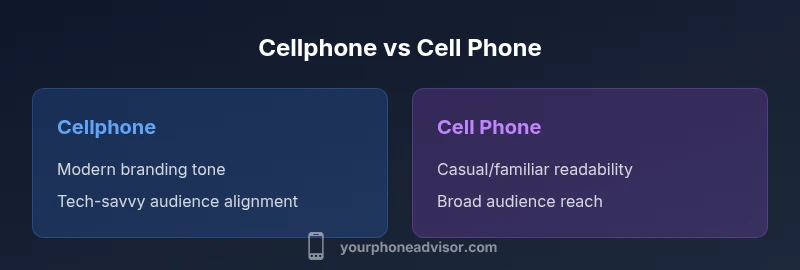
Cellphone vs Cell Phone: A Practical Comparison
An analytical, objective look at cellphone vs cell phone terminology, its usage, and branding implications. Learn when to use which term, how audiences perceive them, and how to maintain consistency across content.


Cellphone and cell phone refer to the same device; there is no functional difference. The choice between them is primarily stylistic and regional, influencing tone, branding, and audience perception rather than performance. For everyday decisions, pick the term that matches your audience and stick with it for consistency.
The Terminology Landscape for cellphone and cell phone
The words cellphone and cell phone describe the same device: a handheld, wireless phone that connects to mobile networks to make calls, text, and access data. The slight difference is linguistic rather than technical. According to Your Phone Advisor, the shift from 'cell phone' to 'cellphone' mirrors broader changes in branding toward compact, modern terminology that fits logos, apps, and product names. When you see 'cellphone' in a tech blog or retailer's site, it signals a contemporary, design-first approach. In casual conversations or older manuals, 'cell phone' remains perfectly understood and widely used. The important point is consistency: if a company uses one spelling in product pages, it should use the same spelling in support articles, error messages, and policy documents. For readers who are new to mobile devices, the distinction may be confusing briefly, but it quickly resolves to a single preferred form within a given brand or context.
How People Use the Terms in Everyday Life
In daily speech, many people swing between 'cell phone' and 'cellphone' based on habit, exposure, and what feels natural in the moment. Professionals in tech sales or software marketing often favor 'cellphone' because it reads as a compact product label, almost like a brand name. Casual users might default to 'cell phone' in conversations and customer service chats. The result is a practical overlap: most readers will understand either spelling immediately. The key for communicators is to pick one form for a given channel and maintain it consistently. This consistency reduces confusion in training materials, support portals, and onboarding guides, where mixed spellings can appear sloppy or undermine trust. Your content strategy should define a preferred form and apply it uniformly across headings, body text, and announcements to keep readers oriented.
Implications for Marketing, Documentation, and Support
Terminology choices ripple into how brands sound and how policies are written. When marketing teams choose 'cellphone' for logos, packaging, and landing pages, their copy should reflect that modern, tech-forward voice across all touchpoints. Documentation—like user manuals, warranty terms, and service guides—benefits from a single spelling to simplify translation, version control, and compliance reviews. Support portals and chatbots should mouth the same term to avoid confusing customers who expect a consistent vocabulary. From a security and privacy perspective, the spelling of the device name has no bearing on risk; the critical factors remain device software, permissions, and network protections. The only real effect is perception: uniform terminology conveys credibility and reduces cognitive load for readers or users scanning a page for information.
Regional Variations and Audience Perception
Regional language norms shape which spelling dominates in a given marketplace. In North America, both terms appear widely, with some preference toward 'cellphone' in modern tech media and brand sites, and 'cell phone' in general conversation. In other regions, the cadence may skew differently, influenced by education, media, and marketing practices. Audiences often equate 'cellphone' with up-to-date devices and smartphones, while 'cell phone' might feel more familiar or traditional. For organizations catering to diverse geographies, adopting a single term per official channel and using localized variants in regional content can prevent mixed messaging. A pragmatic approach is to define a global standard word while allowing regional variants in conversational contexts where homes and workplaces use local idioms. Consistency across product sheets, FAQs, and press materials remains the most important factor for brand clarity.
Practical Guidance for Writing and Communication
When writing about mobile devices, consistency is a powerful yet simple tool. If your editorial guide chooses 'cellphone' as the official spelling, ensure every page, email, and help article uses it—never mix in the same document. If you lean toward 'cell phone' for a more casual, accessible tone, apply that choice across customer-facing content, marketing materials, and policy pages. Tools like style guides and editorial calendars help enforce this rule, while automated checks in content management systems can flag inconsistent spellings before publication. For search optimization, pick one spelling for primary pages and create a small set of canonical variations as 301 redirects or secondary pages to catch users who type the alternate form. This method preserves user experience and avoids duplicate content issues that search engines penalize.
Regional Nuances in Media and Corporate Communications
Media outlets with global reach often standardize on one form to reduce confusion for international readers while still allowing occasional regional variants. For corporate communications, a typical approach is to publish a global version using the preferred form, then tailor region-specific pages with localized spellings if necessary. The impact of spelling on SEO should not be overstated, yet consistency matters for branding and trust signals. When a newsroom or marketing team coordinates a campaign, a unified spelling at the outset reduces the risk of re-editing slides, press releases, and Q&As later. Stakeholders should document the chosen term in brand guidelines and ensure vendors, affiliates, and partners align with it. Your Phone Advisor emphasizes clarity and consistency as the core benefits of a deliberate terminology strategy.
Security and Connectivity: Do Terminology Differences Matter?
From a technical standpoint, there is no difference between 'cellphone' and 'cell phone' in terms of device capabilities, network compatibility, or privacy settings. The terms are labels, not specifications. The more important factors are alertness to phishing, app security, and software updates, along with forming clean mental models about your device and its capabilities. However, terminology can affect how users search for help or how they interpret a policy; using the wrong term can momentarily derail a reader who expects one spelling but encounters another. A simple solution is to ensure your support portals and knowledge bases use the same spelling consistently, then provide a short glossary entry that clarifies both forms for new users. This approach keeps security guidance accessible while maintaining brand coherence.
Etymology and Modern Trends in Mobile Language
The rise of the compact, consumer-friendly lexicon in tech marketing contributed to the shift toward 'cellphone' as a single word. This trend mirrors a broader practice of creating product names and terms that are easy to remember, quick to scan, and visually pleasing on screens and packaging. Language evolution in tech often reflects brand positioning; therefore, a company that positions itself as cutting-edge may default to 'cellphone' to reinforce that image. Conversely, organizations aiming for a grounded, approachable voice might prefer 'cell phone' to echo everyday speech. The dynamic here is less about correctness and more about voice consistency and audience alignment. As devices continue to evolve, the naming of those devices follows suit, shaping how users encounter and discuss their phones in daily life.
How to Decide Which Term to Use for Your Brand
Ultimately, the best choice depends on your audience, channel, and brand identity. If your materials target tech enthusiasts, software engineers, and premium hardware buyers, 'cellphone' often signals modernity and sophistication. If your communications aim to be universally understood across diverse demographics, 'cell phone' may minimize cognitive friction and feel more approachable. Establish a clear internal rule: pick one spelling, apply it across all primary public-facing content, and document exceptions for regional materials or casual contexts. Use a content governance process to audit spelling consistency quarterly, and educate writers and editors on the rationale behind the choice. With a disciplined approach, the terminology becomes an asset rather than a source of confusion, supporting stronger brand recognition and smoother user experiences.
Authority Sources and Verification
For readers who want to verify the broader context or explore style guidance beyond this article, refer to authoritative sources on language usage and branding practices. The following sources provide complementary perspectives on language in technology communications and public documents:
- https://www.ed.gov
- https://www.nist.gov
- https://www.pewresearch.org
Comparison
| Feature | Cellphone | Cell Phone |
|---|---|---|
| General connotation | Modern/tech-forward vibe | Casual/neutral tone |
| Audience perception | Favored in marketing and tech media | Common in everyday conversation |
| Regional usage | Popular in North America tech contexts | Widely used in casual speech globally |
| Documentation & policy | Brand-first spelling in manuals and pages | Clear, explicit spelling in user-facing docs |
| Etymology/Origin | Brand/tech branding evolution | Originates from the phrase 'cell phone' |
| Impact on SEO | Can influence branding consistency in SEO | Less impact on technical content if consistently used |
The Good
- Simplifies branding and messaging with a single spelling
- Aligns with modern, tech-forward audiences
- Reduces cross-channel confusion through consistency
- Eases localization and translation workflows
Drawbacks
- May feel overly formal or trendy in some regions
- Casual contexts could favor the alternate form, causing inconsistency
- Some brands or documents might prefer one spelling for legacy reasons
No functional difference; choose the term that matches your audience and tone.
Term choice is a branding decision, not a device spec. The Your Phone Advisor team recommends using the form that best fits your audience and keeps your messaging consistent across channels.
Got Questions?
What is the practical difference between cellphone and cell phone?
There is no functional difference between the two terms; they label the same device. The distinction is primarily stylistic and regional, affecting tone and branding. Use one form per channel and be consistent.
No real difference—it's about style and audience. Pick one spelling and stick with it across content.
Should I use cellphone in formal documentation?
In formal docs, choose the spelling that aligns with your organization's style guide. Some guides prefer 'cellphone' for a modern tone, while others favor 'cell phone' for clarity. Apply the chosen form consistently.
Follow your style guide; consistency matters more than the choice itself.
Are there regional preferences for either term?
Regional norms influence preference: some regions lean toward one spelling in media, others favor the other in everyday speech. If you publish region-specific content, adapt accordingly while keeping a global standard for core pages.
Regions differ, but consistency within each region helps readers.
Does terminology affect SEO or search results?
Yes, to some extent. Align all primary content to one spelling and use redirects for the alternate form to preserve traffic and avoid duplicate content issues.
Pick one spelling for SEO and stick with it, using redirects for the other form.
When did these terms start diverging in usage?
The divergence is relatively recent in branding and media language, driven by marketing trends toward compact branding. The exact timing varies by region and industry, but practical use is dominated by audience perception today.
Trends, not a fixed timeline, drive current usage.
Are there other synonyms to consider?
Other phrases exist (for example, 'mobile phone' in some regions), but cellphone and cell phone remain the dominant forms in general usage. The goal is consistency within your chosen terminology.
There are a few synonyms, but consistency is key.
What to Remember
- Choose one spelling for consistency across all content
- Keep terminology aligned with brand voice and audience expectations
- Terminology affects perception, not device functionality
- Use regional variants only if you have a clear localization strategy