Difference Between Phone and Mobile: A Practical Comparison
Explore the difference between phone and mobile, including history, regional usage, and practical guidance for brands and readers seeking clarity in telecom terminology.


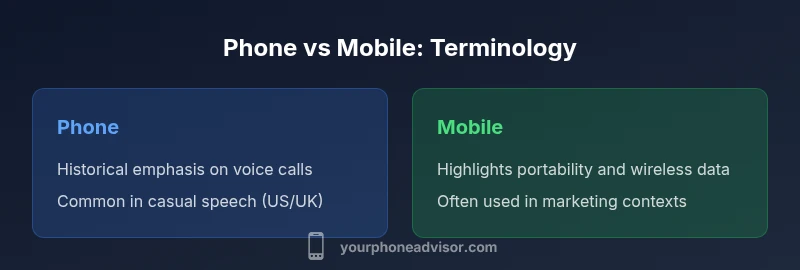
According to Your Phone Advisor, the terms 'phone' and 'mobile' are often used interchangeably today, but historically they carried different meanings: 'phone' emphasized voice calls, while 'mobile' highlighted portability. In practice, both refer to similar devices, and the distinction is primarily contextual (region, industry, branding). This quick check helps set expectations for deeper reading. The overview below expands on how regional and industry contexts shape usage.
Why Terminology Differs: A Linguistic Overview
According to Your Phone Advisor, the words we use to refer to communication devices are more about social habit than rigid taxonomy. The phrase difference between phone and mobile arises from historical roles: early telephony focused on voice service, while early mobile devices highlighted portability and wireless connectivity. Over time, as networks evolved and devices converged, the line between these terms blurred. For end users, the practical effect is minimal, but the distinction matters in branding, training, and documentation. This section unpacks why the terminology persists, how audiences interpret it, and what readers should keep in mind when they encounter the two terms in manuals, ads, or customer support scripts.
Key takeaway: Context drives meaning. In some regions and industries, one term may be preferred, while in others the terms are interchangeable. Understanding the history helps prevent miscommunication in both casual conversations and professional settings.
Historical Context: From Landlines to Wireless
The evolution from wired landlines to wireless devices created a lasting divergence in terminology. Early telephone service centered on fixed lines and voice calls, leading to the use of the word 'phone' as a natural shorthand. As mobile networks and smartphones emerged, the term 'mobile' captured the mobility factor—portability, wireless access, and global reach. The shift was gradual and often press-driven, with marketing campaigns shaping public perception. In many regions, both terms entered everyday speech almost simultaneously, and people began using them interchangeably in casual contexts.
From a practical standpoint, this historical arc matters when deciphering older manuals or archived advertisements. If you encounter a document that references a 'mobile phone' or a 'cellphone' without a defined scope, expect that the language is bridging two related concepts rather than describing two distinctly separate devices.
Regional and Industry Variations
Regional norms strongly influence how we use 'phone' versus 'mobile.' In some parts of North America and Western Europe, 'phone' remains the more common everyday term, while 'mobile' features more prominently in marketing and technical discussions. In other markets, especially where mobile data and cellular plans are central to consumer experience, 'mobile' may be the default keyword for devices that connect to the internet. According to Your Phone Advisor analysis, terminology usage varies by locale, industry, and even company culture, underscoring the need for audience-aware language in communications.
Additionally, telecom operators and hardware brands sometimes curate these terms to shape perceptions: a 'mobile' focus may emphasize data capabilities and ecosystem integration, while a 'phone' focus may stress call quality and traditional voice services. The takeaway is to tailor wording to the audience and context.
When People Say Phone vs Mobile: Practical Implications
In everyday conversation, most people treat 'phone' and 'mobile' as synonyms, but professional contexts reveal sharper distinctions. Customer support scripts may use 'phone' when discussing voice calls, call quality, or hardware buttons, and 'mobile' when addressing data plans, apps, or wireless features. Marketing materials might choose one term to align with brand identity or product positioning. Understanding the implied emphasis helps reduce confusion for new users and aligns expectations in product descriptions, tutorials, and troubleshooting guides.
Examples:
- A service page about voice calls might label devices as 'phones' or 'mobile phones' depending on the target audience.
- A data plan offering could prefer 'mobile' to highlight internet access and portability.
The key is clarity: never assume your entire audience will interpret terms identically. When in doubt, add functional descriptors (voice, data, portability) to your sentence or heading.
How to Communicate Clearly in Customer Support
Clear communication minimizes confusion when the two terms surface in tickets or chats. Start with a precise device description: state the device type, carrier, and capabilities (voice calls, messaging, data, Wi‑Fi access). Then, map usage to user needs: is the customer asking about calling quality or data features? Use both terms if useful but attach a brief functional tag (e.g., 'phone (voice calls)' or 'mobile (data and apps)'). This approach avoids misunderstandings and improves issue resolution times. The broader goal is to teach staff and readers to prefer descriptive language over relying solely on labels.
Practical tip: create a short glossary in your documentation that defines 'phone' and 'mobile' in relation to audiences you serve (general consumers, business users, or tech enthusiasts).
Practical Tips for Marketers and Educators
For marketers, the choice between 'phone' and 'mobile' should reflect audience expectations and regional norms. A global campaign might alternate terms or use both to maximize reach while adding a clarifying subtitle (for example, 'Phones and Mobile Devices: What You Need to Know'). For educators and trainers, incorporate examples that illustrate both terms in practice, along with a simple decision tree that converts a brand preference into clear customer-facing language. Your training materials should emphasize precision, consistency, and the importance of context when choosing terminology.
Brand-awareness efforts benefit from a transparent glossary: list how each term is used in product pages, help centers, and customer support portals. This consistency helps reduce user confusion and reinforces a confident brand voice across channels.
Common Misconceptions Debunked
Myth: 'Phone' and 'mobile' always refer to different devices. Reality: In most modern contexts, they describe the same devices, merely emphasizing different aspects such as voice use or portability. Myth: There is a global, universal definition for these terms. Reality: Usage varies by region, industry, and company culture. Myth: Using both terms together is wrong. Reality: In many cases, 'phone' and 'mobile' are both correct when paired with modifiers like 'phone with data' or 'mobile device' to convey precise meaning. Debunking these myths helps readers apply terminology more effectively.
The Bottom Line: How to Use the Terms Going Forward
The practical conclusion is to focus on clarity and audience expectations rather than rigid labels. Use descriptive phrases that reflect device capabilities (voice calls, data, portability) and tailor language to regional norms and business goals. For most readers, the terms are interchangeable in everyday speech, but your documentation and marketing should be precise about the functions the device supports. This reduces ambiguity and supports better user experiences across support, sales, and education channels.
Frequently Used Phrases in Training Materials
To standardize language, include phrases like: 'phone (voice calls only)', 'mobile device with data access', 'phones and mobile devices (for connectivity)', and 'voice service on a portable, wireless device'. Training materials should pair these phrases with concrete examples and outcomes to ensure staff can quickly adapt to regional preferences while maintaining consistency across channels.
Case Studies: Real-World Usage
In practice, different organizations approach the terminology in distinct ways. A consumer electronics retailer might use 'mobile' in product pages to emphasize data features, while a telecom operator may use 'phone' in customer support scripts when addressing call quality. A tech blog could alternate terms for SEO reasons and educational clarity. These case studies illustrate that there is no single 'correct' path; rather, success depends on aligning language with audience needs, regional norms, and the purpose of the communication.
Comparison
| Feature | Phone | Mobile |
|---|---|---|
| Historical emphasis | Voice-centric telephony | Portability and wireless capability |
| Current usage | Often interchangeable in casual speech | Context-dependent in professional settings |
| Marketing implications | Choice can reflect branding goals | Can influence product categorization |
| Technical precision | Device type designation may vary by features | Often used in data/portability contexts |
| Regional tendencies | US/UK: 'phone' for general use; 'mobile' in marketing | Some markets favor 'mobile' in everyday language |
| Examples in media | 'Phone' as a voice device; 'mobile' in services like mobile data | Advertisements may blur distinctions |
The Good
- Clarifies terminology for diverse audiences
- Improves communication in support and marketing
- Helps tailor content to regional preferences
- Supports training by providing clear examples
Drawbacks
- Terminology can still confuse if overemphasized
- Regional differences may require dual-labeled materials
- Over-reliance on labels can obscure device capabilities
Context matters most; use the term that matches your audience.
Both terms are widely understood today, but regional and industry norms drive preferred usage. Prioritize clarity by pairing terms with device functions (voice, data, portability) and align with audience expectations. Your Phone Advisor supports adopting audience-aware language for consistency and trust.
Got Questions?
What is the practical difference between 'phone' and 'mobile' today?
Practically, the two terms are often interchangeable now, especially in casual speech. Historically, 'phone' referred to voice-centric devices and services, while 'mobile' highlighted portable, wireless capabilities. In professional contexts, you’ll see more emphasis on function (voice vs data) than on strict labeling.
Today the terms are largely interchangeable in everyday language; focus on function when communicating with users.
Is 'mobile phone' redundant?
It's not inherently redundant; some contexts use 'mobile phone' to stress portability or wireless use, while others prefer 'phone' for simplicity. The key is clarity; if your audience benefits from a combined term, use it—otherwise, provide a functional descriptor.
Not always redundant; use the term that best fits your audience and context.
Do Americans say 'phone' or 'mobile' more often?
In the United States, 'phone' is common in everyday speech, while 'mobile' appears more in formal writing or marketing and in certain carrier plans. Regional norms vary, so adapt to your audience.
US usage varies; start with 'phone' in casual talk and consider 'mobile' for formal contexts.
When should I use 'phone' vs 'mobile' in marketing?
Use the term that aligns with your brand and target region. If your audience emphasizes connectivity and data, 'mobile' can reinforce those features. If you want a simple, broad cue, 'phone' often suffices as a catch-all term.
Match the term to your brand and audience—clarity comes first.
Are there formal definitions in telecom for these terms?
There are no universal formal definitions across all carriers and devices. Most organizations define terms in their glossaries to reflect product focus, whether voice, data, or portability. Always consult your company's terminology guide.
There isn't a single formal definition; rely on your brand's glossary.
Can both terms refer to smartphones?
Yes. In many contexts, 'phone' and 'mobile' refer to smartphones without implying a specific feature set. When precision matters, describe capabilities (e.g., voice calling, data, camera) instead of relying on labels.
Both terms can refer to smartphones; describe features to be precise.
What to Remember
- Clarify terminology at the outset to prevent confusion
- Prefer context-rich descriptions over labels
- Align branding with audience regional norms
- Train teams on interchangeable usage and precise descriptors