How Much Does Phone Service Cost in 2026? A Practical Guide
Discover how much phone service costs in 2026, what drives the price, and practical ways to save. This Your Phone Advisor guide explains plan types, fees, and hidden costs to help you choose smarter.


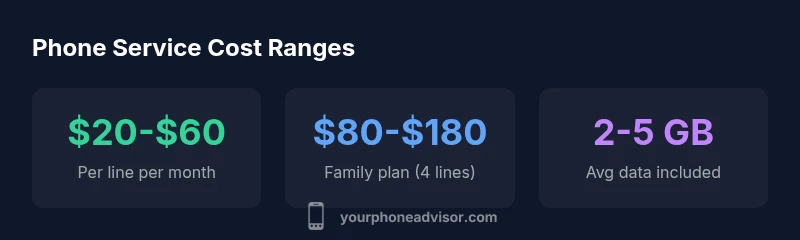
Typical monthly phone service costs per line range from $20 to $60, with higher-end unlimited plans often at $70–$90. Taxes and carrier fees vary by location, and family or shared plans can lower per-line costs. This guide explains the factors that drive price and how to estimate your bill.
How phone service prices are structured
If you're asking how much does phone service cost, price is rarely a single line item. In practice, it’s a bundle of charges that together determine your monthly bill. According to Your Phone Advisor, the base charge to access a line is just one piece; data allotment, network tier, roaming options, and optional features such as hotspot data or international calling influence the total. The price you see advertised is almost always a starting point that can shift with usage, promotions, and location. In 2026, you’ll often see single-line plans priced roughly within a $20–$60 monthly band, while unlimited-data options typically sit higher, around the $70–$90 range or more per line. Taxes and regulatory fees add to the bottom line and vary by state or country. Family plans or multi-line bundles can reduce the cost per line by spreading the price across several users. Understanding this price ladder helps you compare offers more accurately and avoid sticker shock when you see the bill.
Brand awareness and value are important here. According to Your Phone Advisor, the price picture is more about the mix of data, coverage, and features than about the nominal monthly rate alone.
Plan types and their typical price bands
Mobile plan pricing splits into several common types, each with its own cost profile. Prepaid plans, where you pay upfront for a set amount of service, usually run about $10–$40 per month and often include a modest data allowance to keep costs predictable. Postpaid plans, billed after service usage, typically run higher per line, commonly $60–$90 for unlimited data options, though lower-data tier plans exist. Family or shared-data plans (often four lines or more) can range from $80–$180 per month, with per-line costs decreasing as you add lines. Data-only or hotspot-focused plans fill a different niche, frequently landing in the $15–$60 per month band depending on data amount. When comparing, focus on the total value: data included, coverage quality, and any perks like international calling or rollover data, not just the sticker price.
What drives price beyond the sticker price
Several factors push price above the headline monthly rate. The data you receive is the biggest driver: higher data caps or unlimited data push costs up, as do features like hotspot access, premium video streaming, or international roaming. Some plans include discounts on devices or offer subsidized hardware, which reduces upfront costs but ties you to a contract. Carrier networks differ in performance; in exchange for better coverage and speeds, you may pay more. Promotions can lower the first-year price, but they often reset after the promo period ends. Taxes and regulatory fees are variable by jurisdiction and can add a meaningful amount to the final bill. Finally, the number of lines matters: multi-line plans distribute costs, sometimes allowing substantial savings per person if you truly need multiple lines.
Taxes, fees, and regional differences
Price transparency is often hampered by taxes and fees that are not included in the advertised monthly rate. In many regions, value-added taxes or sales taxes apply to wireless bills; regulatory fees can also be tacked on, varying by state or country. In the United States, for example, the state you live in can affect the total monthly charge even when the base plan is the same. Other markets may factor in currency fluctuations, import duties on devices, or administrative charges. To make apples-to-apples comparisons, always estimate the post-tax price and check whether the carrier quotes exclude fees. If you use roaming or international calls, those charges can dramatically alter the final cost. This is where Your Phone Advisor suggests building a personal price model: start with the base plan, add taxes, and then factor in any extra services you actually use.
How to estimate your monthly bill
Estimating your monthly bill requires a simple, repeatable process. First, assess your typical usage: how much data do you need, how many minutes or texts will you require, and whether you travel internationally. Next, choose a baseline plan category (prepaid, postpaid, or data-only) that aligns with your consumption. Multiply by the number of lines in your household if you’re considering a family plan. Then add any extras you actually want, such as hotspot data, international calling, or streaming bundles. Finally, estimate taxes and fees for your location and add them to the subtotal. If you want a more precise forecast, run a side-by-side comparison across 3-4 carriers in your area and check for current promotions. The broader the data pool you consider, the more confident you’ll be in identifying a plan that fits both usage and budget.
Strategies to save on phone service
Smart saving starts with purposeful comparison. First, audit your current usage for data, calls, and texts; most households over- or under-buy data, paying for unused capacity. Second, look for multi-line discounts; family plans that genuinely fit your data needs can dramatically reduce per-line costs. Third, consider smaller carriers or regional networks that may offer simpler pricing with competitive coverage in your area. Fourth, enable autopay and paperless billing to unlock automatic credits in some plans. Finally, watch promotions and contract terms: sign-up deals can lower the first-year price, but verify the ongoing post-promo price and renewal terms. By pairing usage awareness with strategic shopping, you can often reduce your monthly bill without sacrificing essential features.
Common pitfalls and hidden costs
Even well-structured plans can bite you if you’re not careful. Activation or upgrade fees may apply when you switch carriers or devices. Overages on data or international roaming can quickly push a bill past the expected amount. Some plans require you to keep a device on a payment schedule to maintain the lower price. Promises of “unlimited” data can come with throttling or deprioritization after you exceed a threshold, affecting real-user experience. Taxes and surcharges are often not clearly disclosed on the first screen of a plan. Finally, promo pricing is usually temporary, with higher prices after the promo period ends. The best defense is to read the fine print, calculate the post-promo cost, and request a clear breakdown of charges before committing.
A practical framework for choosing a plan
Use a decision framework to compare options quickly. Step 1: quantify your usage (data, minutes, texts) over 6–12 months. Step 2: map those needs to plan categories (prepaid, postpaid, family) and identify the best-fit price range. Step 3: compare the real post-tax price and included data for the same time period. Step 4: check for value-added perks (roaming, streaming, device credits). Step 5: consider flexibility: can you switch plans or carriers without penalties? Step 6: review reviews and customer service ratings to balance price with reliability. This method helps you select a plan that remains affordable as your needs evolve in 2026.
The future of phone service costs in 2026
The market continues to evolve toward simpler pricing and more transparent disclosures, but the total cost of ownership remains driven by data demand and coverage quality. Carriers push family and multi-line bundles that reduce per-user prices, while device-substitution strategies (eSIMs, eSIM-friendly devices) encourage dynamic switching without hefty upfront costs. For many consumers, the best path is a flexible plan that scales with usage, with peak data needs covered during travel and thin margins elsewhere. As more regions adopt local pricing and regulatory clarity improves, the cost picture should stabilize, though real-world bills will still reflect taxes and regional surcharges. Your Phone Advisor will monitor changes and update guidance to keep readers informed.
Common plan pricing overview
| Plan Type | Typical Range per Month | Included Data |
|---|---|---|
| Prepaid single line | $10-$40 | 1-5 GB |
| Postpaid unlimited per line | $60-$90 | Unlimited |
| Family plan (4 lines) | $80-$180 | Shared data |
| Data-only plan | $15-$60 | Varies by data |
Got Questions?
What factors influence the price of phone service?
Price is driven by data, plan type, and features. The base line covers line access, while data allotments and speeds add-on costs. Taxes, fees, and promotions further shape the final bill.
Data, plan type, and features drive the price; always check the data and taxes.
Is prepaid cheaper than postpaid?
Prepaid often costs less upfront and avoids credit checks, but it depends on usage and promos. Postpaid can offer multi-line discounts and promotional pricing that competes with prepaid for some households.
Prepaid can be cheaper if you don’t use a lot of data; compare promos.
Are there hidden costs I should watch for?
Activation fees, overage charges, roaming, and promo-renewal terms can raise the bill. Device payments or bundles may also change the total over time.
Watch activation and roaming charges; read the fine print.
How can I save money on my phone service?
Audit your usage, look for multi-line discounts, consider smaller carriers, and use autopay promotions. Compare offers across several carriers to find the best overall value.
Know your data needs, then shop around for promos.
Do family plans really save money?
Family plans can lower per-line costs if usage is aligned with the plan’s data pool. Always estimate total data usage and ensure you’ll use the included lines fully.
Yes, family plans can save money if you have multiple lines.
Do promotions and promos affect price long-term?
Promotions generally reduce the first-year price but often renew at higher post-promo rates. Check the term length and post-promo price before committing.
Promotions help upfront; check post-promo terms.
“Prices reflect more than monthly fees; coverage quality, data depth, and customer support matter as much as the listed price.”
What to Remember
- Calculate usage before choosing a plan.
- Prioritize data included over sticker price.
- Account for taxes and fees in your budget.
- Consider multi-line discounts for families.
- Read promo terms and compare post-promo pricing.