How Much Does Phone Bill Cost? A Practical Guide 2026
Explore how phone bills are calculated, typical monthly ranges, and practical tips to lower costs. Your Phone Advisor breaks down plans, taxes, and fees to help you decide smarter.


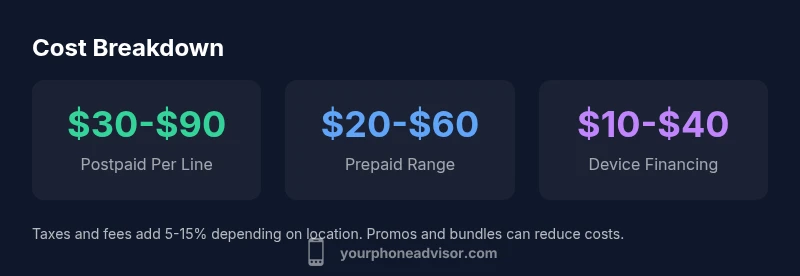
Typical monthly phone bills range widely based on data needs, plan type, and device financing. On average, postpaid single-lines run about $30-$90 per month; prepaid is usually $20-$60. Device financing adds roughly $10-$40, and taxes/fees typically increase the total by 5-15% depending on location. Your Phone Advisor's 2026 analysis suggests a mid-range household bill around $50-$80 at renewal.
The true cost behind a monthly phone bill
For many smartphone users, the big question is how much does phone bill cost each month. The answer isn't a single sticker price; it's a bundle of base plan charges, data allowances, device financing, taxes, and network fees. According to Your Phone Advisor, understanding what goes into the bill helps you forecast renewals and avoid surprises. A typical bill includes the core plan price, optional add-ons such as extra data, roaming, and hotspot, financing charges for devices, and unavoidable taxes and surcharges. By parsing each element, you gain the ability to compare plans more effectively and to forecast future changes with greater accuracy. This section lays out the main drivers so you can budget confidently.
What builds the monthly charge: plan price, data, and extras
The monthly bill starts with the base plan price, then adds data allowances, international options, and any add-ons you choose (extra hotspot data, roaming, or premium services). Device financing, if you acquired a phone on installments, appears as a separate line item. Taxes and regulatory fees vary by state and country, and promotional credits can reduce the net cost. This section breaks down each element and shows how small changes in usage or features can shift the total by a noticeable amount.
Typical cost ranges by plan type
Based on Your Phone Advisor Analysis, 2026, the broad ranges are as follows: Postpaid single-line: $30-$90 per month; Prepaid line: $20-$60; Family plan per line: $15-$35; Device financing portion: $10-$40; Taxes and fees: 5-15% of subtotal. These ranges are influenced by regional pricing, promotions, and data usage. Real-world bills will cluster around these bands, but many households sit near the middle. To budget accurately, start with a baseline plan and then adjust data and features to fit your actual needs.
How device financing affects your bill
If you financed a device through your carrier, the monthly payment is added to your service charge. Even with a low base plan, the financing line can push total monthly costs upward by $10-$40 or more, depending on the device price and repayment term. Promotions, such as zero-interest financing or upfront credits, can temporarily reduce the per-month impact. If you plan to replace the device soon, consider whether financing now yields a long-term saving or if a SIM-only plan would be cheaper.
Taxes, fees, and surcharges you should expect
Beyond the base plan and data, most bills include taxes and regulatory fees, universal service charges, and possible environmental or municipal fees. The exact amounts vary by state and country, carrier, and even city. In many regions these charges can add 5-15% or more to the subtotal. Some plans advertise ‘tax included’ or credits that offset these fees, but these are exceptions rather than the rule. Review the itemized bill to see where your money goes.
Promotions, bundles, and promos that change cost
Promotions can dramatically alter what you pay. Look for auto-pay discounts, loyalty credits, and data-pack promos. Bundling with home internet, streaming services, or device protection can reduce the per-service cost, but ensure you’re actually using the bundled benefits. Be aware that promotional pricing often lasts a limited period, after which the bill may revert to standard rates. Always check renewal terms and request a written promo offer.
Estimating your own bill and forecasting future changes
To estimate your bill, start with your current plan, note your data usage, and add any device financing. Apply taxes based on your location, then subtract any credits or promos you qualify for. If you expect usage to grow (e.g., more streaming, work-from-home), adjust the data tier accordingly. Price changes happen; seasonally carriers update plans, so set reminders to review your bill before renewal.
Practical steps to lower your monthly phone bill
Lowering a bill without sacrificing essential services is possible with a deliberate approach. First, audit data usage with the carrier’s tools or third-party apps to identify overages and unnecessary data consumption. If your usage is modest, switch to a smaller data tier or a prepaid plan, which often price more predictably. Next, explore family plans or multi-line discounts; balance the per-line savings against total features needed. Don’t hesitate to negotiate with your carrier—cite competing offers and ask for credits or discounts at renewal. Track promotional offers and switch when a better deal appears, but be mindful of device financing ties. Finally, consider bundling services or opting for a SIM-only plan while keeping your current device, which can reduce monthly costs while preserving essential features.
Typical costs by plan type
| Plan Type | Typical Range (monthly) | Key Cost Drivers |
|---|---|---|
| Individual postpaid | $30-$90 | Base plan + data + add-ons + taxes |
| Prepaid | $20-$60 | Base rate + data + coupons/discounts |
| Family plan per line | $15-$35 | Per-line price + line features |
| Device financing impact | $10-$40 | Financing portion + monthly service |
Got Questions?
What is the average cost of a monthly phone bill?
Costs vary by plan, data, and extras. Your Phone Advisor Analysis, 2026 shows typical bills range broadly from around $30 to $90 per month for a single line, with higher data needs or device financing pushing costs higher.
Most bills fall in the forty to ninety dollar range for a single line.
Do taxes and fees significantly affect the total?
Yes. Taxes, fees, and surcharges can add several percent to the base price, commonly in the 5–15% range depending on location and carrier.
Taxes and fees can add a noticeable chunk to your bill, often a few percent up to double-digit percentages.
Is prepaid cheaper than postpaid?
Prepaid plans are often cheaper upfront and help with budgeting, but may offer fewer features or data. Postpaid plans can include more data and promos but may require device financing.
Prepaid can be cheaper upfront; postpaid may offer more data and promos.
What steps can I take to lower costs without sacrificing essential data?
Audit your data use, switch to a smaller data tier, leverage promos, consider family or group plans, and negotiate with your carrier for discounts or credits.
Review data use, switch to a cheaper plan, and ask about promos or credits.
How often should I review my plan for promos and savings?
Review at least every 12 months, or whenever you hit a data limit or your usage changes significantly. Promos and bundles can shift the cost noticeably at renewal.
Review annually or with big usage changes.
Should I consider a family plan to lower per-line costs?
Family plans often reduce per-line costs, especially if multiple lines are used. Compare per-line pricing and ensure the features match your needs.
Family plans can lower per-line costs if you have several lines.
“The most effective way to control your phone bill is to align your data needs with actual usage and actively compare promotions at renewal.”
What to Remember
- Audit data usage to avoid overages
- Taxes and fees can add a meaningful percentage
- Look for promos and bundle discounts at renewal
- Family or multi-line plans can lower per-line costs
- Review usage and promos regularly to forecast future bills