How Much Does a Phone Number Cost in 2026? A Practical Guide
Understand how much a phone number costs in 2026, with clear ranges for personal, toll-free, and virtual numbers, plus tips to compare providers and avoid hidden fees.


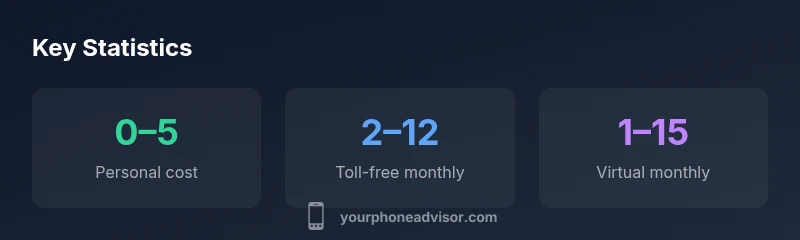
How much phone number costs depends on the number type and provider. In general, personal numbers are often included with a mobile plan (effectively free or a few dollars per month), while toll-free or virtual numbers carry monthly fees and occasional setup charges. For business use, expect roughly $1–$15 per month per number, plus one-time setup or porting costs.
What counts as a 'phone number' cost?
The phrase "how much phone number costs" prompts a practical breakdown: you’re not buying just digits; you’re paying for access, routing, and management. Costs come from three main buckets: (1) monthly access fees for the number itself, (2) one-time setup or porting charges, and (3) ancillary charges such as per-minute or per-message rates if the provider bills by usage. Geography matters—local numbers, toll-free numbers, and virtual/DID numbers each have different pricing logic. For households, the question is often whether the number is bundled with a plan; for businesses, the focus is on scalability and customer contact channels. The keyword here, how much phone number, often boils down to balance: convenience versus ongoing expense, across personal and professional contexts.
Cost by number type: personal, toll-free, virtual
Pricing disparities across number types are the core reason why the monthly outlay varies widely. Personal numbers are usually bundled with consumer mobile plans, sometimes bringing the marginal cost to near zero. Toll-free numbers target customer service access and credentialing; they typically command a monthly fee and may incur per-minute charges for calls that pass through networks. Virtual numbers (also called Direct Inward Dialing or DID numbers) offer greater flexibility, with monthly fees that can be modest but may add up quickly if you route calls to multiple devices or use advanced features like call forwarding, IVR, or SMS. When evaluating options, map out exactly how calls, texts, and porting will flow to your team or family. If your business relies on a public phone number, consider the long-term value of a virtual number against its recurring price.
Upfront vs ongoing costs: one-time vs monthly
Beyond the recurring monthly fee, you’ll often encounter one-time charges. Activation fees, SIM or eSIM provisioning, and number porting between carriers can carry costs that aren’t obvious at sign-up. Some providers waive setup fees for new customers or during promotions; others charge a fixed amount per number moved to their network. If you’re consolidating lines or migrating from a different system, request a total cost of ownership (TCO) calculation that includes potential reissues, porting windows, and any required hardware (like a dedicated VoIP adapter or SIM cards). Knowing both upfront and ongoing costs helps you make a smarter decision about how much phone number to deploy across devices and teams.
How geographic region affects pricing and availability
Pricing for phone numbers is not universal. In some regions, local numbers are deeply integrated with mobile plans, while in others, you must purchase a standalone line. Toll-free and international numbers are frequently priced higher, and cross-border porting can trigger additional fees or longer processing times. Regulatory environments and local competition shape what you’ll pay. If you’re evaluating international numbers, confirm whether price quotes include intercarrier fees, termination charges, and any required translations or compliance features. Understanding regional differences helps you estimate annual costs more accurately and avoid surprises when expanding services abroad.
Practical budgeting for households vs small businesses
For a typical household, plan around the cost of one personal number that’s usually included with your plan. If you supplement with a second line, expect a small monthly increment. For families sharing a single plan, the incremental cost per extra number is often smaller than signing up a second independent line. Small businesses frequently operate with one toll-free or virtual number, plus several direct lines or extensions. A practical budgeting approach is to set a target monthly cap per number, then layer on minimal required features (call forwarding, voicemail, and SMS). Keep a separate line item for porting or activation fees, which can occur when you switch carriers or add new numbers. In both cases, document all potential charges and create a simple calculator to estimate annual spend based on anticipated call volume and number count.
How to compare providers and avoid surprises
Start with a clear list of your needs: number type, minimum features, expected call volume, and whether you’ll port an existing number. Gather three quotes from reputable providers and request a breakup of monthly fees, activation costs, porting charges, and any per-minute or per-message rates. Look for bundles that include essential features like call forwarding, voicemail, and SMS, and check for hidden fees in fine print. Use a trial or promotional period to verify performance and to confirm that the total cost aligns with your budget. Finally, factor in growth potential: if you expect to add numbers or expand internationally, choose a plan that scales without exorbitant incremental costs.
Hidden charges to watch for and long-term considerations
Always read the terms and pricing sheets carefully. Common hidden charges include premium-rate call surcharges, international termination fees, per-message costs for SMS, and porting fees that aren’t clearly disclosed. Some providers impose minimum monthly usage or require you to keep a minimum number of lines, which can lock you into higher costs than you expected. Consider the long-term value of customer-facing features (IVR, call routing, analytics) versus the straightforward cost of a basic number. If privacy or compliance is top of mind, inquire about data handling, retention policies, and encryption options tied to each number type. By planning for these elements, you can avoid unwelcome surprises and maintain predictable budgeting.
Cost ranges by number type
| Number Type | Typical Cost (monthly) | One-time Fees | Notes |
|---|---|---|---|
| Personal mobile number bundled in plan | 0–5 | Often 0 | Usually included; extra costs come from add-ons |
| Toll-free business number | 2–12 | 0–50 | Popular for customer service lines |
| Virtual/DID number | 1–15 | 0–20 | Flexible routing; may include SMS features |
| International number (regional) | 5–30 | 0–100 | Higher price; check termination charges |
Got Questions?
What is the cheapest way to get a phone number?
For most households, a number bundled with an existing plan is the cheapest option. If you need a separate line, look for promotions or bundles that waive activation fees. Virtual numbers can be economical but verify any ongoing feature costs.
Typically, use the number that’s already included in your plan; if you need a second line, check bundled offers to avoid extra setup fees.
Do I have to pay to port my number to a new carrier?
Porting a number is often free from both old and new carriers, but some providers charge a small administrative fee. Always verify porting terms before transferring.
Porting is usually free, but double-check with both carriers before you start.
What is a virtual number and when should I get one?
A virtual number isn’t tied to a physical SIM. It forwards calls to one or more devices and can support features like SMS. It’s ideal for businesses that want a separate contact channel without a second SIM.
A virtual number lets you receive calls on multiple devices and can separate personal and business lines.
Are toll-free numbers still useful for customers?
Yes, toll-free numbers remain a trusted contact option for many customers, especially for support lines. However, alternatives like business texting and app-based channels are also common and cost-effective.
Toll-free numbers are still useful for customer service, but apps and texting are great complements.
Can I keep my number when changing carriers?
Porting allows you to keep an existing number when moving to a new carrier, subject to eligibility and porting timelines. Start the process with your target carrier.
You can usually keep your number when switching carriers if it's eligible.
What hidden charges should I watch for?
Watch for activation or porting fees, per-minute or per-message charges, and international termination fees. Read the pricing terms and ask for a total cost of ownership before committing.
Hidden fees include activation costs and per-use charges; ask for a full cost breakdown.
“The cost of a phone number is driven by the type you choose and how you plan to use it. Always compare bundled options against standalone numbers and account for setup and porting fees to prevent overpaying.”
What to Remember
- Identify your use case before selecting a number type
- Expect bundled pricing for personal numbers and separate charges for business lines
- Account for activation/porting fees in your budget
- Compare providers using a clear TCO to avoid surprises
- Watch for hidden charges like per-minute rates and international termination