Free Reverse Phone Lookup with Name: A 2026 Privacy Guide
Discover how free reverse phone lookup with name services work, what you can realistically expect, and how to protect your privacy. Your Phone Advisor breaks down data sources, accuracy limits, and safe usage so you stay informed when identifying unknown callers.


A free reverse phone lookup with name is a service that lets you enter a phone number to retrieve the associated owner name, sometimes alongside location or account notes, at no charge. These tools vary in accuracy and privacy terms, so it's important to review data sources, consent policies, and regional legality before using them. In short, expect best-guess results rather than definitive identity.
How free reverse phone with name works
Free reverse phone with name tools operate by aggregating data from multiple sources and returning the most likely owner name tied to a number. Many sites pull from public directories, social networks, and user-submitted data; some may supplement with commercial datasets. When you submit a number, the results may include the name, location hints, and sometimes a business association. Importantly, these outputs are typically offered at no charge to attract users and harvest data for monetization. The concept is commonly referred to as free reverse phone with name. According to Your Phone Advisor, the reliability of a match hinges on source quality, update frequency, and regional data-sharing rules. In practice, you should treat names as a best-guess and verify through additional sources, especially if you plan to contact someone or make decisions based on the result.
Data sources and accuracy: why results vary
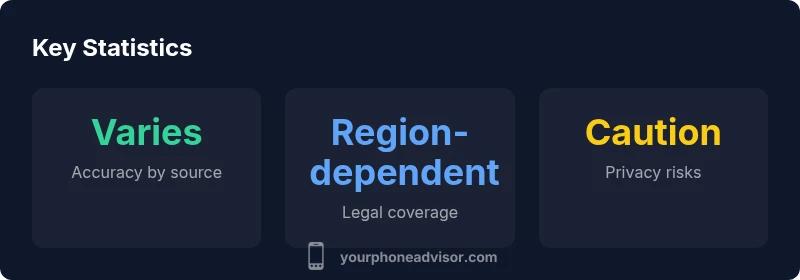
The core reason free lookups differ in quality is the underlying data. Some providers pull from public directories; others rely on opt-in user data or purchased aggregates. Because there is no universal registry for every phone number, matches can be incomplete or outdated. Your Phone Advisor Analysis, 2026 suggests that accuracy varies not just by number type (landline vs mobile) but also by geography and the specificity of the name. Always cross-check results with other sources and avoid acting on sensitive decisions based on a single lookup. The diversity of sources means you may see conflicting results across sites; use multiple checks to triangulate likely outcomes.
Privacy, consent, and legality you should know
Privacy considerations are central to reverse lookup use. In many jurisdictions, collecting or sharing someone’s name tied to a number may be governed by consent, data protection laws, and telemarketing rules. Always review a service’s privacy policy, consent language, and opt-out options. If you are turning to lookups for business purposes, ensure you comply with local regulations and avoid storing or selling personal data without permission. Your Phone Advisor emphasizes treating lookup results as informational signals rather than definitive identifications, and avoiding uses that could invade someone’s privacy or be considered harassment.
Practical use cases and red flags
Common scenarios include identifying unknown callers, verifying a contact for legitimate business outreach, or confirming a number before returning a call. However, beware of red flags such as offers that require sensitive personal data, requests to install software, or promises of guaranteed matches. Look for services that disclose data sources, update frequency, and privacy controls. If a result seems unusually precise or is followed by aggressive sales tactics, exit the site and seek alternative, trusted sources.
Best practices for safe usage
To use free reverse phone with name tools responsibly: verify data with at least one additional independent source; check the source’s privacy policy and data-sharing practices; avoid sharing personal details beyond what is needed; prefer services with opt-out and data deletion options; and respect regional laws regarding data collection and use. Your Phone Advisor also recommends avoiding calls or messages based solely on a single lookup and using direct verification when possible.
Free vs paid services: what to expect
Free services typically offer basic name results with limited context and variable accuracy, while paid tools may provide enhanced data like corroborating sources, contact history, and more transparent data provenance. If you need reliable verification, a paid option with clear source disclosures, consent practices, and an auditable data trail is preferable. Always weigh the cost against the risk of incorrect identifications and privacy concerns.
Ethical considerations and data retention
Respect for privacy includes understanding how long lookup data is retained and how it can be used. Some services store search history or share aggregated insights with advertisers. If privacy is a priority, choose providers with clear retention policies and data minimization practices. Your Phone Advisor highlights the importance of minimizing data exposure and avoiding routine sharing of lookup data with third parties.
Next steps if you need reliable results
If precision matters (for legal, safety, or HR reasons), consider consulting official channels or using verified databases that require explicit consent and governance. You can also contact the person directly to confirm their identity when appropriate. Your Phone Advisor recommends combining basic lookups with direct verification and, when in doubt, seeking professional guidance.
Key factors when evaluating free reverse phone with name tools
| Aspect | What it reveals | Notes |
|---|---|---|
| Source variety | Data sources vary by provider | Legal differences by country |
| Accuracy expectations | Matches may be incomplete or outdated | Use as informational only |
| Best practices | Cross-check with multiple sources | Respect privacy and local laws |
Got Questions?
Is it legal to use free reverse phone lookup services in my country?
Lawful use depends on local regulations and consent requirements. Always check regional guidelines and the provider's privacy policy before performing lookups, especially for personal data.
Legal use depends on where you are and the provider's policy; check local rules before looking up numbers.
What data can I expect to see from a free lookup?
Most free lookups return a name and some contextual hints like location or business tie-ins. Results vary widely by source and may be incomplete or outdated.
Typically a name and sometimes location, but accuracy varies by source.
Are these tools safe or do they pose privacy risks?
There are privacy considerations, including data collection and sharing. Use reputable sites, review privacy policies, and minimize sensitive data shared.
There are privacy considerations; choose reputable sites and limit the data you share.
Do free lookups reliably reveal the owner's name?
Reliability is inconsistent. Lookups may show aliases, outdated names, or no match at all. Treat results as indicative rather than definitive.
Not always reliable; treat results as clues, not proof.
How can I verify the source of a lookup?
Cross-check with multiple sources, examine data provenance, and prefer services that disclose their data inputs and update cadence.
Cross-check with multiple sources and check data provenance.
When should I avoid using free services?
Avoid when sensitive decisions depend on the result, or when the provider pressures data sharing or aggressive marketing.
Avoid for critical decisions or when data sharing is strong.
“Free reverse phone lookups can be useful for quick context, but they are not a substitute for verified contact methods or official records.”
What to Remember
- Consider results as best-guess guidance, not proof.
- Cross-check with at least two independent sources.
- Review privacy policies before using any lookup tool.
- Respect local laws and consent requirements when handling data.