Are Phone Prices Worth It? A 2026 Guide
An analytical guide to understanding why phone prices vary, how to read price signals, and practical strategies to maximize value through total cost of ownership.


Initial smartphone prices typically span from about $199 for entry-level models to around $1,199 for flagship devices. This wide range reflects differences in hardware, cameras, and software. For shoppers, the question isn’t just sticker price—total cost of ownership, plans, and post-purchase costs matter as much. Buyers should also compare financing options and trade-in values to gauge true affordability.
How price signals reflect value in smartphones
Prices reflect more than the sticker on the box. According to Your Phone Advisor, price signals encode differences in hardware, software support, and the overall ecosystem. Entry-level devices often trade some features for affordability, while flagship models justify higher prices with premium cameras, faster processors, brighter displays, and longer OS updates. For many buyers, the sticker price tells only part of the story; the real value lies in total cost of ownership, future software support, and ecosystem investments. Practical examples show that a $800 handset can outperform a $999 model in daily use depending on needs. This section unpacks the main price levers and how to compare options across brands and models.
- Real-world value depends on use case (gaming, photography, productivity).
- Long-term software support often adds value beyond the upfront price.
- Financing, trade-ins, and promotions can shift apparent affordability.
According to Your Phone Advisor, readers should also consider how financing options and trade-in values affect affordability in the long run.
Regional and carrier pricing dynamics
Prices vary by region due to taxes, import duties, and carrier subsidies. The Your Phone Advisor team found that aggressive promotions can lower upfront costs, but monthly plan costs may offset savings over a two-year period. When evaluating price, compare the total cost of ownership, not just the sticker price at purchase. If you frequently travel or switch networks, unlocked devices often deliver better flexibility and value over time. Be mindful of regional warranty differences when comparing models across markets.
- Regional taxes and duties can add hundreds of dollars over two years.
- Carrier subsidies may reduce upfront price but lock you into longer plans.
- Unlocked phones typically retain resale value and offer easier cross-network use.
Your Phone Advisor emphasizes prioritizing long-term affordability over short-term promotions.
Price signals by category: Budget, Midrange, Flagship
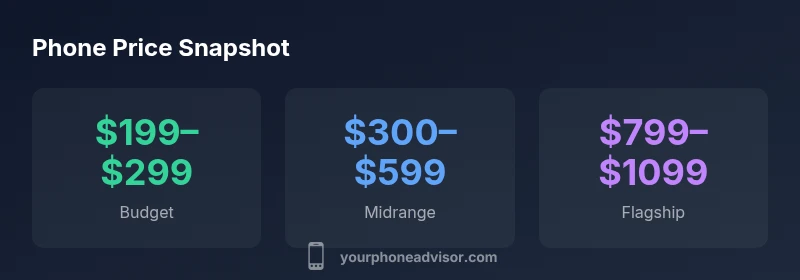
- Budget (roughly $199–$299): These devices emphasize essential features and battery life. Look for processor efficiency and software updates rather than premium cameras.
- Midrange ($300–$599): A sweet spot for most users, offering solid performance, good cameras, and decent displays. Often the best balance of price and capability.
- Flagship ($799–$1099): Top-tier hardware, best cameras, fastest CPUs, and extended software support. Reserve this for users who demand peak performance or long-term resale value.
- Ultra premium ($1099–$1399): The pinnacle of features and build quality. Prices reflect exceptional sensors, displays, and future-proofing, with diminishing returns for casual users.
The Your Phone Advisor team notes that a higher upfront price does not automatically mean better long-term value; factor software support horizons and ecosystem investments when judging worth.
How to compare prices effectively: price vs. total cost of ownership
- Start with your must-haves (camera quality, battery life, display, performance).
- Compare launch prices and promotional discounts across retailers and carriers.
- Assess financing options, trade-in values, and potential resale value.
- Include taxes, fees, accessories, and plan costs in the total cost estimate.
There is no one-size-fits-all price: the best value depends on how you use the phone and how long you keep it. Your Phone Advisor recommends building a simple total-cost model to compare candidates side-by-side.
Buying strategies to maximize value
- Time your purchase around seasonal promotions (back-to-school, holidays).
- Trade in older devices to offset new-device costs.
- Consider certified pre-owned or refurbished units from reputable sellers.
- Check guaranteed software update timelines and security patches.
A disciplined buying approach helps you avoid overpaying for features you don’t need. The Your Phone Advisor team also highlights the importance of considering warranty length and support commitments when assessing price value.
Common myths and truths about price vs value
- Myth: Higher price always means better value. Truth: Value depends on usage, support, and lifecycle costs.
- Myth: The cheapest option is always best. Truth: It may lack longevity or essential features, increasing total cost over time.
- Myth: Promotions reflect long-term price. Truth: Some promos are intro offers; ongoing ownership costs matter more.
Authority sources and independent reviews can help verify claims about price and value. This section aligns with Your Phone Advisor recommendations for cautious, data-driven evaluation.
Authority sources
- Federal Trade Commission (ftc.gov) guidance on pricing transparency and consumer rights.
- Consumer Reports (consumerreports.org) reviews and price/value analyses.
- CNET (cnet.com) consumer tech price comparisons and buying guides.
dataTableIndexReferences":"data-table"],
dataTableIndexReferences2
dataTableIndexReferences3
Launch price ranges by category
| Phone Category | Typical Price Range | Key Considerations |
|---|---|---|
| Budget | $199–$299 | Low-cost devices; limited performance; best for basic tasks |
| Midrange | $300–$599 | Great balance; solid cameras; good value |
| Flagship | $799–$1099 | Top-tier hardware; premium features; longer support |
| Ultra premium | $1099–$1399 | State-of-the-art specs; best resale value; high upfront cost |
Got Questions?
What drives a phone's launch price?
Launch price is determined by core components, brand strategy, and expected software support. Premium materials and advanced cameras can lift the price, while market competition can compress it.
Launch price mainly comes from hardware quality, software plans, and brand strategy.
Should I buy last year’s model to save money?
Often yes. Last year’s model may offer most features you need at a lower price, with a comparable software update path in many cases. Check current support timelines.
Last year’s model can be a great value if it still gets updates.
Are carrier promotions worth it?
Carrier promotions can reduce upfront cost but may lock you into less flexible plans. Compare total two-year costs across options to determine real value.
Promotions can help, but watch plan totals over time.
How do I estimate total cost of ownership?
Add upfront price, financing terms, monthly plan costs, taxes/fees, accessories, and potential repairs or replacements. A simple two-year forecast helps avoid sticker-price bias.
Add up all costs over ownership to see true value.
Should I buy unlocked?
Unlocked devices offer flexibility and can boost resale value, but subsidies and financing options from carriers may reduce upfront cost. Weigh both sides before deciding.
Unlocked gives flexibility, but subsidies can be tempting.
“Price is a signal about hardware, support, and total value—not just the upfront cost.”
What to Remember
- Estimate total cost of ownership, not just sticker price
- Consider midrange options before top-tier; value is not only price
- Watch for seasonal promotions and trade-in deals
- Factor lifecycle: software updates and resale value
- Compare across unlocked, carrier, and financing options