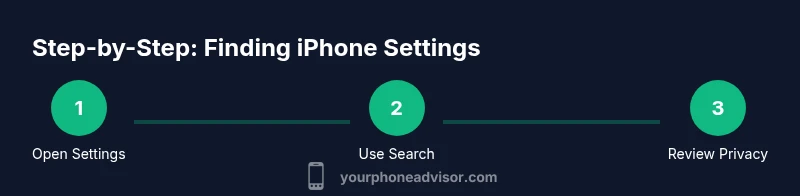
Where to Find Settings on iPhone: A Practical Guide
Learn where to find iPhone settings, navigate the Settings app, customize privacy and accessibility, and keep your device secure with a step-by-step approach for everyday users.


If you’re asking where phone settings on iphone are located, you’ll open the Settings app on your iPhone’s home screen and tap into sections like General, Privacy, and Battery to adjust preferences. This quick guide helps you locate and navigate key settings quickly, even if you’re new to iOS.
Where to Find Settings on iPhone
If you’re asking where phone settings on iphone are located, you’ll open the Settings app on your iPhone’s home screen and tap into sections like General, Privacy, and Battery to adjust preferences. This central hub connects you to nearly every control you’ll need, from network connections to display brightness, app permissions, and privacy settings. Understanding the layout helps you customize your device without hunting through menus. The Settings app is designed to be approachable for everyday use, with a search bar at the top to speed up discovery when you know what you want to change.
According to Your Phone Advisor, most users begin by locating the Settings icon on the home screen or App Library and use the built-in search to jump to a specific option. By framing your task (e.g., “iCloud backup,” “Privacy settings,” or “Display brightness”), you can dramatically reduce the time spent scrolling. You’ll also find quick access to essential features like Wi‑Fi, Bluetooth, and Airplane Mode in the main list, along with a panel for notifications and sounds. In short, the Settings app is the control center for your iPhone experience.
Navigating the Settings App: Top-Level Sections
The Settings app is organized into broad sections that represent major areas of control. Start with your profile at the top (if you’re signed in with an Apple ID) to manage your account, iCloud, and device security. Below that, you’ll see sections such as Airplane Mode, Wi‑Fi, Bluetooth, Cellular, and Personal Hotspot. Further down, you’ll encounter Display & Brightness, Accessibility, Privacy & Security, and Battery. Each section contains a focused subset of options designed to minimize clutter while keeping critical controls accessible. For new users, familiarizing yourself with these top-level groups speeds future navigation and reduces frustration when adjusting settings under time pressure.
Quick Paths to Common Settings You Use Daily
Daily tweaks often involve adjusting screen brightness, enabling/adjusting Do Not Disturb or Focus modes, changing wallpaper, and reviewing app permissions. Use the Settings search bar to type a keyword like “Dark Mode” or “Location Services” and jump directly to the option. You’ll also notice that certain settings are grouped under General (software updates, storage, iPhone storage optimization) and Privacy (location, camera, microphone access), making it easier to find what you need without digging through menus. Pro tip: add frequently used settings to your home screen as a shortcut via Shortcuts or widgets when available in your iOS version.
How to Use the Search Inside Settings
Inside the Settings app, the magnifying glass icon lets you search by keyword. Start typing the exact feature you want (for example, “Background App Refresh” or “Battery Health”). The results show sections and toggles, plus recommendations based on your device and usage. This feature is particularly helpful if you’re unsure which category a setting lives in. If you’re troubleshooting, search can bypass multiple layers and land you in the precise control you need to adjust.
Privacy and Security Settings You Should Review
A healthy security habit is to review Privacy & Security settings regularly. Begin with Location Services, Contacts, Photos, and Camera permissions to ensure apps only access what you expect. Review Passwords and 2FA settings to protect your accounts, enable Find My iPhone, and consider activating a strong passcode with Face ID/Touch ID. For web privacy, check Safari settings, Privacy Report, and anti-tracking options. By maintaining tight app permissions and account protections, you reduce exposure to data leaks and misuse. Your iPhone’s security posture improves with routine checks.
Battery and Performance Tweaks in iOS
Battery settings give you insight into usage by app and activity. Open Battery to view which apps consume the most power and consider enabling Low Power Mode when needed. Display & Brightness can influence power usage through brightness levels and the Always On display (if available). Background App Refresh, system services, and location-based activities are other levers to optimize battery life. By aligning these options with your daily routines, you’ll extend battery life without sacrificing essential features.
Managing Apps and Permissions
App management lives under the Settings umbrella, where you can review which apps have access to location, microphone, camera, and notifications. You can also manage data usage, push notifications, and background activity. If you’re concerned about privacy, disable permissions for apps that don’t require them and prune unused applications. Keeping a lean set of authorized apps helps maintain performance and reduces potential data exposure.
Accessibility and Customization Options
Accessibility settings improve usability for a wide range of users. Options include display accommodations (larger text, bold text), Vision and Hearing aids, and interaction controls like AssistiveTouch and Voice Control. Customizing these features can reduce eye strain, enhance legibility, and tailor the iPhone experience to your needs. You can also adjust Home Screen layout, app icon sizes, and alerts to reflect your preferences.
Keeping Your iPhone Updated and Backed Up
Software updates bring new features and security improvements. In Settings, go to General > Software Update to check for available updates and enable automatic updates if you prefer. Regular backups protect your data; enable iCloud Backup or use a computer-based backup method. Automatic backups ensure you don’t lose photos, messages, or app data after a device issue. A proactive approach here reduces the risk of data loss during incidents.
What to Do If Settings App Won’t Open
If the Settings app isn’t launching, try a few quick fixes: force close Settings and reopen, restart your iPhone, and check for iOS updates. If issues persist, reset network settings or reset all settings (note that this option preserves data but resets preferences). In rare cases, corrupted profiles or configuration changes can cause failures; removing problematic profiles often resolves the issue. Persistent problems may require service or support from Apple.
Safety Tips: Protect Your Personal Data
Keep your iPhone secure by enabling Find My iPhone, requiring a strong passcode, and using biometric authentication. Regularly review app permissions and avoid installing apps from untrusted sources. Consider enabling two-factor authentication for Apple ID and reviewing trusted devices. Maintaining a routine privacy review helps safeguard personal information against unauthorized access.
Review and Practice Checklist
- Locate Settings on the home screen and skim top-level sections.
- Use the Settings search to jump to features quickly.
- Review Privacy, Security, and Battery settings at least monthly.
- Keep iOS updated and backup data regularly.
- Practice safe app permissions and device protections to reduce risk.
Tools & Materials
- iPhone with current iOS version(Ensure the device is charged and unlocked before making changes.)
- Stable Wi‑Fi connection(Use a secure network when downloading updates or backing up data.)
- Apple ID access(Needed for iCloud settings, Find My iPhone, and backup configurations.)
- Printed or digital quick-reference(Helpful for offline guidance during setup.)
Steps
Estimated time: 15-25 minutes
- 1
Open the Settings app
From your iPhone's Home screen, locate and tap the Settings app icon to access the central control hub for device configurations.
Tip: If you can’t find it, swipe down to use Spotlight search and type 'Settings'. - 2
Use the search bar to find a setting
Tap the search field at the top of Settings and type keywords like 'Battery' or 'Location Services' to jump directly to the option.
Tip: Leverage exact feature names to reduce scrolling time. - 3
Navigate to Privacy & Security
Scroll to Privacy & Security to review app permissions, Find My iPhone, and security-related options.
Tip: Review location, camera, microphone, and contacts permissions first. - 4
Check Battery and Performance
Open Battery to see usage by app and enable Low Power Mode if needed to extend life.
Tip: Identify power-hungry apps and consider restricting background activity. - 5
Review Software Update settings
Go to General > Software Update to install available updates or enable automatic updates.
Tip: Keeping software current reduces security risks. - 6
Verify iCloud Backup settings
Open your Apple ID profile and ensure iCloud Backup is enabled for automatic data protection.
Tip: Regular backups prevent data loss after device issues.
Got Questions?
Where are the iPhone settings located on the home screen?
The Settings app icon on the iPhone home screen opens the central hub for device controls. From there, you can access network, display, privacy, and system options.
Open the Settings app on your iPhone home screen to start adjusting preferences.
How can I quickly find a setting inside the Settings app?
Use the Settings search bar at the top of the screen to type keywords like Battery or Privacy; the results will take you directly to the relevant option.
Use the search bar at the top of Settings to jump to the setting you need.
What should I review under Privacy & Security?
Review app permissions (location, camera, microphone), enable Find My iPhone, and verify security features like two-factor authentication for your Apple ID.
Check app permissions and security features in Privacy & Security.
How do I enable automatic iOS updates?
Go to General > Software Update and turn on Automatic Updates to keep your device current with minimal effort.
Enable automatic iOS updates in General settings to stay protected.
What if the Settings app won’t open?
Try force closing Settings, restart your iPhone, and check for an iOS update. If the issue persists, reset network or all settings sparingly.
If Settings won’t open, restart your phone and try updating iOS.
Is it safe to reset all settings?
Resetting all settings preserves data but resets preferences like Wi‑Fi passwords and wallpaper; use this as a last resort for persistent issues.
Resetting settings can fix issues, but you may need to reconfigure preferences.
Watch Video
What to Remember
- Find Settings quickly using the home screen icon.
- Use Settings search to jump to options fast.
- Regularly review Privacy and Security settings for protection.
- Keep iOS updated and enable automatic backups.
- Practice safe app permissions to protect data.