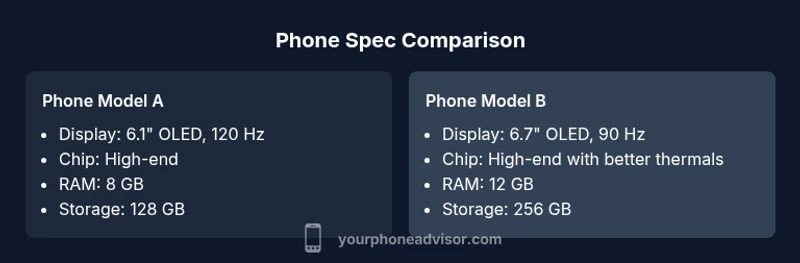
Phone Spec Comparison: Your Guide to Side-by-Side Specs
A practical guide for evaluating phone specs side-by-side, focusing on CPU, RAM, display, battery, storage, camera, and software updates to decide which model best fits your needs and budget.


For a practical phone spec comparison, focus on core metrics: CPU and RAM, display quality, battery and charging, storage, camera capabilities, and software updates. This structured approach shows how each spec translates to real-world use, helping you balance performance with value. Use this guide to shape your evaluation and avoid marketing hype when choosing a model.
What a phone spec comparison actually measures
When people say they want a phone spec comparison, they usually mean a structured evaluation of the most influential hardware and software characteristics. At its core, a well-executed comparison translates raw numbers into meaningful differences for daily use. The phrase phone spec comparison is more than a checklist; it’s a framework for deciding what matters to you—speed, longevity, or media quality—before you buy. Your Phone Advisor emphasizes that spec sheets are a starting point, not a final verdict. By aligning each specification with real-world tasks (gaming, photo editing, or long-haul video calls), you can separate marketing hype from genuine advantages. In this guide we’ll break down the essential specs you should compare, outline how to read them, and show how to weigh trade-offs across two representative models. The goal is clarity: a repeatable method you can apply to any future device, so you can trust your choice even as new smartphones hit the market.
Core metrics to prioritize first
In any phone spec comparison, a handful of core metrics set the baseline for performance and value. Start with the processor and RAM, because CPU power and memory directly influence app multitasking, gaming, and smoothness of the user interface. Next, storage capacity and memory type determine how many apps and media you can keep on device without pressure to offload or cloud-store everything. Display quality matters too: resolution is important, but refresh rate, brightness, color accuracy, and HDR support shape the everyday viewing experience. Battery size is not the whole story; charging speed, charging ecosystem, and efficiency of the chipset determine how long the device lasts between charges. Finally, software updates and security patch cadence affect long-term value. When you quantify these metrics side-by-side, you’ll see where two phones converge and where they diverge, helping you pick a device that aligns with your priorities and budget. Remember: numbers matter, but context matters more.
Display metrics and how they translate to daily use
Display specs get a lot of attention, but the real impact depends on how you use the screen. A larger diagonal with higher resolution yields crisper text and more immersive video, yet it can also mean heavier devices and shorter battery life. Look beyond the headline megapixels: refresh rate, brightness, contrast ratio, and color gamut determine how readable content is in bright sunlight, how smooth animations feel, and how colors appear in photos and apps. A 120 Hz panel can make scrolling feel fluid, but this benefit may be wasted if apps aren’t optimized or if the brightness drops in outdoor use. In a phone spec comparison, the critical question is: does the higher spec translate into noticeable benefits for your typical tasks? If you’re a commuter who uses the phone outdoors, you’ll value outdoor brightness and color accuracy; if you’re a media consumer, you’ll care more about HDR support and contrast. The bottom line: match display capabilities to your real-world needs rather than chasing the latest spec headlines.
Performance, memory, and software: turning numbers into experience
CPU cores, clock speeds, and RAM sizes are the obvious numbers in a spec sheet, but real-world performance depends on how those pieces fit together. A high-end CPU with ample RAM offers snappy app launches and smoother multitasking, yet software optimization matters just as much. In a phone spec comparison, two devices might list similar RAM, but differences in storage speed (UFS type), GPU tie-ins, and thermal design can yield very different sustained performances under load. Storage type and capacity influence app loading and file handling; faster storage reduces texture loading in games and speeds up app caches. Software updates and security patches extend a device’s useful life, improving compatibility with new features and protecting data. When evaluating, consider benchmarks as directional guides rather than verdicts, and prioritize day-to-day experiences over synthetic scores. Your Phone Advisor recommends cross-checking any factory numbers with user experiences and battery profiles for the two models you’re considering.
Battery life and charging ecosystems
Battery life is often the deciding factor for many buyers, but it’s not just the battery capacity that matters. Efficiency—how much energy a processor and display draw under typical tasks—plays a critical role. A phone with a 4500 mAh pack can outlast a 5000 mAh device if it’s less power-hungry, and vice versa. In a phone spec comparison, examine real-world endurance in mixed-use scenarios, not only standby tests. Look at charging speeds and the availability of efficient charging accessories. Fast charging can cut downtime, while wireless charging adds convenience but may slow top-speed replenishment. Ecosystem factors also matter: compatible chargers, official accessories, and brand guarantees influence long-term costs and convenience. If you rely on all-day use with late-night streaming, prioritize higher practical battery life and faster charging. For lighter users, a balanced pack with solid efficiency and moderate charging may deliver similar outcomes with smaller heat generation and better long-term battery health.
Cameras and image quality: megapixels vs real-world results
Megapixel counts are eye-catching, but sensor quality, lens pairing, sensor-shift stabilization, and image processing matter more for actual results. When you compare camera specs, consider low-light performance, dynamic range, autofocus speed, stabilization, and video capabilities (resolution, frame rate, and stabilization). Two phones may share similar sensor resolutions and still produce markedly different photos due to algorithmic processing and processing power. In a phone spec comparison, it’s helpful to separate hardware from software: you can love one phone’s hardware but prefer another’s camera software for color science and noise reduction. If you prioritize photography, evaluate sample shots in conditions you actually shoot in—indoor lighting, backlit scenes, night mode performance—and check how well RAW capture translates into post-processing flexibility. Real-world testing, not just numbers, will guide you toward the model whose camera behavior matches your style and expectations.
Software support and long-term value
Software support determines how long a phone remains useful after purchase. Even the most capable hardware can feel outdated if the operating system stops receiving essential security patches or feature updates. When you perform a phone spec comparison, check the stated update window and whether the manufacturer commits to major Android/iOS version upgrades and quarterly security patches. Consider if the user experience remains clean and responsive as new features arrive, not just at release. A device with a longer support timeline often represents better value, especially if you tend to keep phones for several years. If security and compatibility are important to you, include update cadence in your decision matrix and weigh it alongside raw hardware specifications. Your Phone Advisor notes that software longevity can often outweigh a marginal advantage in a single hardware spec.
How to conduct your own side-by-side comparison
A practical approach combines official spec sheets with hands-on testing. Start by listing the top tasks you perform each day, then map each task to the relevant specs: processor and RAM for smoothness, display for readability, battery for endurance, and camera for photo quality. Gather official spec sheets from manufacturers, then cross-check with independent reviews to capture real-world notes about thermals, battery life, and software experience. Build a simple matrix with two phones and fill in every category—display quality, performance, long-term updates, cameras, and charging. Don’t forget to consider ecosystem factors: charger compatibility, case availability, and software support commitments. Finally, simulate your own usage: run a few common apps, perform a camera test, and monitor how quickly the device warms and how battery drains under load. The result should be a clear, personal verdict that aligns with your priorities and budget.
Interpreting trade-offs for different user profiles
Different users prioritize different aspects of a phone spec comparison. A student or budget-conscious buyer may value cost efficiency, solid battery life, and essential cameras over top-tier processing. A creator who edits videos and photos on the go will appreciate fast storage, robust RAM, capability for RAW capture, and advanced stabilization. A power user or gamer needs a capable GPU, ample RAM, and efficient thermal management to maintain performance over longer sessions. When you synthesize the data from a phone spec comparison, align the results with your goals: daily use, productivity, media consumption, and security updates. Remember, no single model is universally best; the best choice is the one that minimizes gaps between your needs and the device’s strengths. Use the two-model comparison as a baseline, then expand to a wider range if your priorities shift.
Comparison
| Feature | Phone Model A | Phone Model B |
|---|---|---|
| Display (size) | 6.1 inches | 6.7 inches |
| Display (type) | AMOLED, 120 Hz | OLED, 90 Hz |
| Chipset / CPU | High-end quad-core, 3.0 GHz | High-end with improved thermals |
| RAM | 8 GB | 12 GB |
| Storage options | 128 GB / 256 GB | 256 GB / 512 GB |
| Battery capacity | 4000 mAh | 5000 mAh |
| Charging speed | wired 25W | wired 65W |
| Camera setup | Triple camera: 50 MP main | Quad camera: 108 MP main |
| OS / updates | Android-based, 3-year updates | Android-based, 4-year updates |
| Price range | $699–$799 | $899–$1099 |
The Good
- Helps avoid overpaying for features you won’t use
- Reveals trade-offs between performance and battery life
- Supports objective decision-making with measurable metrics
- Aids in prioritizing future-proofing (updates, storage)
Drawbacks
- Can be overwhelming if many metrics exist
- Differences may be subtle without real-world testing
- Requires access to reliable spec sheets
- Display measurements may vary by region
Model B is the stronger overall choice for most users.
Model B offers better performance, more RAM, and longer software support, yielding superior long-term value. Model A remains a solid budget option for those prioritizing price and simplicity.
Got Questions?
What is the most important spec to compare when choosing a smartphone?
The most important spec depends on your usage, but typically CPU/RAM, battery life, and camera capabilities drive day-to-day satisfaction. Security updates also influence long-term value. Use a balanced approach rather than focusing on a single metric.
Prioritize the specs that match how you use your phone, then check the two models side by side to compare those areas.
Do higher megapixel counts always mean better photos?
Not always. Sensor size, lens quality, image processing, and stabilization often determine photo quality more than megapixel count alone. Look at real-world samples and user reviews, not just camera specs.
Megapixels aren’t everything—sensor quality and processing usually decide the result.
How should I weigh battery life vs charging speed?
It depends on your daily routine. If you recharge often, charging speed matters more. If you’re away from power for long stretches, endurance takes priority. Consider both together for a practical view.
Think about your day: do you need fast top-ups or longer battery life?
Why is software support important in a phone spec comparison?
Software support extends the usable life of a device, improving security and adding features. It’s a key factor in total cost of ownership and long-term satisfaction.
Updates matter because they keep your phone safer and more capable over time.
Is official spec data reliable for comparing phones?
Official specs are reliable anchors but should be supplemented with independent reviews and hands-on testing to capture real-world performance and thermals.
Specs are a good starting point; real-world tests confirm how it feels in day-to-day use.
Should I include camera samples in a spec comparison?
Yes. Camera samples show how hardware and software work together in real scenarios, which numbers alone can’t reveal.
Look at actual photos from similar lighting to judge color and detail.
What to Remember
- Analyze core specs first to gauge baseline performance
- Match display capabilities to real-world use, not just numbers
- Consider software updates as a long-term value factor
- Use side-by-side tables to visualize trade-offs quickly
- Don't rely on megapixels alone for camera quality