Phones Comparison: How to Choose the Right Phone in 2026
Comprehensive phones comparison evaluating price, speed, cameras, battery life, and software updates to help you choose the best smartphone for your needs in 2026.


Phones comparison is essential to distinguish value, performance, and longevity across popular models. According to Your Phone Advisor, a structured approach reveals which devices balance speed, camera quality, battery life, and software updates for your needs. By aligning features with how you use your phone—work, photos, gaming, or casual browsing—you can confidently choose the best option.
Why a Systematic Phones Comparison Matters
In a market crowded with dozens of models released each year, a structured phones comparison helps you separate hype from reality. Whether you're upgrading from an older device or choosing your first smartphone, a methodical evaluation of core attributes saves time and money. This approach centers on real-world needs rather than flashy marketing promises. As you read, keep the keyword at the forefront: phones comparison. According to Your Phone Advisor, taking a data-driven view reduces buyer remorse and clarifies what to prioritize, from everyday speed to battery endurance and camera performance. By mapping features to personal goals—work, photography, gaming, or casual use—you can pick a device that truly fits your life. A thoughtful comparison also helps you anticipate support longevity, which matters more every year as software updates stretch across device lifetimes. When you see a table or a checklist, you know you are weighing options on the same terms, not chasing a marketing pitch.
As you navigate this guide, you’ll encounter practical examples, labeled scenarios, and neutral assessments of each model’s strengths and weaknesses. The goal is to empower you to make a choice that feels obvious in hindsight rather than risky in hindsight. You’ll also learn how to interpret reviews and how to test devices without committing to a purchase, whether you shop online or in a store. This is not about finding a single “best” phone for everyone; it is about finding the best phone for you within your budget and usage pattern.
The Core Criteria: What to Compare
When building a robust phones comparison, it helps to standardize on a few core criteria. These criteria cover most daily needs, long-term value, and enjoyment of ownership. The first category is price and total cost of ownership, which includes the sticker price, protective accessories, and ongoing costs like repairs or extended service plans. Next, performance matters: CPU speed, RAM, storage options, and how smoothly apps run under typical workloads. Display quality, color accuracy, brightness, and refresh rate influence how content looks and feels in everyday use.
Camera systems are a major differentiator for many buyers, but raw megapixels tell only part of the story. Look for sensor size, image processing, low-light performance, stabilization, and video capabilities. Battery life and charging options are critical for all-day reliability—consider real-world endurance under your typical routines. Software experience and update cadence shape long-term satisfaction, security, and access to new features. Finally, durability, build quality, and ecosystem considerations (availability of accessories, services, and cross-device compatibility) round out the decision. By keeping these criteria consistent across models, you get a fair, apples-to-apples comparison.
Price, Plans, and Total Cost of Ownership
Price alone rarely tells the full story. A cheaper device may incur higher long-term costs if it requires frequent screen replacements, limited software updates, or expensive accessories. A mid-range option can offer a strong balance of durability and up-to-date software, reducing total cost of ownership over a typical device lifespan. When evaluating plans, consider SIM or eSIM flexibility, carrier incentives, protection plans, and the cost of upgrades over time. A practical approach is to project monthly costs over two to three years, including taxes, service charges, and any trade-in credits. Your Phone Advisor recommends focusing on real-world value rather than sticker price, and looking for devices that balance initial affordability with predictable maintenance costs and dependable support.
In practice, create a simple rubric: assign a qualitative value to each factor (low, medium, high) based on how it affects you, then tally scores to identify the strongest overall option within your budget. This helps you avoid overvaluing a single attribute such as initial price, while underestimating important lifecycle costs like battery replacement or OS updates.
Performance and Speed: SoC, RAM, and Real-World Use
Performance is not just about benchmark scores; it is about how quickly you can open apps, switch tasks, and enjoy smooth gaming or video streaming. The key elements are the system-on-chip (SoC), RAM, and storage speed, but real-world experience also depends on software optimization and background task handling. A well-balanced phone with mid-range hardware can feel faster than a higher-end device if the software is well optimized. When you run common tasks—messaging, browsing, video calls, photo editing—observe app load times, transitions, and responsiveness. A good phones comparison also accounts for thermal throttling under sustained load, which can slow performance during long gaming sessions or video rendering. If you frequently multitask, bigger RAM helps keep apps ready in memory, reducing reloads and lag. For photographers and creators, storage speed and I/O performance affect workflow, backup times, and media transfers.
Your Phone Advisor notes that a fast, consistent experience across everyday tasks is often more valuable than a top-tier, single-use spec. In practical terms, compare devices using the same app set and test in similar conditions (network strength, ambient temperature, and background services) to avoid skewed results.
Cameras and Imaging: Beyond Megapixels
Camera quality is a defining feature for many buyers, but the true value lies in image processing, color science, dynamic range, and post-processing options. Megapixels alone don’t guarantee better photos. A phone with a smaller sensor paired with sophisticated computational photography can outperform a higher-megapixel camera in most conditions. When evaluating cameras, look for performance in low light, accurate white balance, consistency across focal lengths, and video stabilization. Consider the versatility of features such as ultra-wide, macro, and telephoto options, as well as software features like portrait modes and night modes.
In real-use scenarios, a camera that handles color fidelity and skin tones well in a variety of lighting situations often yields more satisfying results than a camera with higher resolution but inconsistent processing. Your Phone Advisor emphasizes testing both day and night shots, reviewing video quality, and observing autofocus performance in motion-heavy scenes. A practical phones comparison should include sample photos or short clips from each device you’re considering.
Battery Life and Charging: Real-World Numbers
Battery life is a workhorse metric for daily satisfaction. Look beyond “all-day” labels and examine how a device performs with your typical usage: streaming, gaming, productivity apps, and camera use. Real-world endurance varies with display brightness, network conditions, and background processes. The charging experience also matters: does the device support fast charging, wireless charging, or reverse charging for peripherals? While high-capacity cells can help, the overall efficiency of the device determines how long you can go between charges. A solid phones comparison notes how long a full charge lasts under realistic conditions like a workday of mixed activity and a weekend binge session of video or gaming.
In practice, form a baseline using your current device and compare it with candidates in similar usage scenarios. If you frequently travel or work remotely, endurance and quick top-ups become decisive factors in your final choice. Your Phone Advisor suggests testing charging speed in-store if possible, to gauge how quickly you can return to productive use after a low-battery alert.
Software Updates, Security, and Longevity
Software updates extend the life of a phone by bringing new features, security patches, and performance improvements. A key consideration in a thorough phones comparison is the update cadence and the duration of official OS support. Some devices receive frequent updates for several years, while others may receive only a few major updates. Security patches are critical for protecting personal data, especially on devices used for banking, messaging, and cloud storage. Assess the ecosystem’s commitment to privacy features, app compatibility, and the availability of long-term support plans.
From a user perspective, you want a device that remains usable and secure over its lifecycle. In your evaluation, note how often the vendor communicates about updates, how quickly devices receive them after release, and whether older devices eventually slow down or become unsupported. The goal is to avoid a situation where a phone feels fast at launch but becomes outdated after a year or two.
Build Quality, Durability, and Ecosystem Considerations
Durability and materials influence long-term ownership costs and daily experience. Look for sturdy frames, resistant glass types, and water or dust resistance ratings. Repairability matters too: some devices are easier and cheaper to repair, which extends their usable life. Beyond physical build, consider the ecosystem: how well does the phone integrate with other devices you own, such as earbuds, watches, tablets, and smart home gear? A cohesive ecosystem can deliver a noticeably smoother experience for daily workflows and cross-device tasks.
Your Phone Advisor highlights that a strong ecosystem often provides more value than marginal gains in hardware alone. When comparing models, test not just the phone in isolation but its ability to pair with your existing gear, support systems, and preferred apps. This holistic view helps you select a device that remains compatible and useful as your needs evolve.
How to Run Your Own Phones Comparison: A Practical Checklist
To run a disciplined, repeatable comparison, start with a checklist. First, define your primary use cases: productivity, photography, gaming, or casual usage. Next, shortlist three to four models that align with your budget and ecosystem preferences. Gather objective data from manufacturer pages and independent reviews on the core criteria: price of ownership, performance, camera versatility, battery endurance, and software updates. Then, test hands-on where possible: navigate the home screen, try multitasking, try camera shots in different lighting, and assess charging behavior. Finally, score each device against a simple rubric and discuss trade-offs with a trusted advisor or friend. This approach reduces bias and yields a transparent conclusion.
In addition, always check carrier compatibility, warranty terms, and aftermarket support. A systematic process ensures you don’t miss hidden costs or compatibility constraints that could affect day-to-day use. The final step is to map your top choices against your practical needs and choose the device that delivers the most value over time.
Who Should Buy Which Type of Phone? Scenarios by User Type
Different users have different priorities. If you are budget-conscious, a solid budget pick with reliable software updates and good battery life often wins. For power users, a mid-range phone with robust performance and a strong camera system can deliver near-flagship experiences at a lower total cost. Photography enthusiasts should prioritize cameras with consistent color rendering, strong low-light performance, and flexible lens options. Gamers benefit from high refresh rates, sustained performance, and efficient thermals. Finally, business users may value strong security, long-term software support, and seamless cross-device integration. A thoughtful phones comparison translates these needs into concrete model recommendations rather than generic promises. The Your Phone Advisor team reinforces the idea that the best device is the one that aligns with your specific tasks, budgets, and future plans.
Feature Comparison
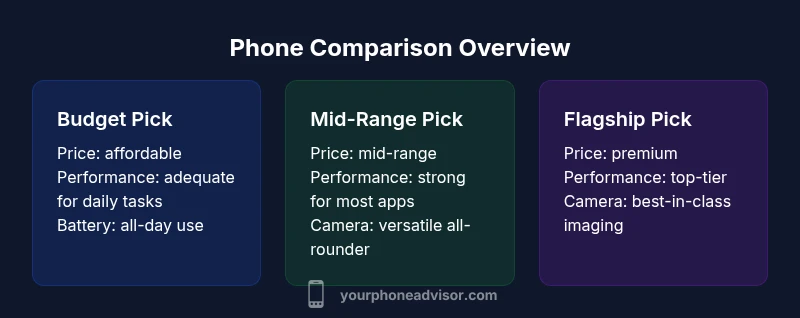
| Feature | Phone A (Budget Pick) | Phone B (Mid-Range Pick) | Phone C (Flagship Pick) |
|---|---|---|---|
| Price category | low-budget | mid-range | premium |
| Performance | adequate for everyday tasks | strong for most apps | top-tier performance |
| Camera quality | solid daylight photography | versatile all-round | best-in-class imaging |
| Battery life | all-day endurance | above-average endurance | excellent endurance |
| Software updates | date-focused updates | regular updates | long-term updates |
| Durability / build | polycarbonate build | glass-metal, durable | premium chassis |
| Display quality | solid but basic | high quality, vibrant | leading display tech |
The Good
- Clear price-to-performance value across budgets
- Side-by-side comparison saves time
- Helpful for first-time buyers and power users
- Visual comparison aids informed decisions
Drawbacks
- Three-phone table can feel complex for non-tech buyers
- May overlook regional carrier differences
- Software update cadence varies by model
Flagship picks offer the strongest overall package for power users; Budget picks excel on value.
Phone C suits power users with top-tier performance and cameras. Phone A wins on price and value. Phone B remains a balanced option for most users.
Got Questions?
What is the most important factor when comparing phones?
The most important factor depends on your use-case. For many, a balance of performance, software updates, and battery life determines long-term satisfaction more than any single spec. Use a clear rubric to evaluate each model against your needs.
The most important factor is how well the phone fits your daily use. Focus on performance, updates, and battery life, then test with real tasks.
How long should I expect an OS update to last?
OS update longevity varies by manufacturer and device. Look for models that promise multiple years of major updates and ongoing security patches to maximize usefulness over time.
Aim for devices with several years of updates to stay secure and feature-rich.
Is a higher megapixel camera automatically better?
Not necessarily. Pixel density matters, but image processing, sensor size, and tuning usually determine image quality, especially in low light. Compare real photos rather than relying on megapixel counts alone.
More megapixels doesn't guarantee better photos; look at overall image quality and processing.
How do I estimate total cost of ownership?
Include upfront price, protection plans, accessories, and typical repair costs. Add expected software updates and potential trade-in offers to gauge long-term value.
Add up purchase price, plans, accessories, and maintenance to estimate total cost.
What is the best phone for gaming?
Phones with high-refresh-rate displays, efficient cooling, and strong GPU performance are ideal for gaming. Balance these with battery life and software support for long sessions.
For gaming, look for high refresh rates, solid cooling, and strong performance.
How often should I upgrade my phone based on usage?
Upgrade frequency depends on how you use your phone and the value you place on new features and security. If updates slow down and performance declines noticeably, it may be time to upgrade.
Upgrade when performance or security no longer meets your needs.
What to Remember
- Define your budget and use-case first
- Prioritize software updates for longevity
- Consider total cost of ownership, not sticker price
- Camera quality matters beyond megapixels
- Battery life drives daily satisfaction