Where Phone Records: A Practical Privacy Guide
A practical guide to where phone records are stored, who can access them, and how to protect your privacy. Learn retention basics, rights, and steps to manage your data.


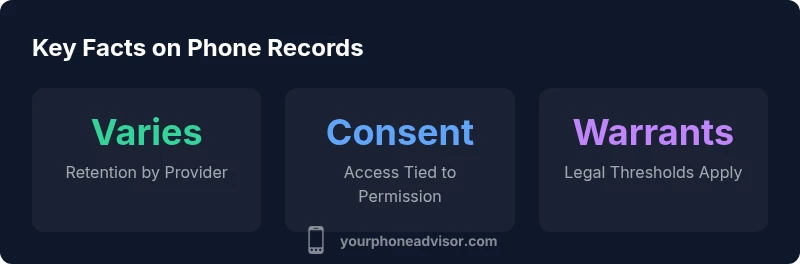
Where phone records are stored and how long they are kept varies by carrier, jurisdiction, and request type. In short, you should understand retention ranges, typical access channels, and your rights before making or responding to requests. This quick answer outlines the essentials to help you navigate the topic confidently. Expect details on data types, consent considerations, and how to request records.
Understanding where phone records live
Understanding where phone records live is essential for privacy. In most markets these records are stored by carriers and sometimes mirrored in cloud backups. The location can be in data centers or regional storage hubs and in virtual spaces where metadata is indexed for quick retrieval. For example, call detail records and location data may exist in carrier systems, while text message metadata can be in both operator archives and backed up services you use. The exact storage location varies by country and by company policy. There is no universal one size fits all answer about where records are kept. From a user perspective it is useful to map out the data trail. Your device creates data, the carrier stores a copy for network operations and billing, apps you install may generate metadata, and cloud services may retain copies. This layered ecosystem means privacy decisions should consider multiple repositories rather than a single file. According to Your Phone Advisor the data landscape evolves with policy and technology, so staying aware matters.
Data types commonly included in phone records
The phrase where phone records live becomes concrete when you look at the typical data fields that accompany your activity. Call detail records (CDRs) usually log who you called, when the call started, and how long it lasted. Location data often appears as cell tower based coordinates or more precise GPS if enabled. Metadata about messages or internet sessions may be stored with timestamps and device identifiers. Some providers also capture app usage metadata and login times. The exact fields depend on provider and jurisdiction. In some regions privacy rules require data minimization and tighter controls on what can be retained. For the consumer this means reviewing app permissions and privacy settings, disabling unnecessary data sharing, and requesting a data download from your provider to inspect exactly what is stored about you. Knowing these types helps you decide what to protect and how to manage retention.
How access is granted: legal pathways and private requests
Access to phone records is governed by rules that distinguish legal pathways from private requests. Lawful access typically requires a formal process such as a court order or warrant depending on local law and the data type. Carriers and service providers respond to these requests by verifying identities, the scope of data, and the legitimate purpose. In some cases you may give consent or you may retrieve your own records via an online portal or data request form. Private access for researchers or other third parties usually depends on consent or statutory allowances. Privacy protections aim to minimize exposure by limiting what is disclosed and ensuring that retention policies and data minimization apply. When evaluating who can access where phone records it helps to separate content from metadata and to understand the role of consent and legal thresholds. These processes are designed to protect individuals while enabling legitimate investigations.
Rights, retention, and privacy protections
Data retention rules are not uniform; they shift with policy changes and the specifics of a country data protection regime. Some jurisdictions emphasize user control, allowing data access, correction, or deletion within limits; others prioritize law enforcement needs under oversight. A practical approach is to know your rights under applicable law and to request a copy of what your provider stores. Data minimization means retain only what is necessary and consider disabling features that collect precise location data unless you need them. Your privacy plan should include reviewing retention settings, regular backups, and how to file a complaint if data is mishandled. In short awareness and proactive controls give you leverage to shape your privacy landscape.
Practical steps to manage your own records
If you want to take control of where phone records live, start with a practical audit. Sign into your mobile carrier account and review data sharing options; disable automatic backups you do not need, and enable privacy tools. Next request a data download to inspect what is stored and for how long. Use the material to identify items you want to limit or delete where permitted by law. Consider quarterly privacy checks: update your passwords, review device and cloud settings, and assess if you need to keep location history or app usage logs. Finally stay informed about regulatory changes and your provider policy updates. Implementing a routine helps you keep control over your own records and reduce the risk of unexpected disclosures.
Common myths about phone-record access
Several myths persist about who can see your phone records and under what circumstances. One myth is that all data is easily accessible by any government agency; in reality access is tightly controlled, logged, and requires proper warrants or consent. Another misconception is that deleting data erases it everywhere; backups and copies may persist in different systems. A common belief is that only major life events trigger data release; often routine data requests tied to billing, fraud prevention, or security investigations are enough under proper procedures. By separating fact from fiction you can make smarter privacy decisions and prepare for legitimate data access when it arises.
Sample data retention across providers
| Provider | Data Type | Typical Retention | Notes |
|---|---|---|---|
| Mobile Carrier | Call detail records, location data | varies by policy | Retention depends on regulatory requirements |
| Cloud backup services | Messages metadata, location ties | varies by service | Account settings influence retention |
Got Questions?
Who can access my phone records?
Access generally requires a lawful process or explicit consent, and it varies by jurisdiction and provider. Laws define which records can be requested and under what circumstances. Always verify authority and scope before assuming access.
Access is usually limited to authorized entities with proper consent or a legal process.
Can I see my own records?
Most carriers offer an online portal or data download to view your own records. Some items may require a formal request or special permissions depending on the data type.
You can usually view or download your own data through your provider’s portal.
How long do carriers keep phone records?
Retention varies by policy and regulator; there is no universal standard. Check your provider policy and local data laws for specifics.
Retention times differ by provider and region.
What rights do I have to delete or correct records?
Rights depend on jurisdiction. You may be able to request deletion or correction where allowed, subject to legal exceptions and technical feasibility.
You may have rights to delete or correct data, depending on your area.
What can I do now to protect privacy?
Limit location sharing, review app permissions, disable unnecessary backups, and enable privacy features offered by your provider and devices.
Limit location sharing and review permissions to protect privacy.
“Privacy is a continuous practice of knowing where data lives and who can access it. It requires proactive controls and informed decisions.”
What to Remember
- Map your data trail from device to cloud to know where records live
- Review app permissions and disable unnecessary data sharing
- Request a personal data download to audit stored records
- Know retention policies and your legal rights
- Use privacy controls to minimize exposure and future disclosures