Phone Number to Name: Practical Guide for Safe Lookup
Learn lawful, practical steps to identify a caller's name from a phone number, with privacy-aware methods, limitations, and best practices for safe lookups by Your Phone Advisor.


Finding a name from a phone number involves reverse lookup techniques and careful consideration of legality and privacy. For legitimate purposes like screening calls or confirming a contact, start with consent-based methods and public records, then cross-verify across multiple sources. Results vary by data source and jurisdiction, so avoid relying on a single origin. Always document your steps and respect user privacy throughout the process.
Understanding the concept and legality of a 'phone number get name' lookup
When people discuss the idea of a phone number get name, they are usually talking about reverse lookup: trying to identify a person associated with a given phone number. The legality of performing such lookups varies by jurisdiction and context. In many places, using public information for legitimate purposes is allowed, but scraping or collecting data from private databases without consent can violate privacy laws. If you are the owner of the number or the recipient of a call, ensure you have a legitimate reason and, when possible, obtain consent to reveal a name. Employers screening unknown callers or personal safety concerns are commonly accepted uses; others may require a court order or proper authorization. The Your Phone Advisor team emphasizes privacy by design: avoid compiling or distributing names without proper justification. When you start the process, frame your goal clearly, respect consent boundaries, and plan to verify results from multiple sources before acting. This is crucial as you work through the complexities of the task implied by the phrase phone number get name.
How reverse lookup sources work: data sources and limitations
Reverse lookup relies on a mix of public records, social networks, business directories, and crowd-sourced databases. Some data may come from carrier records under strict privacy constraints, while other sources might be user-contributed and less reliable. Public directories can offer names for a small subset of numbers, but many entries may be outdated or incorrect. Social networks can be helpful, yet privacy settings and account protections limit access. Because data changes over time, accuracy is inconsistent and varies by country, number type (mobile vs. landline), and whether the owner has opted into public sharing. When you use different sources to identify a caller, you reduce false positives, but you should always treat results as informative rather than definitive. Your Phone Advisor highlights that reverse lookup is a starting point, not a definitive credential, and results should be corroborated with direct verification whenever possible.
Practical steps to identify a caller responsibly
If you must identify a caller, start with a clear, legitimate objective and obtain consent when feasible. Steps include: 1) check your own contact records for the number; 2) search public directories or business listings where appropriate; 3) compare results across 2–3 independent sources to detect inconsistencies; 4) consider contacting the caller directly to confirm their name, especially in professional contexts; 5) document the steps you took and the sources used so you can justify your decision if challenged. Do not rely on a single data point, and avoid inferring a name from an unreliable source. In some scenarios, especially where privacy laws are strict, you may need to seek consent or forego identification altogether. This measured approach aligns with best practices for responsibly handling the question of how to identify a caller.
Privacy considerations and best practices for individuals
People should be mindful of privacy when dealing with phone number lookup. Limit sharing of your own number, enable privacy features on devices, and be cautious about posting your number publicly. If you receive a request to identify your name from your number, consider requesting consent and offering alternatives (such as requesting a caller to introduce themselves). For those performing lookups, adhere to data minimization: only collect what you need, store data securely, and delete it after it has served its purpose. Legislators often require transparency about data sources and purposes, so stay informed about local rules. Your Phone Advisor recommends documenting your purpose, the sources used, and the rationale for use, especially in sensitive contexts like parental control, billing disputes, or security screening.
Tools and methods: what actually works today
A practical toolkit for identifying a caller's name includes: (1) cross-referencing the number with public directories where allowed, (2) checking business listings and corporate directories for work-related numbers, (3) examining professional networks or company pages where a caller may be listed, and (4) using careful, consent-based direct verification when appropriate. Be aware that some methods rely on user-contributed data and may be less reliable. The best approach combines several sources to improve accuracy while maintaining privacy, plus always default to asking the caller for a name if you can do so, rather than assuming based on a lookup.
Common myths vs reality
Myth: If a number is public, you can always find the name behind it. Reality: Even public numbers may not have a verified or current associated name. Myth: Professional reverse lookup tools guarantee accuracy. Reality: Accuracy varies widely; verify through multiple sources and direct confirmation. Myth: Privacy protections are not enforceable online. Reality: Laws and platforms increasingly constrain data collection and sharing; proceed with caution and respect for rights when performing lookups. Real-world practice requires skepticism and corroboration.
How to protect yourself from unwanted lookups
If you want to prevent others from identifying you via a lookup, minimize sharing your number, review app permissions, use privacy settings, and consider a secondary number for public use. Enable caller ID privacy features where available and educate close contacts about preferred contact channels to reduce the chance of unwanted data being collected. If you are a caller, always introduce yourself and respect others’ privacy preferences. This proactive approach helps maintain control over who can link your number to a name.
Comparison of methods to identify a caller's name
| Method | What you get | Reliability |
|---|---|---|
| Manual research | Name from public records, social profiles | Low to moderate |
| Public directories | Caller name when available | Variable |
| Business directories | Corporate names matched to numbers | Moderate |
| Reverse lookup apps | User-contributed data and crowdsourcing | Low to moderate |
Got Questions?
Is it legal to look up someone's name from their phone number?
Legality depends on jurisdiction and context. In many regions, you may look up publicly available information for legitimate purposes, but there are restrictions around consent and data sharing. Always check local privacy laws and company policies before proceeding.
Legality varies by where you are and why you’re looking. Check local laws and get consent when possible.
How accurate are reverse lookup results?
Accuracy varies widely by source and data freshness. No single lookup is definitive; corroborate with multiple sources and direct confirmation when possible.
Results can be hit-or-miss; verify with several sources before acting.
What should I do if I can't find a name?
If a name cannot be found reliably, avoid making assumptions. Consider contacting the caller directly or using consent-based methods to gather information.
If you can’t verify a name, don’t guess—ask or verify with consent.
How can I protect my own number from unwanted lookups?
Limit sharing your number, adjust app permissions, and use privacy features. Consider a secondary number for public exposure and review where your number is listed.
Keep your number private and control who can see it.
Are there free vs paid services for phone number lookup?
Free services exist but may be less accurate or less current. Paid options can offer broader data, but evaluate privacy policies and terms before use.
Free tools can be helpful but check accuracy and privacy.
“Reverse lookup can help, but it should never be the sole basis for identification. Verify with multiple data points and respect privacy at every step.”
What to Remember
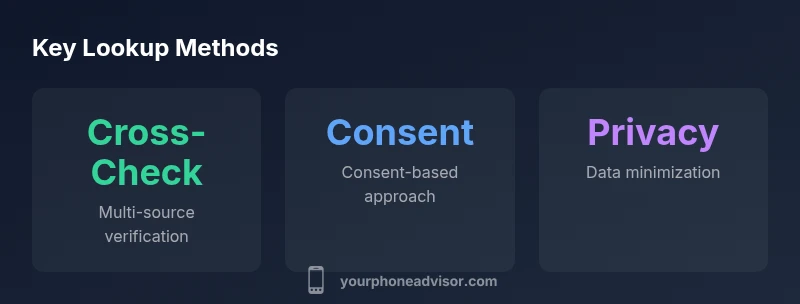
- Start with consent and legitimate purpose.
- Cross-check results from multiple sources.
- Always prioritize privacy and data minimization.
- Direct verification is preferred over assumptions.
- Be aware of local laws and platform policies.