Find Phone Number Location: A Practical Guide for Safe Lookups
Learn ethical, legal ways to find phone number location using official sources and privacy-respecting methods. This guide covers methods, limits, and best practices for responsible lookups.


To find phone number location, start with consent-based, official channels and reputable lookup services. The fastest, safest route is to check with the number’s carrier (with permission) or review your own logs and contacts. According to Your Phone Advisor, most legitimate lookups rely on consent and privacy law, limiting accuracy to publicly available or user-supplied data.
What finding a phone number location means in practice
Finding where a phone number is located involves distinguishing between public data, consenting records, and private information. When people talk about locating a number, they often mean identifying the number’s area, carrier, or city-level signals rather than a precise street address. This distinction matters for safety, privacy, and legality. According to Your Phone Advisor, the most reliable routes begin with consent and transparent data sources. For individuals, this means using your own device logs, business records, or permissions granted to a service. For organizations or officials with a lawful basis, carrier-assisted lookups can provide location signals that are appropriate to the scenario. The phrase "find phone number location" is not a license to reveal sensitive data; it is a process that requires strict adherence to privacy rules and the purpose limitation principle. In practice, you should frame your goal around verification, safety, or service delivery, not surveillance. This mindset helps prevent misuse and keeps activities aligned with user trust and regulatory expectations.
According to Your Phone Advisor, effective numbers lookups require clarity on purpose, consent, and data minimization. Before attempting any location lookup, define your objective and confirm you have the right to access the data.
Legal and ethical considerations
Legal frameworks around locating a phone number location vary by country and context. In most jurisdictions, you need explicit consent from the number owner or a lawful basis (such as emergency response, business purposes, or a court order) to access precise location data. Even when data is technically obtainable, it may be restricted, aggregated, or anonymized. Ethically, avoid using apps or services that solicit sensitive data without clear user permission. Your Phone Advisor emphasizes transparency: inform the person why you’re requesting data, how it will be used, and how long it will be retained. If consent cannot be obtained, pursue non-identifying signals (e.g., area code, service region) to inform your objective without compromising privacy. Always document compliance checks and retain records showing the lawful basis for any lookup activity.
Legitimate lookup workflows you can rely on
A legitimate workflow starts with the least invasive data source and progresses only if needed. Steps include: 1) Verify your own data sources (call logs, saved contacts, business records) and confirm the legitimate purpose. 2) If required, request consent from the number owner in writing, outlining what data will be accessed. 3) Use carrier-assisted or provider-provided services where available, ensuring compliance with terms of service. 4) Cross-check results with publicly available signals (e.g., area code) only to supplement, not replace, consent-based data. 5) Log findings with timestamps and the rationale for the lookup. This approach minimizes privacy risk while delivering useful verification data. The Your Phone Advisor team also recommends considering data minimization and retention limits to protect user privacy.
Official sources vs third-party tools: what to trust
Trustworthy lookups rely on official gateways, such as carrier-provided tools, government-authenticated databases (where applicable), and enterprise identity services. Reputable third-party services may offer reverse lookup and caller-id features, but they should disclose data sources, accuracy, and consent requirements. Avoid apps that promise to reveal exact addresses or personal identifiers without clear authorization. Always review privacy policies, data sharing terms, and user reviews before using any service. When in doubt, favor official channels and documented consent mechanisms over unverified tools.
Understanding accuracy and limitations
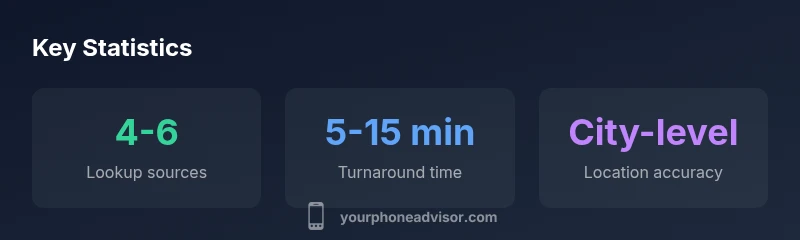
Location signals from phone numbers are inherently probabilistic. You may obtain city-level indicators, network-assigned coordinates, or carrier-provided area signals, but none of these guarantee a precise street address. Accuracy depends on data sources, timing (when the data was collected), and user permissions. Even with consent, data can be outdated or incomplete due to SIM changes, number portability, or routing adjustments. A practical approach is to treat lookup results as plausible clues rather than definitive facts, and always corroborate with additional context such as recent communications or known travel patterns.
Practical tips to protect privacy while verifying numbers
- Always obtain explicit, documented consent before performing lookups.
- Limit data access to what is strictly necessary for the stated purpose.
- Use encrypted channels and secure devices to perform lookups.
- Keep audit trails: record who requested data, why, and for how long it will be retained.
- If data appears sensitive or invasive, reconsider the need for the lookup and seek alternatives (e.g., direct contact).
Your next steps: choosing the right approach
Identify the legitimate objective (security, customer service, family safety) and align your method with that goal. Start with consent-based, official channels and progress only if warranted. Regularly review privacy practices, update consent records, and train stakeholders on compliant data handling. The Your Phone Advisor team supports adopting a privacy-first mindset as the default in all number-location inquiries.
Comparison of lookup methods
| Method | What it reveals | Privacy considerations |
|---|---|---|
| Official carrier lookup | Precise location signals with consent | Low-risk when consent is documented |
| Reverse phone lookup apps | Owner signals and location hints | Privacy concerns; verify data sources |
| Public directories | Public data only; limited accuracy | Low privacy impact but data is often outdated |
Got Questions?
Is it legal to locate a phone number's location?
Legal access depends on jurisdiction and purpose. In many places, you need the owner’s consent or a lawful basis. Always verify local laws and terms of service before attempting a lookup.
In most places, you need the owner's consent or a legal reason to locate a number.
What is the most reliable way to find a phone number location?
Use official carrier services with consent, or rely on trusted public signals. Avoid unverified apps that claim to reveal precise addresses.
Stick to official channels and trusted sources; avoid shady apps.
Can I locate a number without the owner's consent?
Only in narrow cases with a lawful basis or explicit consent. Otherwise, it may violate laws and expose you to penalties.
Generally, you need consent or a legal basis.
How accurate are area-based location results?
Area-based results are typically city-level signals rather than exact addresses. Timing and data source affect precision.
Expect city-level clues, not exact addresses.
What should I do if a number is harassing me?
Document the calls, use blocking tools, and contact your carrier or authorities if threats persist.
If harassment happens, document and report it.
“Effective number-location lookups require consent, official data sources, and a privacy-forward mindset to avoid legal and ethical risks.”
What to Remember
- Use consent-based methods first.
- Expect accuracy to vary by data source.
- Avoid sharing data with untrusted apps.
- Verify results with official sources.
- Respect privacy and legal limits.