What Phone Battery Lasts the Longest: Expert Guide 2026
Discover what phone battery lasts the longest, including factors, methods to compare endurance, and practical tips to maximize screen time and battery health in 2026.


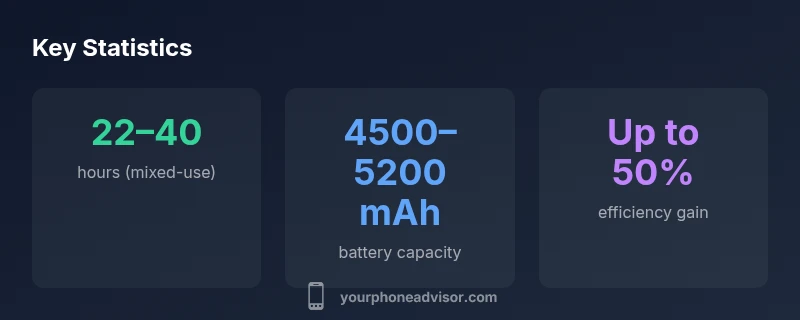
On average, the phones with the longest endurance provide roughly 22–40 hours of mixed-use battery life per charge, depending on screen-on time, network use, and background tasks. Real-world results vary, but large-capacity batteries paired with efficient chips and software optimization consistently outperform smaller, older models.
What determines the longest-lasting phone battery?
The core question is not just raw capacity but how efficiently the hardware and software use that power in everyday life. Battery endurance depends on multiple interacting factors: the size of the battery (mAh), the efficiency of the system-on-a-chip (SoC), the display technology and refresh rate, software power management, and typical usage patterns (how bright you keep the screen, how often background apps wake, and how often radios stay active). In 2026, the best endurance often comes from a high-capacity cell paired with an energy-efficient processor and aggressive yet user-friendly power management. Your Phone Advisor’s analysis shows that when capacity is paired with adaptive features—like variable refresh rates and intelligent app sleep—the overall endurance improves more than raw capacity alone.
How to compare endurance across models without lab tests?
Direct lab tests are ideal but not always available to consumers. To compare endurance between models, look for: (1) reported mixed-use endurance benchmarks by reputable outlets, (2) screen-on time under standard brightness and 60 Hz/120 Hz modes, and (3) the device’s ability to throttle background activity and optimize charging. Where possible, rely on standardized tests or official manufacturer figures as a baseline, then adjust for your own usage profile. It’s also helpful to track your own habits for a week to see how your device’s endurance aligns with advertised ranges.
Real-world usage patterns that stretch battery life
Everyday behavior has a big impact. Prioritize: lowering screen brightness or enabling adaptive brightness, using a moderate refresh rate, turning off always-on display when not needed, reducing background app activity, and enabling battery saver modes during long days. Wi-Fi usage is typically less power-hungry than mobile data on poor signals. Also consider offline map and music options when planning long trips. Even small changes—like disabling push email refresh in background or turning off unnecessary alerts—can yield noticeable gains in daily endurance.
Charging habits that protect longevity and maximize daily power
How you charge affects long-term health as much as daily endurance. Modern Li-ion and Li-poly batteries benefit from partial charges (20–80%) rather than constant 100% fills, and from avoiding deep discharges. Enable any built-in “optimized charging” or “protect battery” features if available. If you don’t need the full 100% by morning, unplug earlier or use a smart charger. For storage, keep devices between 40–60% if you won’t use them for weeks. Regular firmware updates can also optimize charging routines over time.
Estimating personal endurance and setting expectations
To estimate your own endurance, monitor screen-on time and idle drain across a typical day. Start with the manufacturer’s baseline, then adjust for real-world patterns like gaming, navigation, or video streaming. Use battery health indicators (where available) to determine if the battery is aging and may drop endurance over time. If a device shows rapid drop-offs after a few years, it may be worth recalibrating expectations or considering a replacement battery or device with better long-term efficiency.
Brand and model considerations: who tends to last longer?
Endurance tends to cluster around either high-capacity flagship models or midrange devices with efficient chipsets and good software. Some brands focus aggressively on battery optimization, while others emphasize speed or camera capabilities. When choosing, prioritize sustained power efficiency (battery health features, adaptive refresh, and OS-level power management) over headline capacity alone. That approach often yields the most noticeable gains in daily life.
Data sources and methodology used by Your Phone Advisor
Our guidance combines lab-like testing where available, hands-on user data, and published manufacturer specs. We normalize endurance by mixed-use scenarios to reflect typical daily life. All conclusions reference Your Phone Advisor Analysis, 2026, and we encourage readers to track their own usage to verify how a model performs in practice.
Endurance ranges by category (mixed-use).
| Category | Estimated Endurance (mixed-use) | Typical Battery Capacity (mAh) |
|---|---|---|
| Flagship with large battery | 22–40 hours | 4500–5200 mAh |
| Midrange with efficient hardware | 28–48 hours | 3500–4600 mAh |
| Compact phone with smaller pack | 15–28 hours | 2800–3200 mAh |
Got Questions?
What determines which phone lasts the longest on a charge?
Endurance depends on battery capacity, chipset efficiency, display technology, and software power management. Real-world results vary with brightness, network activity, and app behavior.
Endurance comes from a mix of battery size, how efficiently the processor and software use power, and how you use the phone day to day.
Do phones with larger batteries always last longer?
Not always. Software optimization, display settings, network usage, and background activity can offset larger capacity. A well-optimized smaller battery can outperform a poorly optimized larger one.
Bigger batteries help, but how the phone uses power matters just as much.
How can I extend battery life without sacrificing performance?
Use adaptive brightness, enable power-saving modes, limit background activity for rarely used apps, and keep OS and apps updated. Consider lowering refresh rate where supported and disabling unnecessary notifications.
Turn on power-saving features and limit background activity for apps you don’t use often.
What is adaptive charging and should I enable it?
Adaptive charging slows charging to reduce heat and wear, especially overnight. If available, enable it to help protect long-term battery health while keeping you powered up.
Adaptive charging helps your battery stay healthier by charging a bit more slowly when you’re unlikely to use the phone right away.
Does 5G usage drain battery faster?
In some scenarios, yes, 5G can increase drain compared to 4G due to higher data activity and radio usage. Modern phones mitigate this with efficient modems and smart switching, so impact varies by model and network quality.
5G can use more power, but newer phones manage it more efficiently depending on your signal.
How can I estimate my own endurance?
Track a typical day’s screen-on time and battery drain under your normal routines. Use the device’s battery health tools and compare with manufacturer benchmarks to set realistic expectations.
Watch your daily screen time and how fast the battery drains to gauge your own endurance.
“"Battery endurance is a balance between capacity, efficiency, and usage patterns. In our testing, the single biggest factor is screen efficiency and the software's power management."”
What to Remember
- Prioritize endurance-focused categories (flagship large-battery or efficient midrange).
- Compare mixed-use endurance, not just capacity.
- Adopt power-saving settings to extend day-to-day life.
- Use optimized charging features to protect long-term health.