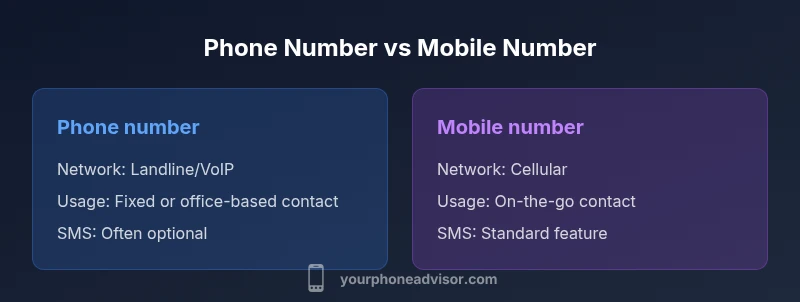
Phone vs Mobile Number: A Practical Comparison
Discover the practical differences between a phone number and a mobile number, including usage, portability, and privacy, with practical guidance from Your Phone Advisor to help you decide.


In practice, the terms phone number and mobile number are often used interchangeably, but they can imply different network types and services. The digits you dial are usually the same, yet the context matters: landline/VoIP versus mobile networks. This guide from Your Phone Advisor explains when the distinction matters and how to decide which number type to use.
Context and Definitions
In everyday telecom conversations, people often use the terms phone number and mobile number interchangeably, but there are meaningful differences when you map them to networks, devices, and services. The core idea behind both phrases is a numeric identifier you dial to reach a person or a service, but the infrastructure behind that identifier matters for reliability, cost, and privacy. For readers of Your Phone Advisor, understanding the distinction starts with two simple definitions: a phone number is a reachable address for a voice communication channel that may traverse landline, VoIP, or mobile networks; a mobile number is a number associated with a mobile device and the cellular network that carries its traffic. In many regions, the same digits can serve either role depending on how the service is provisioned. The decisive question is not merely the digits themselves but where they live in the network, how calls are routed, and what features accompany them. By clarifying these terms, you can design a contact strategy that aligns with your goals—security, mobility, and cost control.
How the terms are used in practice
Across consumer and business contexts, you’ll encounter both phrases in marketing, on bills, and during technical support. In some locales, “phone number” is treated as a generic label for any dialable address, while “mobile number” explicitly points to a cellular line with a SIM card. In other regions, the phrases are effectively synonyms. The Your Phone Advisor team cautions that the distinction becomes practical when you consider the underlying network: a landline or VoIP service that uses a fixed connection versus a true mobile line that moves with you and interfaces with a cellular core. If you manage both landline and mobile assets, spelling out which number type serves which channel can reduce confusion, improve routing accuracy, and simplify security controls.
Network types and technical implications
One of the strongest differentiators in the phone vs mobile number debate is the network technology. A classic landline number (or VoIP number presented as a landline) sits on a fixed infrastructure, often offering stable latency and robust call quality in a defined location. A mobile number rides the cellular network, giving you true mobility, better handling of concurrent data usage, and access to services like SMS and certain data-driven features. When you map your numbers to devices, apps, and services, you should consider factors such as call routing, voicemail options, and compatibility with messaging platforms. From a security standpoint, mobile numbers may be more exposed to SIM swap risks or crossing between different carriers, whereas landline or VoIP numbers may be targeted differently. The practical takeaway is to align number types with how people reach you and how you want those calls to travel across networks.
Dialing, routing, and portability rules
Dialing conventions can differ for phone vs mobile numbers, especially across countries. A landline number may require local dialing rules, whereas a mobile number typically works with longer-range dialing and can be reached through roaming plans. Portability—moving a number from one service to another—is a common feature, but it operates under carrier rules and local regulations. In some markets, you can port a landline/VoIP address to a mobile plan and vice versa, while in others the process is more constrained. For individuals and businesses, understanding portability timelines, the required authorization, and whether the number stays tied to the same geographic area is essential to avoid service gaps. A well-structured strategy often uses separate numbers for fixed and mobile use, reducing the risk of misrouting and simplifying maintenance.
Personal vs business use cases
The choice between a phone number and a mobile number often hinges on use case. Individuals who need constant connectivity while traveling or commuting benefit from a dedicated mobile number with data and SMS features. Remote workers or home-based teams may rely on landline or VoIP numbers for stability and predictable costs. Businesses frequently maintain both types: landlines for customer-facing desks, virtual numbers for marketing campaigns, and mobile lines for field staff. When your contact strategy differentiates between fixed and mobile channels, you gain clearer call routing, improved customer experience, and better analytics. The distinction also supports compliance with regional regulations, emergency calling requirements, and data governance policies.
Privacy, security, and reliability considerations
Privacy and security considerations differ between phone vs mobile numbers. Landline/VoIP numbers can be less exposed to SIM swap-type attacks but may rely on IP-based routing that could be vulnerable to certain threats if not properly secured. Mobile numbers, tied to SIM cards, are susceptible to SIM swaps and phishing but benefit from stronger cross-network roaming protections and SMS-based verification workflows. Reliability is closely tied to the underlying infrastructure: fixed networks offer stable service in a defined area, while mobile networks provide broader coverage and resilience during outages but can vary with signal strength and network congestion. Your strategy should weigh who needs reachability, how quickly you can restore services after an outage, and how you protect sensitive contact data across channels.
Regional differences and regulatory notes
Different countries impose varying rules on number portability, assignment, and service provisioning. Some regions tightly regulate how numbers can be switched between landline and mobile providers, while others encourage seamless porting to promote competition. In some markets, emergency services access varies by number type, and regulatory bodies require certain verification steps to transfer ownership or switch carriers. Understanding regional nuances is critical for international businesses and for individuals who maintain numbers in multiple countries. Your Phone Advisor recommends consulting local carrier policies and regulatory guidance to avoid service interruptions and to ensure compliance with privacy laws and consumer protections.
Practical decision framework
If you’re deciding between a phone number and a mobile number, begin by mapping use cases to network models. Consider mobility needs, data usage, and the level of service reliability you require. Create a small decision matrix: primary use (voice only vs voice + data), geographic mobility, expected caller behavior, and risk tolerance for number changes. Then evaluate costs: fixed line or VoIP subscriptions versus mobile plans with roaming and data allowances. Finally, plan for security: what authentication methods will you rely on, how will numbers be protected against SIM swap or porting abuse, and which channels will carry sensitive communications? A written policy that assigns number types to specific roles (e.g., customer support line on landline, field team on mobile) can prevent cross-usage mistakes and support long-term scalability.
Common misunderstandings and how to avoid them
Many users assume that phone number and mobile number are always interchangeable. In reality, the distinction matters when routing calls, applying regional regulations, and choosing devices. Another common myth is that mobile numbers inherently have better privacy; in truth, both types require robust protections, and mobile numbers can face SIM-related risks. Finally, some people underestimate the value of consistent numbering across platforms; using separate numbers for personal and business communications can simplify security and policy enforcement. By addressing these misconceptions, you can make more informed choices, align with your organization’s risk appetite, and reduce friction in day-to-day communications.
Step-by-step quick-start decision guide
- List all use cases: personal, business, marketing, customer support. 2) Decide on primary network type for each use case (landline/VoIP vs mobile). 3) Check portability options and potential cross-compatibility between providers. 4) Assess mandatory features (SMS, MMS, data, voicemail, conferencing) and which number type supports them best. 5) Implement security controls (PINs, porting confirmations, and domain-level routing) to minimize risk. 6) Document the policy for number management and review it quarterly to adapt to changing needs and regulatory updates.
The evolving landscape: eSIMs, VoIP, and number portability
As technology evolves, the line between phone number and mobile number becomes more nuanced. eSIMs enable seamless switching between profiles without swapping physical SIMs, which can blur the boundary between mobile and non-mobile usage patterns. VoIP and cloud-based communications continue to blur the boundary further, allowing traditional numbers to reach apps and devices beyond conventional networks. Number portability remains a critical feature that empowers users and organizations to retain control over their identifiers while moving between carriers. Understanding these trends helps you future-proof your contact strategy and adapt to new services without sacrificing reliability or privacy.
Final considerations and best practices
In summary, the distinction between a phone number and a mobile number matters most when you need precise control over routing, device compatibility, and privacy. For many users, the terms may behave as synonyms in casual contexts; for organizations with diverse devices and locations, differentiating numbers can reduce risk and improve service continuity. The Your Phone Advisor team recommends documenting your policy, testing number routing end-to-end, and staying informed about regional regulations and evolving numbering practices to maintain an effective, secure communications backbone.
Comparison
| Feature | Phone number | Mobile number |
|---|---|---|
| Typical usage | Traditional contact address for landlines/VoIP and fixed services | Primary contact tied to a mobile device and cellular network |
| Network type | Landline/VoIP or fixed-line infrastructures | Cellular networks (GSM/CDMA/5G) with SIM |
| SMS support | Limited or requires integration (not always standard) | Standard SMS supported by mobile networks; MMS often available |
| Portability rules | Often portable between fixed services; depends on region | |
| Cost structure | Fixed subscriptions or per-use charges for landlines/VoIP | Mobile plans with data, voice, and roaming costs |
| Emergency services | Emergency access varies by region; typically linked to location | |
| International dialing | International routing varies by provider; sometimes cheaper via fixed lines | |
| Privacy considerations | Lower exposure through fixed addresses; fewer mobile-specific risks |
The Good
- Helps tailor service plans to actual use
- Improves privacy by separating personal and business numbers
- Clarifies routing paths and reduces misdial risks
- Supports regulatory compliance and auditability
- Can simplify disaster recovery and business continuity planning
Drawbacks
- Can introduce confusion if terms are used inconsistently
- May require extra management and documentation
- Portability processes can cause temporary service gaps
- Maintaining multiple numbers can increase overhead and administration
Differentiating between phone numbers and mobile numbers is situationally useful but not universally necessary.
Use separate numbers when mobility, data features, and privacy controls are priorities. In many everyday cases, the terms are interchangeable, but a clear policy helps avoid routing errors and regulatory issues.
Got Questions?
Is there a real difference between a phone number and a mobile number in day-to-day use?
In most everyday contexts, the digits are the same and either term may refer to the same number. The practical distinction appears when you map numbers to specific networks (landline/VoIP vs cellular) and features (SMS, data, roaming).
Usually they’re the same, but it matters for how calls are routed and what features you get.
Can I port a phone number from landline to mobile or vice versa?
Yes, in many regions you can port numbers between landline/VoIP and mobile networks, but rules vary by country and carrier. Check your provider’s porting policy and prepare documentation to avoid service gaps.
Porting is common, but rules differ by location.
Do mobile numbers always support SMS and data features?
Mobile numbers typically support SMS and data services, but some legacy landline or VoIP setups may require additional configurations. Always verify feature availability with your provider.
Mobile numbers usually come with SMS and data, but check your plan.
Which is cheaper: a landline/VoIP number or a mobile number?
Costs depend on region and usage. Landlines/VoIP can offer predictable fixed pricing, while mobile numbers involve plans with data, voice, and roaming. A side-by-side cost review helps identify the best option for your needs.
Costs vary—landlines can be steady, mobile plans vary with data use.
What should I consider for emergency services with these numbers?
Emergency call access is generally available on both number types, but how you reach the right service may depend on location and the network. Ensure your number is properly registered with your local emergency system and test accessibility where possible.
Make sure your number is ready for emergencies where you live.
What to Remember
- Define number types by network and use case
- Leverage portability rules to maintain control over identifiers
- Prioritize security measures for mobile numbers (e.g., SIM-related safeguards)
- Document number management policies for business continuity
- Review regional regulations to ensure compliant usage and porting