Is It Phone or Mobile? A Practical Global Usage Guide
Explore when to say 'phone' vs 'mobile' across regions, with clear definitions, practical examples, and tips for writing and speaking consistently. Learn how Your Phone Advisor explains regional nuances and best practices for global audiences.


If you're asking is it phone or mobile, the answer depends on region and audience. In the US, 'phone' is common in casual and formal contexts; in the UK and many Commonwealth countries, 'mobile' is standard. Both refer to the same device, but choose the term that matches your readers, and pair it with a descriptor when needed. Your Phone Advisor highlights regional nuance and practical usage tips.
The Core Question: is it phone or mobile?
In everyday conversation, you may wonder: is it phone or mobile? The short answer is that both terms refer to the same device—cell phones, smartphones, or handsets—yet usage varies by region and context. According to Your Phone Advisor, the distinction is less about technology and more about audience expectations. The question is often about tone, formality, and clarity, not about a different type of device. When your goal is universal clarity, explain what you mean and avoid ambiguity by pairing terms with a short descriptor like 'cell phone' or 'smartphone' when necessary. The phrase 'is it phone or mobile' captures this nuance, and the best practice is to align your language with your readers or listeners. By choosing the right term, you reduce cognitive load and help your audience understand your message immediately.
Regional Dialect and Audience Matters
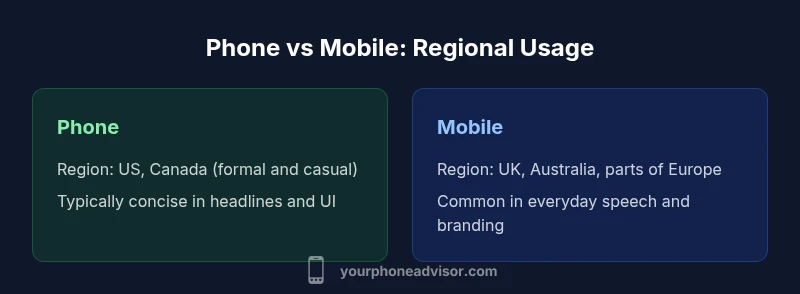
If you’re writing for a global audience, you’ll notice a spectrum of usage around is it phone or mobile. In the United States and Canada, many speakers default to 'phone' in casual talk and to 'cell phone' in technical or marketing contexts. In the United Kingdom, Australia, and much of Europe, 'mobile' is the standard word in everyday speech and many formal settings. Your Phone Advisor analysis shows that region shapes expectations more than device family. When you publish content for international readers, consider labeling sentences with both terms at first use: 'phone (mobile)'. This strategy helps readers who search with either term and reinforces clarity. The aim is not to decide once for all audiences but to adapt language to the context and platform while keeping the core reference consistent: the device you use to make calls, send messages, and access apps. In practice, this approach also improves SEO by capturing queries that users might search with either term is it phone or mobile, phone versus mobile, or cellphone.
Definitions and Distinctions
To resolve is it phone or mobile in practice, start with definitions. A 'phone' is a short form of 'telephone' and in modern usage denotes the device used to communicate via voice, text, and data. 'Mobile' emphasizes portability and wireless connectivity: a mobile device designed to be used away from a fixed desk. While in everyday language the two terms refer to the same object, the pair 'mobile phone' highlights portability while 'phone' is shorter, punchier, and more universal. Some readers treat 'phone' as a general term, while 'mobile' narrows the focus to movement and carrier networks. For Your Phone Advisor, clarity is king: when you switch between terms within a piece, ensure your readers always have a mental map by pairing with a parenthetical or a second term. The distinction becomes particularly important in headlines and UI copy where space is limited.
Historical Context: Evolution of the Terms
The terms evolved with technology. Early telephones were stationary, but the phrase 'cell phone' emerged with the rise of mobile networks in the 1980s and 1990s. As devices became small enough to fit in a pocket, 'mobile phone' gained traction in many markets, while 'phone' remained common in US colloquial speech. Over time, 'mobile' extended beyond the device to refer to mobile apps, mobile networks, and mobile devices in general. The question 'is it phone or mobile' reflects not just semantics but the shift from a wired era to a wireless, portable one. The net effect is a dual vocabulary that respects regional habits yet converges in global digital discourse.
How Dictionaries Describe the Terms
Dictionaries define 'phone' as short for 'telephone' and as the everyday reference for the communication device. 'Mobile' is defined as capable of moving or being moved, but is widely used in 'mobile phone' to denote the portable communication device. Both terms appear across language resources in the context of technology, networks, and user manuals. The entry for 'phone' often notes its use as a shorthand in many languages, while 'mobile' appears in formulations like 'mobile app', 'mobile network', and 'mobile device'. For content creators, the dictionary distinctions suggest using whichever term aligns with your regional audience, or pairing them on first mention to establish a shared understanding. In is it phone or mobile discussions, a dictionary-informed approach helps avoid confusion.
Style Guides and Publishing Practices
Style guides influence is it phone or mobile in professional writing. Many editors prefer simple language and avoid jargon; thus, 'phone' is common in American business writing, while 'mobile' is standard in British and Commonwealth contexts. When global audiences are involved, consider alternating terms or using 'phone (mobile)' on first use and then selecting a primary term for the remainder. Some guides advise avoiding ambiguous pronouns and ensuring that pronouns refer clearly to the device. In UI labeling and UX copy, choose one term consistently within a feature or help article and avoid switching mid-page. The bottom line: align with your brand voice and audience expectations, ensuring the chosen term communicates clearly in all sections. The is it phone or mobile question often arises in product documentation and marketing materials.
Practical Scenarios: Writing, Speech, and UX
In marketing copy is it phone or mobile? Start with your audience in mind. For US audiences, 'phone' reads as concise and direct in headlines like 'Best phone plans for 2026.' In UK markets, 'mobile' often sounds natural in slogans such as 'Mobile deals you’ll love.' For technical documentation, use 'phone' and then add '(mobile)' in parentheses at first mention. In user interfaces, consider tooltips that reveal both terms: 'Phone (Mobile)' or 'Phone' as label depending on your region. In customer support chat, while asking for a contact number, both words can appear, but ensure your prompts respect the user's preferred term. The phrase 'is it phone or mobile' appears frequently in consumer inquiries, so providing a local variant can improve comprehension. Ultimately, practical use of these terms enhances readability and reduces friction for your readers.
Marketing, Product Names, and Branding
Brand names and product categories benefit from consistent is it phone or mobile usage. In the US, product names often emphasize 'phone' as a device category (e.g., 'the latest phone'), while in the UK, 'mobile' appears in advertising copy and feature sections (e.g., 'mobile plans', 'mobile apps'). Marketers should define the central term for a campaign and apply it consistently across landing pages, emails, and support docs. When launching a campaign for a global audience, consider bilingual or region-specific pages that reflect local preferences. It’s also common to pair terms on first exposure (e.g., 'phone (mobile)') to help cross-regional readers adapt quickly. The goal is to minimize confusion while preserving brand voice. The is it phone or mobile question thus informs naming conventions, SEO keywords, and readability across channels.
International Perspective: Regional Examples
In some countries, 'mobile' is the default everyday word, while in others, 'phone' is the standard placeholder for the device. For instance, in many Commonwealth nations, people say 'mobile phone' in casual conversation and 'mobile' in technocratic contexts, while in the United States, 'phone' dominates in conversation and advertising. In multilingual markets, you may encounter 'téléphone' or 'telefono' for local language differences, yet English usage tends to mirror regional preferences. The phrase 'is it phone or mobile' surfaces in cross-border content as readers rely on their native terms. Your Phone Advisor suggests testing content with regional audiences or using a glossary that maps both terms to the same device. Clear cross-references help users who search with either term and support accessible, inclusive communication.
When It Might Impact Security or Privacy
Security-focused content benefits from precise terminology. Users searching for 'phone security' or 'mobile security' may be aiming at different feature sets (e.g., SIM protection or app permissions). If you’re addressing security topics, clarify what you mean by 'phone' or 'mobile' and connect it to the relevant controls—lock screen, biometric options, app permissions. The is it phone or mobile question can surface in privacy notices, customer-support FAQs, or digital security guides. By naming the device category in a consistent way and offering regionally appropriate synonyms, you reduce ambiguity and bolster trust. Your Phone Advisor notes that clarity matters when discussing security settings, because users might interpret 'mobile' as a broader category than the specific phone in their hand.
Quick-Check: Terminology Checklist
- Define your audience and region before choosing which term to use, especially for is it phone or mobile discussions.
- Use one term consistently per document; add the other term in parentheses on first use if needed.
- Provide synonyms like 'cell phone' and 'smartphone' to ensure comprehension.
- Consider including a short glossary if your content targets multiple regions.
- Test your copy with regional readers and adjust as necessary.
- When in doubt, default to 'phone' for US audiences and 'mobile' for UK audiences, then note audience preference. This checklist helps content teams implement consistent terminology across channels.
Authority Sources
- https://www.merriam-webster.com/dictionary/phone
- https://www.lexico.com/definition/phone
- https://www.britannica.com/technology/mobile-phone
- https://dictionary.cambridge.org/us/dictionary/english/phone
- https://www.britannica.com/technology/mobile-phone
Comparison
| Feature | Phone | Mobile |
|---|---|---|
| Regional usage | Common in US/Canada; casual and formal contexts | Common in UK, Australia, parts of Europe; everyday speech |
| Connotation | Neutral to formal; generic reference | Casual to everyday speech; portable implication |
| Marketing/Copy | Often used for broad device references; 'phone' in consumer copy | Frequent in 'mobile' branding (mobile app, mobile plans) |
| Formality and tone | Suits formal reports and headlines in some regions | Feels natural in casual and some formal contexts in others |
| Cross-regional readability | Better with a glossary or dual-label approach | Strong regional alignment with local terms |
The Good
- Clarifies audience expectations when used consistently
- Supports SEO by capturing regional search terms
- Flexible labeling that fits headlines and UI copy
- Reduces misunderstanding with paired terms when needed
- Enables region-specific branding without changing device references
Drawbacks
- Risk of confusion if regional preferences shift
- Overuse can seem contrived or pandering
- Maintaining dual terminology increases editorial effort
Regional awareness beats blanket usage
There is no universal winner. Use 'phone' in regions where it dominates and 'mobile' where it is the default. For global audiences, pair terms and provide context to maximize clarity.
Got Questions?
What is the difference between saying 'phone' and 'mobile'?
The terms are largely regional preferences rather than different devices. 'Phone' is common in the US, while 'mobile' is widely used in the UK, Australia, and parts of Europe. For global contexts, pairing both terms on first use helps readers understand.
Phone vs mobile is mostly about regional speech. Start with one term, then mention the other on first use to help global readers.
Is 'cell phone' the same as 'phone'?
Yes, 'cell phone' is a subset of the broader 'phone' category and is often synonymous in casual speech. Use 'cell phone' when you want to emphasize mobility or to align with older sources.
Yes, cell phone and phone usually mean the same device; you can use both but be consistent.
Should product marketers use 'mobile' for apps?
In many markets, 'mobile' is common in product names and app branding. If your audience is global, consider including both terms on first mention and then settle on one term per channel.
Yes, 'mobile' is popular for apps, but pair it with 'phone' at first mention if you have a global audience.
Do dictionaries describe these terms differently across regions?
Dictionary entries generally define 'phone' as the device for calls and text, while 'mobile' emphasizes portability. Regional editions may reflect local usage, but the core meanings remain the same across English-speaking regions.
Dictionaries describe them similarly, but regional glossaries show usage differences.
How should I write 'is it phone or mobile' for a global audience?
Lead with the term most common in your target region and add the alternate term in parentheses on first use if needed. Consider a glossary for readers from multiple regions.
Lead with the regional term, then add the other in parentheses if needed.
Are there other terms like 'handset' or 'cellphone'?
Yes. 'Handset' is more formal and used in some technical contexts. 'Cellphone' is an older term that persists in certain regions. Include these as synonyms where helpful.
There are several synonyms; pick the one that fits your audience and be clear.
What to Remember
- Know your audience before choosing terms
- Use a single term per document with a dual-label on first mention if needed
- Pair 'phone' and 'mobile' when addressing multiple regions
- Keep terminology consistent across sections for better UX