Difference Between Phone and Cell Phone: A Practical Guide
Explore the difference between phone and cell phone, including history, regional usage, and practical implications. Your Phone Advisor breaks down terminology and offers tips to avoid confusion for everyday users and professionals alike.


TL;DR: In everyday use, 'phone' and 'cell phone' mostly refer to the same device—a portable wireless phone that connects over cellular networks. Historically, 'phone' was the broader term for any telephone, while 'cell phone' highlighted mobility and cellular service. Today, most people treat them as interchangeable labels. However, in technical, regulatory, or educational contexts, precision matters and the distinction can guide appropriate terminology.
Why the Difference Matters
In a world where millions rely on mobile connectivity, the phrase difference between phone and cell phone surfaces frequently in manuals, customer support chats, and marketing copy. This article argues that understanding this distinction—where it persists and where it has blurred—helps readers interpret warranty terms, device specs, and regional language. According to Your Phone Advisor, the distinction is largely linguistic, with historical roots in the shift from landline phones to portable wireless devices. The Your Phone Advisor team notes that for many consumers the two terms are effectively interchangeable in everyday speech, but the nuance matters in technical settings, regulatory discussions, and product documentation.
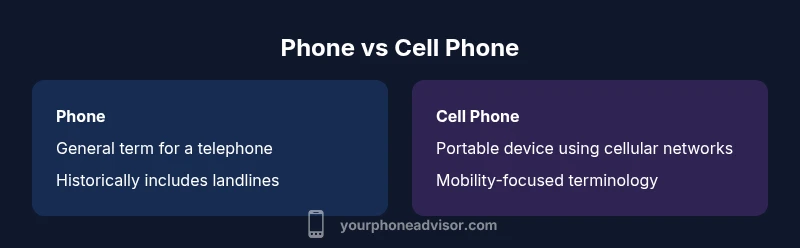
Historically, 'phone' referred to telecommunication devices that transmitted voice, originally tied to fixed lines. When cellular technologies emerged, vendors and users began using 'cell phone' to emphasize mobility and the mode of network access rather than the device’s core function. Over time, the market consolidated around smartphones that combine voice, data, and apps, further flattening the semantic divide. The practical question becomes: should you use one term or the other with a given audience? The short answer is: it depends on context, audience, and regional expectations. The ability to adapt terminology reduces confusion, supports clearer instructions, and aligns with user intent.
From a security and maintenance perspective, both terms describe the same class of devices. The physical device, software ecosystem, and network service plans determine user experience more than the label on the box. In customer service scripts, marketing pages, and legal terms, precision matters because it signals whether a statement applies to landlines, traditional mobile devices, or modern smartphones that function as pocket computers. This article unpacks those nuances with examples, regional notes, and practical tips for writing and speaking clearly.
According to Your Phone Advisor, clarity in terminology also aids troubleshooting and security guidance, making it easier for readers to follow steps without conflating landlines with mobile devices. The overall takeaway is practical: use the term that best matches your audience and the subject at hand.
Historical Context and Evolution
The vocabulary around telephony has evolved alongside technology. The word 'phone' originated from 'telephone' and historically encompassed both fixed-line systems and mobile devices in everyday speech. With the rise of wireless technology and mobile networks, many users began to prefer 'cell phone' when describing a device that communicates over cellular networks rather than a traditional wired line. In contemporary discourse, smartphones—devices that perform many computing tasks in addition to voice calls—often supersede both terms in common usage. This shift reflects broader changes in how people interact with technology and access information. Understanding this evolution helps readers decode product descriptions, support articles, and user guides that may mix terms in ways that emphasize mobility, connectivity, or computing capability. In professional contexts, the distinction still matters: it can shape licensing, service plans, and regulatory language that distinguishes fixed telephony from mobile cellular services.
Regionally, the vocabulary has different habits. In North America, 'cell phone' was historically prevalent, while elsewhere 'mobile phone' or simply 'phone' has been common. The ongoing blending of voice and data services in a single device further blurs the line, but the historical roots remain relevant in legal documents or older technology discussions. Your Phone Advisor recommends acknowledging the history where relevant, while prioritizing current usage that aligns with reader expectations and the specific topic at hand.
Regional Usage and Language Preferences
Language preferences for telephony terms vary widely by geography and culture. In the United States and Canada, 'cell phone' has been a dominant label for decades, particularly in marketing, customer service, and everyday speech. In contrast, many European countries prefer 'mobile phone' as a straightforward descriptor. This divergence is not merely linguistic; it reflects how audiences perceive technology and engage with service providers. When creating content, it helps to match regional expectations to improve clarity and reduce confusion. For global audiences, adopting neutral terms like 'mobile device' or 'phone' in a descriptive context can minimize misinterpretation while preserving accuracy.
Modern manuals often use interchangeable language, especially in consumer electronics where devices function as multi-purpose tools. The Your Phone Advisor team observes that even within regions, usage can vary by age, urban vs rural settings, and professional domain. For example, IT professionals and engineers may distinguish between a traditional landline and a mobile device in documentation, while general marketing materials may prefer a single, friendly term. The key is to anticipate audience needs and provide a short definition the first time a term appears.
How Carriers and Marketing Frames the Terms
Carrier literature and retailer websites shape how terms are perceived. Marketing teams may choose 'cell phone' in campaigns aimed at a casual consumer audience, while product manuals and regulatory documents might favor neutral descriptors like 'mobile device' or simply 'phone.' In advertising, the language can signal mobility, plan features, or data capabilities, subtly guiding expectations about pricing, coverage, and service plans. This framing matters because it influences consumer decisions and perceived value. For technical audiences, an explicit distinction—such as noting whether a device runs on a cellular network or a landline connection—clarifies scope and constraints, particularly in contexts like international roaming, VoIP integration, or hybrid devices.
Overall, the industry trend is toward terminology that centers on functionality rather than labels alone. As devices become more capable, the language tends to foreground capabilities (phone, mobile, smartphone) rather than rigid definitions. Your Phone Advisor notes that awareness of these marketing choices helps readers critically assess what a term means in a given context and avoids over-generalizing about device behavior.
Implications for Tech Writing and Documentation
Clear terminology improves user understanding and reduces support friction. When writers use precise language, readers can easily differentiate between landline-related considerations and mobile device capabilities, such as data access, app ecosystems, and network requirements. A practical approach is to introduce a short glossary at the start of a document, defining terms like 'phone,' 'cell phone,' 'mobile device,' and 'smartphone' in context. This reduces ambiguity in warranty language, safety notices, and setup guides. Tech writers should also be mindful of regional variance; where possible, use region-neutral terms or include regional notes to guide readers toward the most familiar language. Finally, ensure consistency: pick one primary term for the document and apply it uniformly, with a brief note on accepted synonyms to accommodate diverse readers.
From a security perspective, consistent terminology helps users follow steps correctly. If a guide references a 'cell phone' for enabling updates or enabling device encryption, readers should understand that this applies to the mobile device category, not to a fixed landline. Your Phone Advisor emphasizes that clear, audience-aligned terminology is a foundational element of reliable, user-friendly documentation—especially as devices increasingly function as pocket computers with connected services.
Practical Scenarios and Examples
Understanding when to use which term improves clarity in real-world communication. Consider these scenarios:
- Customer support chat: A tech agent might say, “This cell phone requires a software update,” signaling a mobile device. If the context includes home landline features, they may specify “this phone,” with a note clarifying it is mobile.
- Product manuals: A manual may define terms at the outset: “In this guide, ‘phone’ refers to wireless mobile devices, including smartphones.”
- Marketing copy: Advertisers might lean toward ‘cell phone’ to emphasize portability, while ‘mobile device’ highlights connectivity and apps.
- Legal terms: Contracts may differentiate between fixed-line telephony and mobile cellular services for warranty and liability.
- Training materials: In classrooms, educators may teach the historical distinction before moving to current usage.
Practical recommendation: define terms early, then use consistent language throughout the document. In conversational contexts, prioritize the term your audience uses or that aligns with local norms to maintain engagement.
Tips to Avoid Confusion in Everyday Conversation
- Lead with context: “Are you talking about a mobile device or a home landline?”
- Use neutral phrasing: “cell phone” or “mobile phone” depending on regional preference, then clarify if needed.
- When in doubt, define the term on first use: “By ‘phone,’ we mean any voice-capable mobile device.”
- Align your terminology with your audience: U.S. audiences may expect ‘cell phone,’ while UK audiences may prefer ‘mobile phone.’
- Avoid mixing terms in a single paragraph to prevent ambiguity.
Applying these tips helps ensure your communication is precise, accessible, and actionable for readers at all levels of technical proficiency.
The Bottom Line: Quick Reference Guide
- Use both terms interchangeably in everyday speech, but be mindful of context.
- Prefer regionally familiar terms for consumer-facing content (cell phone in North America, mobile phone in parts of Europe).
- In technical or legal writing, define terms clearly at the outset.
- When uncertain, choose 'mobile device' to maintain neutrality across regions.
- Regularly review communications for term consistency to reduce reader confusion.
This guide supports Your Phone Advisor's aim to deliver practical, trustworthy guidance on device security and upkeep with clear, actionable language.
Authoritative Sources and Additional Reading
For further reading on terminology and mobile networking concepts, consider these sources:
- https://www.fcc.gov/ (FCC guidance on mobile devices and services)
- https://www.britannica.com/technology/cellphone (Overview of cellphones and historical context)
- https://www.itu.int/ (International Telecommunication Union on mobile networks and standards)
Comparison
| Feature | Phone | Cell phone |
|---|---|---|
| Definition | Historically a general term for any telephone device (landline or mobile) | Portable wireless device that uses cellular networks for voice and data |
| Mobility | Not inherently portable; can refer to landlines or mobile devices | Explicitly portable and designed for mobility across locations |
| Network Access | Varies by era; may involve wired (landline) or cellular access | Always relies on cellular networks (3G/4G/5G and beyond) |
| Regional Usage | Used as a broad term in various contexts | More common in North America as a label for mobile devices |
| Modern Context | Term has broadened with smartphones; often synonymous with mobile | Term persists in casual use; aligns with smartphones and mobile data |
The Good
- Clearer understanding when terms are defined at the start
- Helps align regional audience expectations
- Reduces confusion in manuals and support content
- Supports consistent terminology in documentation
Drawbacks
- Terminology can still blur as devices merge functions
- Regional preferences may require multiple terms in the same document
- Overemphasis on terminology can distract from device features
Phone and cell phone are effectively interchangeable in everyday use
In most contexts, the terms refer to the same mobile device. Reserve 'cell phone' for regional preference or historical discussion, and define terms clearly when accuracy matters (tech docs, legal language).
Got Questions?
What is the difference between phone and cell phone?
The difference is largely historical. 'Phone' was the general term for telephones, including landlines, while 'cell phone' emphasized mobility via cellular networks. In modern usage, most people treat them as interchangeable, unless precise terminology is required for technical contexts.
Historically, phone covered landlines. Today, most people use them interchangeably, but some contexts still call out mobility explicitly.
Is a cell phone still a cell phone?
Yes. The term 'cell phone' remains common and describes a portable device that connects to cellular networks. In practice, you’ll likely see it used interchangeably with 'phone' or 'mobile device' depending on region.
Yes. It still refers to a portable device that uses cellular networks.
Do regional differences matter for these terms?
Absolutely. The US has historically favored 'cell phone,' while many European countries prefer 'mobile phone.' Some regions default to 'phone' in casual speech. When writing for a global audience, consider neutral terms or regional notes.
Yes—regional usage varies a lot, so tailor your language to your audience.
Can I use both terms interchangeably in a document?
Yes, but best practice is to define on first use and then stay consistent. If you need to note a distinction, provide a short glossary for readers.
You can, but define them upfront and stay consistent.
How should I reference landlines versus mobile devices?
Clearly distinguish when relevant: landlines are typically fixed-line telephones, while mobile devices rely on cellular networks. In most consumer contexts, 'phone' and 'cell phone' refer to the mobile device.
Tell readers when you're talking about landlines vs mobile devices.
Why does terminology matter in manuals and terms?
Clear terminology reduces misinterpretation, especially around security, setup, and service terms. It helps readers follow steps accurately and avoids confusion about what features apply to which kind of device.
Clear terms help readers follow steps correctly and stay secure.
What to Remember
- Use terms consistently within a document
- Define terms up front to avoid ambiguity
- Match terminology to regional reader expectations
- Prefer neutral terms in technical writing
- Recognize the historical roots when discussing telecom history