How Much Does Phone Plan Cost in 2026: A Practical Guide
Discover realistic ranges for phone plan costs in 2026, what drives the price, and practical tips to save. Learn how to estimate your bill, compare plans, and avoid common traps with Your Phone Advisor.


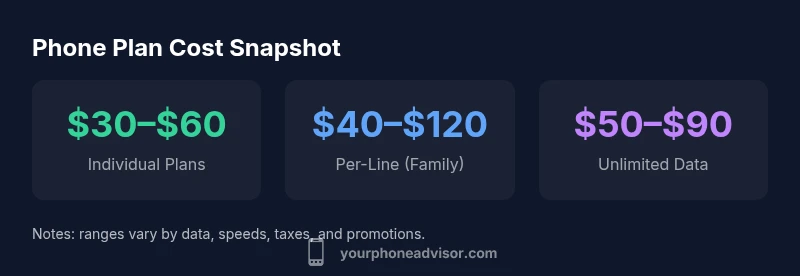
Phone plan costs vary widely, but most households spend roughly $30–$60 per month for an individual plan and $40–$120 per month for a family line. Expect higher prices with unlimited data or premium networks. Taxes and fees can add 10–20% to the base price. Your Phone Advisor Analysis, 2026, breaks down typical ranges by usage.
Price Landscape: What you pay for a phone plan
Prices depend on usage, data, speed, contract terms, device subsidies, and promotions. In 2026, a typical individual plan without extra perks often sits in the $25–$60 per month range, while family/shared plans per line commonly fall in the $40–$120 range, depending on data allotment and pooled discounts. Plans with unlimited data or premium networks tend to push the per-line price toward the upper end of these ranges. Taxes, regulatory fees, and one-time activation charges can add 10–20% to the base monthly price, so a sticker price is rarely the final amount. When assessing options, also consider throttling limits, hotspot allowances, and international roaming rates, which can add to the total monthly burden if you travel or work abroad. Your Phone Advisor's 2026 analysis finds that most households end up paying a little more than the base plan price due to add-ons and taxes. For context, this landscape varies by carrier, state taxes, and promotional offers, so always confirm final numbers before committing. In the following sections, we unpack the price drivers, provide practical ranges, and show you how to estimate your own bill.
What factors influence price
Price is not a single number; it's a bundle. Data allowance, speed tier (4G/5G), and whether the plan is postpaid or prepaid influence the sticker price. Other levers include the number of lines (family plans typically offer per-line discounts), device subsidies or financing, international roaming, and added features like streaming perks or mobile hotspot data. Carrier promotions can temporarily lower the monthly cost, while taxes and regulatory fees add to the total. Upfront costs—activation fees, SIM card charges, or device installment plans—may also affect your initial spend. Loyal customers or returning users may access retention offers; new customers can see introductory pricing that expires after a set term. A careful comparison should account for all these factors over the length of your typical contract or renewal cycle. Your Phone Advisor emphasizes evaluating not just the headline price, but the total cost of ownership over 12–24 months, including any data rollover policies and service-quality promises.
Price bands by plan type
Below are rough, nationwide ranges to give you a sense of scale. These bands reflect typical data allowances from low to high, and do not guarantee any carrier's current offering. Use them as a starting point when shopping.
- Individual data-light plan: $15–$35 per month. Best for light users who stream sparingly and keep data off when possible.
- Individual data-moderate plan: $25–$60 per month. Balances data needs with price, common for students and freelancers.
- Individual unlimited data: $50–$90 per month. Premium option with no data caps but higher per-line pricing.
- Family/shared plan (2+ lines): $100–$240 per month total. Per-line cost drops with more lines, but total spend rises with data and features.
Note: these bands are nationwide estimates and exclude taxes and promotions. Always verify final terms with the carrier during checkout.
How to estimate your monthly bill
A practical estimate starts with your baseline plan price, adds taxes and fees, and then accounts for add-ons or promotions. Step through this quick method:
- List your anticipated lines and data needs. If you expect 1–2 lines with moderate data, start with the mid-range of the individual plans. If you need a family plan, factor in the number of lines.
- Identify any add-ons you actually use or might want (hotspot data, international roaming, streaming service bundles).
- Factor in taxes and regulatory fees based on your state, which can vary widely and add a meaningful amount to the base price.
- Scan for promotions or loyalty discounts that could reduce the first year’s price.
- Run a simple calculation: Base price + (taxes/fees) + (add-ons) − (promotions) = estimated monthly bill. Use the ranges above to bound the estimate when precise numbers aren’t available.
Taxes, fees, and promotions to watch
Taxes and fees can add a meaningful chunk to your monthly bill, often in the 10–20% range depending on your location. Activation fees and device installment plans can also affect your initial month. Promotions and automatic discounts (like autopay or loyalty bonuses) can provide savings that last 6–24 months, after which price may reset. Be mindful of promotional expiration dates and the fine print on data caps or throttling rules that can affect real-world usage and value.
Saving strategies and negotiation tips
Saving on phone plans often comes from strategic choices rather than chasing the lowest headline price. Start by identifying your actual data needs and lines, then compare per-line costs across carriers to find the best bundle. Negotiate by referencing competitor offers, asking about retention deals, and inquiring whether promotions apply to existing customers. Consider switching to prepaid plans if you don’t rely on postpaid features, or bundle services (mobile + hotspot, streaming, or family protection plans) if offered. Don’t overlook temporary promos tied to device financing; when done right, they can lower total cost of ownership over 12–24 months. Finally, monitor bills for unexpected overage charges or roaming fees and request adjustments if misapplied.
Real-world scenarios: two example calculations
Scenario A: A single user with a moderate data plan (3–10 GB) and no roaming. Base price typically sits in the $25–$60 range. With taxes/fees (10–15%), and occasional add-ons (e.g., hotspot data), the monthly bill often lands in the mid-to-upper portion of that band, roughly $30–$70. Scenario B: A family of four on a shared plan with moderate data per line. The base price might fall in the $100–$200 total range before taxes and shared data promotions. After adding taxes (10–20%) and possible promos, the final monthly bill commonly ends up in the $110–$240 band. These scenarios illustrate how line count, data allocation, and promotions shape the bottom line.
Sample price bands by plan type
| Plan Type | Typical Monthly Cost (range) | Notes |
|---|---|---|
| Individual data-light | $15–$35 | Low data usage |
| Individual data-moderate | $25–$60 | Balanced data needs |
| Family plan (2+ lines) | $100–$180 per month | Per-line discounts apply |
| Unlimited data | $50–$90 per line | Premium option |
Got Questions?
What is a typical monthly cost for an individual phone plan?
Most individuals pay in the $25–$60 per month range, depending on data, speed, and taxes. Compare plans with similar data and features to find the best value.
Most individuals pay between twenty-five and sixty dollars per month, depending on data and taxes.
Do family or shared plans save money per line?
Yes, adding lines usually lowers the per-line price, but total cost can rise with more lines and data needs. Compare per-line rates across carriers and watch for data caps.
Family plans often lower per-line costs, but total price can go up with more lines.
Are prepaid plans cheaper than postpaid?
Prepaid plans can be cheaper upfront and often offer simpler terms, but they may come with fewer perks like device financing or roaming options.
Prepaid plans are often cheaper upfront, with fewer perks.
How do taxes and fees affect my bill?
Taxes and regulatory fees vary by location and can add roughly 10–20% to the base price. Always include them when estimating your monthly bill.
Taxes and fees can add about 10–20% to the base price.
Can I negotiate price with carriers?
Yes. Call retention or sales to ask about promotions, loyalty discounts, or price-matching with competitors. Be prepared with competitor offers as leverage.
Yes—ask about promos or price-matching during renewal.
What should I consider before switching carriers?
Compare total cost over 12–24 months, including device costs, fees, and roaming. Check network reliability and customer service reputations before committing.
Compare total cost and network reliability before switching.
“Pricing varies with usage and network quality, but a structured approach—identify data needs, compare per-line costs, and account for taxes—will yield real savings.”
What to Remember
- Identify your data needs before shopping
- Per-line discounts matter in family plans
- Taxes and fees can add 10–20% to the base price
- Prepaid plans can be cheaper, with different trade-offs
- Always compare total cost, not just headline price