Motorola phone vs samsung: A comprehensive 2026 comparison
A comprehensive, data-driven comparison of Motorola phones and Samsung devices. Understand software, hardware, price, and ecosystem to decide which brand fits your needs in 2026.


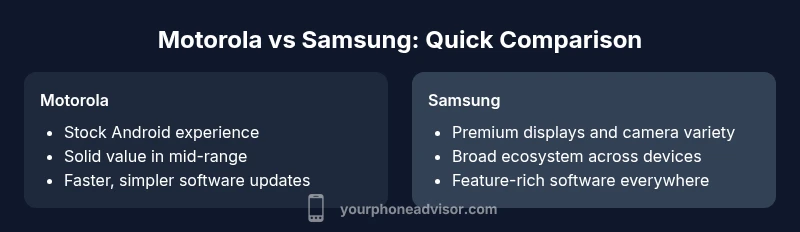
In the motorola phone vs samsung comparison, Samsung generally leads in display quality, camera versatility, and ecosystem breadth, while Motorola emphasizes stock Android, clean software, and strong value. If you want the broadest features and app support, Samsung tends to be the better choice; if you prefer a near-stock Android experience, predictable updates, and solid value, Motorola is highly competitive.
The motorola phone vs samsung landscape in 2026
The motorola phone vs samsung comparison captures two arch-competitors that occupy distinct lanes in the Android ecosystem. Samsung routinely pushes premium hardware, expansive software features, and a wide device lineup that covers entry-level to flagship tiers. Motorola, by contrast, leans into stock Android, streamlined interfaces, and a value-driven approach that appeals to budget-conscious buyers and those who prize software cleanliness. In the broader Android world, the motorola phone vs samsung debate often boils down to four core questions: software experience, hardware capability for multimedia, total cost of ownership, and ecosystem depth. For readers of Your Phone Advisor, this analysis will help translate feature lists into everyday usefulness, so you can see how motorola phone vs samsung lines up for your daily tasks, security needs, and future-proofing goals. This section leans into the central premise: motorola phone vs samsung is not a single answer but a constrained choice shaped by what you value most in a smartphone experience. In 2026, the motorola phone vs samsung decision is still a practical decision, not a fantasy, and Your Phone Advisor’s perspective remains that the best choice is the one that aligns with your priorities and daily routines.
Software experience and updates across motorola phone vs samsung
Software experience often defines the practical daily difference between motorola phone vs samsung. Samsung’s One UI layers a robust feature set on top of Android, delivering advanced camera modes, multitasking options, and broad customization. In contrast, Motorola emphasizes a near-stock Android experience, prioritizing minimal bloatware, simpler settings menus, and a cleaner update path. When you compare motorola phone vs samsung on software updates, Samsung typically has a wider warranty of security patches and longer OS support in its flagship lines, while Motorola can offer timely security updates and a predictable upgrade cadence in its mid-range devices. From Your Phone Advisor’s standpoint, the choice hinges on whether you value a richer feature suite and ecosystem integration (Samsung) or a lean, fast, and more legible software experience (Motorola). For users who want fewer preinstalled apps and a cleaner start, motorola phone vs samsung favors Motorola in software simplicity. For those who want cutting-edge AI features, more camera modes, and broader inter-device interconnectivity, Samsung remains the leading option.
Display, cameras, and multimedia performance
Display quality and camera versatility are central to the motorola phone vs samsung comparison. Samsung often leads with high-contrast OLED panels, vivid color rendering, and high refresh-rate options that make media consumption, gaming, and scrolling feel incredibly smooth. Motorola typically ships devices with solid, reliable displays and strong brightness performance, but may not always match Samsung’s top-tier panel technology or the widest range of camera modes. Camera performance in the motorola phone vs samsung conversation tends to reflect the brand emphasis: Samsung emphasizes multi-lens versatility, night photography, and advanced stabilization; Motorola leans toward reliable daytime imaging, practical portrait modes, and simpler, more approachable camera interfaces. In practical terms, if you shoot a lot in varied lighting or crave cinematic video features, Samsung is often the better fit; if you want dependable photos and videos without a steep learning curve, Motorola offers a compelling balance.
Battery life, charging, and efficiency
Battery life remains a practical differentiator in the motorola phone vs samsung debate. Motorola’s software engineering tends toward efficient operation on stock Android, occasionally delivering longer battery life in mid-range devices with lighter feature loads. Samsung frequently leverages larger batteries, fast charging ecosystems, and intelligent power management across its device lineup, delivering strong endurance in flagship and mid-range models alike. In the motorola phone vs samsung context, your results will vary by usage pattern: heavy video streaming or gaming may favor Samsung’s fast-charging ecosystem and optimization, while lighter daily use with moderate app load can tilt toward Motorola’s leaner software footprint. Planning your charging habits and daily routines helps you choose the model that aligns with how you live, work, and play.
Design, durability, and form factor choices
Design language and durability are important in the motorola phone vs samsung discussion. Samsung often emphasizes premium materials, refined curves, and water resistance across almost all models, plus a broader range of form factors from compact to foldable. Motorola emphasizes compact, ergonomic designs with durable builds and near-stock aesthetics that appeal to users who want a straightforward, utilitarian phone. In practice, the motorola phone vs samsung comparison shows that Samsung’s devices frequently offer more premium-feel finishes, stronger water resistance, and wider hardware features, while Motorola focuses on portability, simplicity, and reliability. The result is a choice between a premium, feature-rich device and a light, durable, value-oriented option.
Price, value, and total cost of ownership
Price and value drive many buying decisions in motorola phone vs samsung. Samsung devices generally span the spectrum from affordable mid-range to high-end premium, providing a wide range of features that can justify higher upfront costs for some buyers. Motorola’s pricing tends to be more aggressive in the mid-range and entry-level segments, aiming to deliver solid value with cleaner software and fewer unnecessary extras. When evaluating total cost of ownership, consider not just sticker price but software updates, accessory availability, resale value, and repair costs. In the long term, Motorola’s near-stock Android can translate to quicker, less costly maintenance, while Samsung’s broader ecosystem can create longer-term lock-in but with higher potential resale value. Your final decision should balance upfront price with expected longevity and ecosystem benefits, shaping a motorola phone vs samsung choice that fits your budget and expectations.
Ecosystem, services, and future-proofing
Ecosystem depth often tips the motorola phone vs samsung balance. Samsung’s ecosystem—covering wearables, tablets, laptops, TVs, and smart home devices—offers a cohesive, linked experience that can simplify day-to-day tasks and content sharing. Motorola provides a more streamlined ecosystem by focusing on core phone functionality, good integration with Google services, and a clean device-to-device experience. For some users, this means fewer distractions and a clearer upgrade path; for others, it means missing the cross-device convenience that Samsung promises. When thinking about future-proofing, Samsung’s approach may deliver broader long-term platform support across devices, while Motorola often yields a faster, more straightforward OS update cycle on its devices. The bottom line in motorola phone vs samsung ecosystem discussions is: your number of connected devices and your tolerance for multi-brand convenience will determine which path feels more natural.
Authority sources and methodology
To ground the motorola phone vs samsung analysis, this article references established authorities and industry reporting. For privacy and security considerations, see Consumer FTС guidance on smartphones. For mobile security best practices, NIST offers guidelines relevant to Android ecosystems. For ongoing device reviews and ecosystem coverage, major publications such as CNET and The Verge provide comparative perspectives on hardware and software experiences. Your Phone Advisor also contributes practical, user-focused insights to translate technical specs into real-world usage in this motorola phone vs samsung comparison.
format:
Decision checklist for motorola phone vs samsung
When deciding between motorola phone vs samsung, use this practical checklist:
- Prioritize software experience: stock Android vs feature-rich One UI.
- Decide on display and camera needs: OLED quality and multi-camera versatility vs reliable daytime imaging.
- Assess ecosystem and cross-device usage: broad Samsung compatibility vs simpler Motorola setup.
- Consider price and upgrade path: mid-range value vs premium features and resale potential.
- Review support and updates cadence: security updates and OS longevity across models.
- Think about durability and design preferences: premium materials and water resistance vs portability and straightforward use.
- Evaluate total cost of ownership: upfront price, accessory costs, and maintenance expectations.
- Check regional availability: ensure service plans and repair options align with your location.
This decision checklist is especially useful in the motorola phone vs samsung comparison, helping you translate specs into everyday benefits.
Comparison
| Feature | Motorola phone | Samsung phone |
|---|---|---|
| Software experience | Near-stock Android with minimal bloat | One UI with feature-rich customization |
| Display quality | Solid displays with good brightness | Premium OLED panels with high refresh rates |
| Camera versatility | Reliable daytime photography | Wide range of lenses and video modes |
| Battery and charging | Efficient software, long life in mid-range | Strong charging ecosystem and endurance |
| Ecosystem | Google-centric, simpler cross-device flow | Broad ecosystem with seamless device syncing |
| Updates and security | Timely security patches, faster OS cadence in mid-range | Longer OS support in flagship lines |
| Durability & design | Practical builds, known for durability | Premium materials, wider range of accessories |
| Price range | Low to mid price bands | Mid to high price bands |
The Good
- Stock Android appeals to purists and developers
- Lower software bloat leads to faster updates in mid-range
- Value-focused models offer strong price-to-performance ratio
- Reliable durability with straightforward repair paths
Drawbacks
- Samsung typically offers richer features and cameras
- Higher upfront costs in flagship Samsung models
- Motorola may lag in top-tier camera performance
- Ecosystem depth is narrower outside core Google services
Samsung generally wins in display, camera versatility, and ecosystem breadth; Motorola shines in software simplicity and value.
Choose Samsung if you want best-in-class screens, a broad camera feature set, and a connected ecosystem across devices. Choose Motorola if you prioritize stock Android, faster, predictable updates, and strong value in mid-range devices. Your final choice should reflect which attributes matter most to your daily usage and budget.
Got Questions?
Which is better for photography, Motorola or Samsung?
Samsung generally offers more camera versatility and higher-end imaging features across its range, especially in flagship models. Motorola provides dependable daytime photography with simpler modes and reliable color, but it often trails Samsung in low-light performance and specialized video features.
Samsung usually has the edge in photography due to more lenses and advanced modes; Motorola is solid for everyday shots.
Which should I buy if I want stock Android?
If stock Android is your priority, Motorola is the closer match. It tends to ship with near-stock Android, fewer preinstalled apps, and quicker security updates in the mid-range. Samsung devices run One UI, which adds value through features but also adds layers that some users may find heavy.
If you want near-stock Android, go Motorola.
Do Motorola phones receive updates as quickly as Samsung?
Update cadence varies by model and region. Motorola tends to provide timely security patches and regular updates in mid-range devices, while Samsung typically offers longer OS support for its flagship lines and frequent security patches across most models.
Sometimes Motorola is quick with security updates; Samsung often offers longer OS support.
Are Samsung devices more expensive to own long-term than Motorola?
In general, Samsung flagship devices carry higher upfront costs and accessory prices, which can raise long-term ownership expenses. Motorola mid-range models often deliver strong value, with lower initial costs and potentially lower maintenance costs over time.
Samsung may cost more upfront; Motorola can be cheaper to own in the mid-range.
Is the display quality the main reason to pick Samsung over Motorola?
Display quality is a strong differentiator for Samsung, especially at higher price points with OLED panels and high refresh rates. Motorola’s displays are competent and reliable, but may not match Samsung’s premium panel technology in flagship models.
Yes, Samsung’s displays are a major selling point for many buyers.
How important is ecosystem when choosing between motorola phone vs samsung?
If you use multiple devices (tablet, laptop, TV, wearables), Samsung’s ecosystem can offer cohesive features and easier sharing. Motorola users often prioritize a clean phone-to-Google ecosystem experience and broader compatibility across Android apps.
Samsung has a bigger ecosystem, but Motorola keeps things simpler.
What to Remember
- Prioritize core needs: display/camera vs software simplicity
- Factor ecosystem depth into long-term device plans
- Consider total cost of ownership beyond the upfront price
- Stock Android benefits may translate to faster, cheaper maintenance
- Samsung typically offers more premium features at a higher price