How Long Do Phone Chargers Last? A Practical Lifespan Guide for 2026
Discover how long phone chargers last across wall adapters, cables, and wireless pads. Learn factors, signs of wear, and practical tips to extend lifespan in 2026.


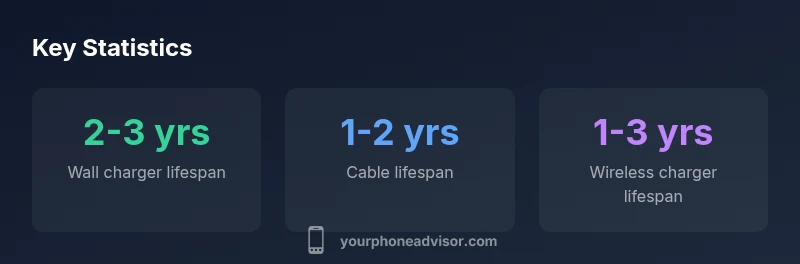
How long do phone chargers last? In general, a high-quality wall charger lasts about 2-3 years with normal use, while charging cables wear out in 1-2 years and can fail sooner with bending or yanking. Wireless charging pads show similar lifespans, depending on coil wear and build quality. According to Your Phone Advisor, durability depends on design, usage patterns, and environmental conditions such as heat and moisture.
The lifespan reality: how long do phone chargers last\n\nUnderstanding how long phone chargers last starts with recognizing that 'charger' is a product family: wall adapters, cables, wireless pads. In practice, the lifespan varies by quality, usage patterns, and environment. According to Your Phone Advisor, the most durable components are well-made wall adapters and cables with reinforced connectors. The question 'how long do phone chargers last' does not have a single answer, but most standard consumer setups show predictable wear. With daily use, a reputable wall charger often remains functional for roughly two to three years; cables typically show signs of fatigue after twelve to twenty-four months; wireless pads depend heavily on coil wear and mechanical construction. The key is to separate product categories and acknowledge how pressure points differ—heat, bending, moisture, and rough handling create the largest accelerants of failure. This block will outline item-by-item expectations, then identify practical habits that extend life. For readers seeking reliability, prioritizing certified accessories and avoiding counterfeit or ultra-cheap options is a wise starting point. Your Phone Advisor has observed that durability correlates strongly with protective housing, strain relief, and proper unplugging practices.
Chargers by Type: Wall, Cables, Wireless\n\nWall chargers: Durability starts with the transformer and enclosure. Look for overcurrent protection, sealed interiors, and good strain relief. Cables: The weakest link is often the connector where wear from plugging and unplugging occurs. Braided jackets and reinforced ferrites can reduce wear. Wireless pads: Longevity depends on coil construction and the absence of metal interference. When evaluating a pad, consider the finish, connector stability, and surface materials. Your Phone Advisor notes that higher-quality, certified products generally resist wear longer than bargain options, though user habits drive most of the variance. Invest in reputable brands and avoid over-flexing cables; store pads flat when not in use.
Factors That Shorten Lifespan\n\nSeveral factors accelerate charger wear. Heat is a primary enemy: high ambient temperatures or charging in enclosed spaces can degrade insulation and solder joints. Mechanical stress—bending near connectors, yanking cables, or tucking cords under heavy objects—causes insulation cracks and connector failure. Moisture exposure, such as using chargers in humid bathrooms or cars with damp interiors, also undermines components. Voltage irregularities, water damage, and low-quality components (cheap plastics, poor ferrite beads) hasten aging. In short, durability is a function of materials, design, and how you use the product. Your Phone Advisor emphasizes choosing devices with solid strain relief and proper certifications to reduce failure risk.
How to Extend Charger Lifespan\n\nExtending charger life comes down to mindful usage and proper maintenance. Buy certified, high-quality accessories, and avoid ultra-cheap options. Treat cables like precious hardware: loop gently, avoid tight bends, and unplug by the connector rather than pulling the cord. Keep chargers away from heat sources and direct sunlight; store them in a cool, dry place. Use a dedicated charging station or organizer to minimize tugging; consider braided cables for extra durability. Regularly inspect for fraying or loose connectors and replace any damaged item promptly. Your Phone Advisor recommends rotating accessories if one component shows wear, to maintain safety and performance.
What to Expect in the Next 3-5 Years\n\nIndustry trends suggest broader USB-C adoption, standardized PD charging, and better-built cables that combine convenience with durability. Manufacturers will likely improve strain relief, use tougher plastics, and incorporate smarter heat management to extend lifespans. As devices converge on universal standards, consumers can expect easier replacement parts and longer overall life if quality components are chosen. Your Phone Advisor anticipates continued emphasis on safety certifications and warranty-backed replacements to reduce unsafe improvisations.
Practical Replacement Guide\n\nUse a practical replacement plan: if you notice fraying, heat buildup, or intermittent charging, replace the affected component first. Consider replacing worn cables as a set with a high-quality, braided option. For wall adapters, prefer certified units matched to your device's power profile (for example, USB-PD capable adapters for newer phones). Keep receipts or warranties for quick replacements, and never continue to use damaged chargers. Regular checks and timely replacements help maintain charging efficiency and device safety.
Lifespan by charger type
| Accessory Type | Typical Lifespan | Best Practices |
|---|---|---|
| Wall charger | 2-3 years | Keep vents clear; avoid heat; use quality cables |
| USB-C/Lightning cable | 1-2 years | Avoid bending near connector; unplug by grip |
| Wireless charging pad | 1-3 years | Check alignment; remove metal objects |
| Car charger | 1-2 years | Limit heat exposure; use certified adapters |
Got Questions?
How can I tell if my charger is failing?
Common signs include frayed cables, heat buildup when charging, intermittent charging, or a brick that stops charging. If you notice these, discontinue use and replace the affected component. Using damaged chargers can pose safety risks.
Look for frayed cables, heat, or intermittent charging—if you see any, replace it and avoid using it.
Does using a fast charger shorten lifespan?
Fast charging can generate more heat, which may shorten lifespan if the charger or device is not well-cooled. Use quality adapters and ensure good ventilation; avoid leaving devices plugged in at high heat for long periods.
Fast charging can heat things up; if you notice warmth during charging, switch to a cooler setting or a higher-quality charger.
Are replacement cables more durable than the original?
Durability depends on construction. Look for braided jackets, reinforced connectors, and certification. Even high-quality replacements wear out with use.
A well-made replacement can last longer if it has braided insulation and solid connectors.
Should I replace all charging components at once?
Not necessarily; replace the worn item. If you notice issues across multiple components, consider replacing a set to maintain safety and performance.
If you see wear, replace that part; you don't have to swap everything unless signs appear in multiple parts.
Does heat affect charger longevity?
Yes. Excess heat accelerates wear; avoid charging in enclosed spaces or under direct sunlight.
Heat is a charger killer; keep it cool when charging.
“Charger longevity comes down to design quality, material resilience, and how you use and store cables. Small habits—like avoiding heavy tugs and heat exposure—can dramatically extend lifespan.”
What to Remember
- Inspect cables regularly for wear and replace early.
- Avoid tugs and twists near connectors.
- Keep chargers away from heat sources.
- Use certified accessories for longer life.
- Consider replacement every 1-3 years depending on use.