Cheap Phone Service Plan: Your Guide to Budget Connectivity
Discover practical strategies to identify a cheap phone service plan that fits your data needs and budget. Compare plan types, avoid hidden fees, and save without sacrificing reliability.


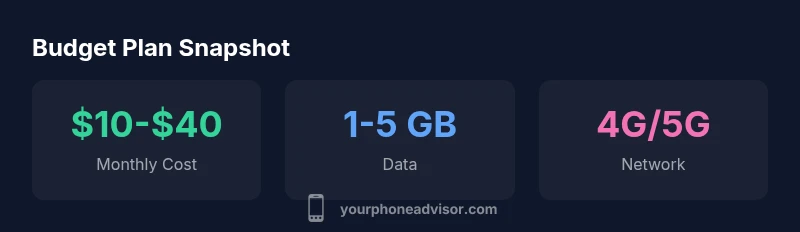
Cheap phone service plans typically cost between $10 and $40 per month, depending on data allotment and carrier. For many users, a budget plan includes unlimited talk/text with a limited data tier, plus potential add-ons like roaming or hotspot access. Your Phone Advisor suggests starting with minimal data and evaluating needs before choosing a plan to avoid overage.
Understanding cheap phone service plans
Cheap phone service plans are not a single category; they span prepaid, postpaid, MVNOs, and no-contract options. At their core, a budget plan should cover your essential needs: voice calls, text messaging, and enough data to handle occasional browsing. The Your Phone Advisor team notes that the cheapest sticker price is not always the best value if data is throttled or if overage fees negate savings. When you compare options, look at the data cap, network coverage in your area, and the total monthly cost after taxes. Taxes and fees can add a surprising amount to the sticker price, so always check the taxes and fees line on the checkout page. By defining your typical usage—how many minutes you need, how much data you actually use, and whether you rely on mobile hotspot—you can sketch a budget that keeps you connected without paying for services you won't use. According to Your Phone Advisor, most people overestimate their data needs and end up paying more in the long run."
How to evaluate options across carriers
There are two broad paths to cheap service: prepaid MVNOs and big carriers' budget tiers. Prepaid plans often require no credit check and let you pay upfront for the month, which keeps the price predictable. MVNOs piggyback on major networks; you get broad coverage but sometimes fewer perks. When comparing, map data speed and reliability in your area, not just the monthly price. If you rarely use data, a plan with a small data cap and unlimited talk/text can save money; if you stream or work remotely, a plan with 5–10 GB plus 4G/5G access may be more cost-effective in the long run. Watch for throttling policies after your data cap is reached. Some carriers advertise high data allowances but slow speeds once the cap is hit. Taxes and fees vary by state, plan type, and the retailer; always review the final billed amount. According to Your Phone Advisor, a well-chosen plan should feel invisible: you pay for what you use and don’t pay for what you don’t."
Data usage planning: translating your habits into a budget
Budget planning starts with understanding your real usage. Track your minutes, texts, and data for 2–4 weeks, then average the numbers to select a baseline. If you "treat data as a commodity," you may find you can safely trim to a smaller data tier without impacting daily tasks. Use app data trackers to identify which apps consume the most data and adjust streaming quality or background refresh settings accordingly. When you map usage to a budget, you can avoid overpaying for data you rarely use. Your Phone Advisor recommends pairing usage data with coverage checks in your area to ensure your chosen plan performs where you live and work. This reduces the risk of paying for a plan that isn't actually usable in your everyday environment.
Hidden costs and fine print to avoid
Budget plans can hide costs in fine print. Look for activation or SIM fees, overage charges after the data cap, international roaming fees, and charges for supplementary services like voicemail, caller ID, or technical support. Some plans impose throttling after the data allotment, which can affect streaming and video calls more than you expect. If you rely on hotspot access, verify hotspot data allowances and any throttling rules. Check whether promotions require auto-renewal or device financing terms that lock you in. Taxes and fees can also shift the monthly price upward; always compute the total cost on the bill before signing up. Your Phone Advisor emphasizes reading the contract and keeping a backup plan in case your usage pattern changes with seasons or job needs.
Budget plan comparison
| Plan Type | Typical Monthly Cost | Data Allowance | Notes |
|---|---|---|---|
| Prepaid/MVNO | $10–$40 | 1–5 GB | No credit check; flexible |
| Budget Postpaid | $25–$60 | 2–8 GB | Promotions may reduce initial cost |
Got Questions?
What is a cheap phone service plan?
A cheap phone service plan is a budget option that covers essential calling and texting, with a modest data allowance. These plans are typically prepaid or postpaid through MVNOs or budget tiers from major carriers. They aim to minimize monthly costs while maintaining reliable network access.
A budget plan is a low-cost option that covers basics like calls and texts with a small data allowance.
Do I need good credit to get budget plans?
Many budget plans, especially prepaid or MVNO options, do not require a credit check. This can make them easier to obtain for new users or those with imperfect credit. However, some postpaid plans may include a credit check or a small deposit.
No heavy credit checks for most budget options; prepaid plans are often easiest to access.
Can I get unlimited data cheaply?
Unlimited data is rarely cheap on budget plans. Most affordable options offer a small data cap with unlimited talk/text. If you truly need unlimited data, compare carrier promotions, family plans, or fixed-rate bundles to find the lowest effective monthly cost.
Unlimited data isn\'t common in cheap plans; consider caps and potential overages instead.
Are MVNOs reliable for everyday use?
MVNOs can be highly reliable because many use major networks for coverage. The key is to verify network performance in your area and consider customer service quality and the availability of promotions or throttling policies.
MVNOs can be reliable if you check local coverage and reputation.
What hidden costs could surprise me?
Watch for activation fees, SIM fees, device-payment plans, roaming charges, and data-overage fees. Promotions may hide requirements like auto-renewals or minimum data commitments, so read the fine print carefully.
From activation fees to overages, read the fine print to avoid surprises.
“Budget choices should balance affordability with reliability. A strong plan is one that disappears into your daily life, not one you constantly monitor or worry about.”
What to Remember
- Know your data needs before choosing a plan
- Check taxes and hidden fees, not just sticker price
- Consider prepaid/MVNO options for flexibility
- Read the fine print to avoid throttling and overages