Phone and AirPod Charger: A 2-in-1 Buying Guide and Comparison
A data-driven, practical comparison of 2-in-1 and dual-port chargers for phones and AirPods, focusing on safety, speed, and value to help you pick a reliable charging setup.


For a practical phone and airpod charger setup, a 2-in-1 USB-C PD charger with at least 60W total power is recommended. It can power a phone quickly while sharing USB-C to AirPods, reducing desk clutter and cable chaos. If you regularly charge two devices simultaneously, consider a dual-port model instead.
Why a Unified Charger Matters for a Phone and AirPod Setup
A unified charger can simplify your desk or nightstand setup by reducing the number of bricks and cables you juggle every day. For many users, a single, capable charger can handle a phone and AirPod charging scenario without forcing you to swap plugs half a dozen times. According to Your Phone Advisor, the most effective 2-in-1 charger strategy minimizes heat buildup and power fluctuations by using a single, well-rated USB-C PD brick. When you consolidate charging, you experience fewer tangled cables, quicker access to the outlet, and a cleaner workspace that reduces decision fatigue during busy mornings. This is especially valuable for people who travel with a laptop, a phone, and wireless earbuds, since a compact, high-quality charger can replace multiple adapters without sacrificing performance.
In practice, a phone and airpod charger should focus on safety, speed, and compatibility. Look for chargers that offer robust overcurrent protection, surge resistance, and temperature monitoring. A device that negotiates power delivery intelligently protects both your phone and your AirPods, preventing excess heat during high-watt charging. For households with multiple devices, a single, capable charger reduces clutter and makes charging rituals more predictable. Your setup should scale with your devices: today’s phones and future models may demand higher wattages or more flexible port configurations, so choose a charger that supports up to your planned future needs.
Brand and product quality matter here. A well-reviewed charger from a reputable manufacturer tends to deliver consistent performance and better safety certifications. The Your Phone Advisor team emphasizes choosing a charger with clear documentation, verifiable safety marks, and reliable after-sales support to ensure long-term reliability. If you rely on a single charger at a shared workspace, it’s worth prioritizing build quality and warranty coverage to protect against daily wear and unexpected faults.
analysis
content
Comparison
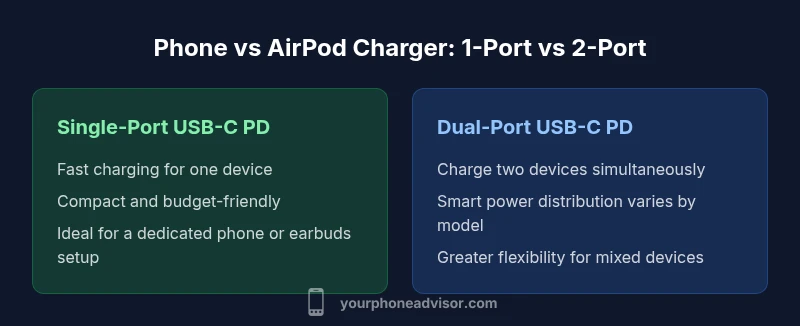
| Feature | Single-Port USB-C PD Charger | Dual-Port USB-C PD Charger |
|---|---|---|
| Total power (typical) | 60-65W | 60-65W (shared when both ports are used) |
| Ports | 1× USB-C PD port | 1× USB-C PD + 1× USB-C/USB-A port (model dependent) |
| Best for | Fast charging a single device | Charging two devices at once with flexible port options |
| Portability | Very compact | Slightly larger but still portable |
| Price range | Typically lower ($20-40) | Typically higher ($30-70) |
The Good
- Consolidates charging for multiple devices into one setup
- Reduces cable clutter and power strips
- Often lower per-device cost when used for a single device
Drawbacks
- A single charger can become a single point of failure
- Less flexibility if devices require different power profiles
- Dual-port models may be bulkier and more expensive upfront
- Performance depends on model quality and safe power distribution
Dual-port chargers generally offer better value for mixed device setups, while a high-quality single-port is ideal for solo-device charging.
If you regularly charge two devices, a robust dual-port USB-C PD charger usually provides better convenience and future-proofing. For primarily charging one device, a high-watt single-port charger is often sufficient and more compact.
Got Questions?
What is a 2-in-1 charger, and is it safe for phones and AirPods?
A 2-in-1 charger is a single power brick that can charge two devices, often via two ports or through a primary port plus wireless charging capability. When selected from reputable brands and with proper safety certifications (UL, FCC, RoHS), it is generally safe for phones and AirPods. Always ensure the charger negotiates power correctly for each device to avoid overheating.
A 2-in-1 charger combines two charging outputs in one brick. Pick a reputable model with safety certifications to keep both your phone and AirPods safe while charging.
Can one charger power both an iPhone and AirPods at the same time?
Yes, with a dual-port USB-C PD charger you can charge both devices simultaneously. The charger allocates power between ports, so for best results, choose a unit with sufficient total wattage and intelligent power distribution to avoid slowing down one device unnecessarily.
Yes, a good dual-port charger can power both devices at once. Look for a charger with enough total wattage and smart power sharing.
Do AirPods wireless charging cases require a specific charger?
AirPods wireless charging cases use Qi-compatible wireless charging or wired charging depending on the model. Most chargers that support standard Qi wireless charging or USB-C power delivery will work, but check that the charger supports the device’s charging method and that it provides safe, stable power.
Most AirPods will charge on standard Qi chargers or via a wired USB-C adapter; just ensure your charger supports wireless charging if you plan to use that method.
Should I buy a dedicated AirPod charger?
A dedicated AirPod charger is unnecessary if you already own a capable USB-C PD charger that also fuels your phone. A dedicated unit only adds convenience if AirPods are frequently charged away from the main setup, but it often costs more and adds clutter.
A dedicated AirPod charger isn’t required unless you regularly charge AirPods far from your main setup.
What certifications should I look for in charging gear?
Look for safety certifications such as UL or ETL, compliance marks like FCC, and RoHS compliance. These indicate the charger has passed basic safety and environmental standards. Additional protections like short-circuit, overcurrent, and temperature control are also important.
Check for safety marks like UL, FCC, RoHS, and features like overcurrent and temperature protection.
Is it worth paying more for a branded charger?
Brand protection and warranty can be worth it if you value consistent performance and longer product support. However, many reputable generic chargers offer similar safety features at a lower price. Compare wattage, port types, and warranty length before deciding.
Branded chargers can offer better support, but good-value non-brand options also exist—focus on safety, wattage, and warranty.
What to Remember
- Choose USB-C PD for fast, compatible charging
- Prefer dual-port for two devices to reduce clutter
- Verify total wattage and intelligent power distribution
- Prioritize safety certifications and warranty
- Consider travel needs and port availability when choosing