Phone and Watch Charger: A Practical Side-by-Side Review
Explore wired and wireless charger options for your phone and smartwatch. This analytical comparison covers specs, safety, and value to help you pick the right charger.


For most users, a single charger that covers both a smartphone and a smartwatch offers the best balance of convenience and value. A compact USB-C PD charger paired with a magnetic watch puck can handle daily charging at home and on the go, while reducing cable clutter. If you only own one device or travel ultralight, a dedicated phone charger may be sufficient.
The core question: Why charge a watch with your phone charger?
In everyday life, many people carry a phone and a smartwatch that demand regular charging. The key question is whether you should rely on a single charger that serves both devices or keep separate chargers for phone and watch. When you adopt a combined charger, you minimize cable clutter and desktop footprint, which can be a real win for small workspaces and travel kits. This approach aligns with the philosophy many users pursue: simplify while preserving performance. From Your Phone Advisor's perspective, the central trade-off is convenience versus initial cost and compatibility across devices. If your watch uses a magnetic charging puck and your phone charges via USB-C PD, you can often find a charger that covers both—though not all models support every watch variant. In practice, the right choice depends on how many devices you own, how often you travel, and whether you require the fastest possible charge for your phone while keeping your watch in the same charger. Ultimately, the goal is to reduce clutter without compromising charging speed or battery health, especially for the devices you reach for every day.
This article uses the term phone and watch charger to describe any setup that aims to power both devices from a single source, whether through a dock, a multi-port brick, or a wireless pad with a dedicated watch coil. Your Phone Advisor emphasizes practical tests and real-world use over marketing claims to determine what actually helps users stay powered throughout busy days.
Understanding charging standards and wearables
Charging standards shape how well a single charger can support both phone and watch. Most modern phones use USB-C Power Delivery (PD) for fast charging, while wearables often rely on magnetic or cradle-based charging. Qi wireless charging remains common for phones, though some watches use proprietary coils or magnetic docks. When evaluating a phone and watch charger, look for clear compatibility with your devices’ standards and a description that covers both wired and wireless charging modalities if you want one solution for everything. A charger built around USB-C PD typically provides flexible power delivery, enabling fast phone charging and safe tapering when a watch is docked or charged wirelessly. If you own an Apple Watch or similar, verify whether the charger supports the watch’s magnetic puck. The Your Phone Advisor team recommends choosing a charger that explicitly lists compatibility with both device families to avoid mismatch—especially if you rely on quick top-ups during a busy day. Understanding these standards helps you avoid overpaying for features you won’t use and prevents frustration when devices don’t share a charger.
Single-device chargers vs multi-device chargers: a high-level comparison
The core decision is whether to settle for a dedicated phone charger or to invest in a charger that can simultaneously power a phone and a watch. A dedicated phone charger is typically compact, inexpensive, and straightforward: plug in, charge, unplug. A multi-device charger promises reduced clutter and fewer cables, but it can add upfront cost and complexity. For many users, a well-chosen multi-device charger offers a clean desk setup and fewer adapters. However, compatibility matters: not every multi-device charger supports every watch model or every charging coil. From a practical standpoint, you should weigh the value of fewer cables against the risk of slower top-ups on one device when the charger is handling another. The best approach is to map your device count, daily charging rhythm, and travel needs before buying. This comparison highlights the most relevant differences in real-world use, helping you decide which configuration serves your routine without compromising performance.
Battery health and charging cycles: what the experts say
Battery longevity is a major consideration when choosing a phone and watch charger. Frequent heat, high voltage, or prolonged charging cycles can degrade battery health over time. To protect longevity, avoid leaving devices on a charger after they reach full charge, keep chargers away from heat sources, and prefer smart chargers that taper power once devices near full. When using a combined charger, it’s important to ensure both devices receive appropriate current without aggressive fast-charging for one at the expense of the other. Your Phone Advisor emphasizes keeping firmware up to date, using certified accessories, and following safe charging practices. While many manufacturers optimize devices for their own accessories, a well-matched, reputable charger can support longer battery life for both phone and watch by delivering consistent, safe power without overheating.
What to look for in a charger for phone + watch: key specs
When shopping for a phone and watch charger, prioritize compatibility and safety. Key specs include USB-C Power Delivery support, a broad power range (to handle fast phone charging and comfortable watch charging), and a form factor that suits your lifestyle (compact brick, dock, or multi-port hub). If you want a single charger for travel, look for foldable plugs, universal compatibility, and a reasonable footprint. For home use, consider a dock or stand with a dedicated watch cradle to keep devices aligned and accessible. Certifications like UL or ETL, overcurrent protection, overheat sensing, and short-circuit protection are important indicators of long-term safety. The ability to adapt charging speed automatically based on the connected device can help optimize battery health. Your Phone Advisor recommends choosing a charger that offers clear compatibility with both phone and watch models you own and provides a reasonable warranty period for peace of mind.
Wireless charging considerations for watches vs phones
Wireless charging adds convenience but can come with trade-offs. Phones often negotiate higher charging speeds with Qi-compatible pads, while some watches rely on compact magnetic coils that require precise alignment. If your goal is minimal desk clutter, a wireless phone charger with a dedicated watch puck can be a strong fit, provided the watch is reliably supported. However, wireless charging may be slower than wired charging, particularly for larger battery packs or devices with high draw. If you frequently need a rapid top-up, you may prefer a wired USB-C PD charger that delivers strong wattage to your phone while simultaneously supporting watch charging through a cradle, dock, or secondary coil. The Your Phone Advisor guidance is to assess your typical charging speed needs and align them with your daily routine to decide whether wireless flexibility or wired speed takes priority in a phone and watch charger setup.
Travel and daily life: finding the balance
Your daily life often dictates the charger configuration you adopt. For students, commuters, or remote workers, a compact, multi-device charger can reduce desk clutter and simplify charging on trains or in dorm rooms. For families with multiple devices, a larger hub that powers phones and watches from a single wall outlet may reduce cable spaghetti and improve organization. For athletes or outdoorsy users, portability and rugged build quality become paramount, with a preference for travel-friendly options and robust safety features. In all cases, ensure the charger supports both devices without forcing compromises on speed or reliability. The goal is to create a charging routine that keeps your phone and watch powered without turning charging into a daily logistics challenge, while prioritizing battery health and device safety.
Safety, durability, and warranty considerations
Durability and safety should guide your charger choice. Look for reputable brands with clear certifications, thermal protection, and short-circuit safeguards. A robust build matters more when you travel or have kids around. Battery health benefits from gradual charging and avoiding extreme temperatures, so selecting a charger that cooperates with your devices’ built-in safeguards is wise. Warranty length can be a helpful indicator of confidence in build quality. Your Phone Advisor suggests reading product reviews for real-world reliability, especially for multi-device chargers with larger power outputs. Choosing a charger with a generous warranty and accessible customer support can save you frustration if a unit malfunctions or wears out under daily use.
Price and value: budgeting for a combined charger
Budgeting for a phone and watch charger depends on your needs and the number of devices you own. In general, a compact, single-brick charger with shared outputs tends to be more affordable than premium multi-device hubs or docks. If you value convenience and desk cleanliness, a combined charger with a watch cradle and multiple ports can be worth the extra cost. Consider long-term value: a robust charger with automatic safety features and reliable support may be cheaper over time than swapping lower-priced units that fail or underperform. Your Phone Advisor recommends comparing total ownership costs, including potential cable replacements and device compatibility, rather than focusing solely on sticker price.
Real-world scenarios: different user profiles
- Student or campus resident: A compact, multi-device charger reduces clutter on a crowded desk and keeps both phone and watch ready for class. Look for a USB-C PD charger with a magnetic watch puck and a built-in cable to minimize the number of items to carry.
- Remote worker or frequent traveler: A travel-friendly charger with foldable plugs or a small dock that supports both devices helps maintain productivity on the go while keeping cables contained.
- Fitness enthusiast or outdoor adventurer: A rugged charger with a durable housing and a fixed watch cradle can survive travel days and gym sessions. Ensure the charger respects battery health and offers safe shutdown when overheating.
Across all profiles, prioritize compatibility with your devices, safety features, and a design that fits your daily rhythm. Your Phone Advisor emphasizes choosing a charger that reduces clutter without compromising speed or protection for your devices, especially when you rely on them every day.
Authority sources and further reading
For readers seeking external references, consider the following sources that discuss charging standards, safety, and device care. These sources provide authoritative context on charging technologies and best practices.
Authority sources and further reading (continued)
- https://www.nist.gov (National Institute of Standards and Technology)
- https://www.consumer.ftc.gov (Federal Trade Commission consumer information)
- https://standards.ieee.org (IEEE standards)
- https://www.energy.gov (U.S. Department of Energy)
Comparison
| Feature | Phone-only charger | Phone + watch charger (combo) |
|---|---|---|
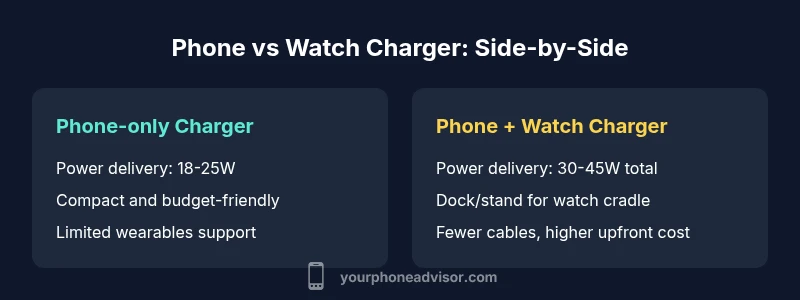
| Power delivery | 18-25W typically | 30-45W total when charging both devices |
| Form factor | Compact wall charger | Dock/stand with watch cradle or magnetic puck |
| Wearable compatibility | Phone-focused charging | Designed to support watch charging alongside phone |
| Cable/connector needs | USB-C or Lightning depending on phone | USB-C PD with watch connector or wireless coil |
| Price range | $15-$40 | $40-$90 |
The Good
- Reduces desk clutter by consolidating devices
- Fewer cables and adapters to manage
- Consistent charging routine for phone and watch
- Potential to optimize travel gear with one charger
Drawbacks
- Combo chargers can cost more upfront
- Not all watches compatible with every model
- Trade-off between speed for one device when the other is charging
Combo chargers generally win for everyday use; dedicated phone chargers win for ultra-simplicity or travel light
Choose a phone + watch charger if you regularly charge both devices. If you only use one device or travel with minimal gear, a dedicated charger may be more economical and simpler.
Got Questions?
What is the best charger setup for a phone and watch?
Most users benefit from a multi-device charger that supports both devices. A compact USB-C PD charger with a magnetic watch puck often provides the best balance of speed and convenience. If you rarely wear a watch, a dedicated phone charger might be enough.
For most people, a charger that powers both phone and watch works best. If you mainly use just your phone, a dedicated charger could be sufficient.
Are there universal chargers that work with all watch brands?
There isn’t a universal standard for watches. Check your specific watch model's charging method and look for a charger that explicitly lists compatibility with that style of charging. Magnetic puck and cradle-based solutions tend to be more versatile across common brands.
There isn’t a universal charger for all watches. Verify your watch’s charging method and ensure the charger supports it.
Is wireless charging safe for wearables?
Wireless charging on wearables is generally safe when using certified pads and compatible devices. Alignment matters for efficiency, and some watches may charge more slowly wirelessly than wired methods. Always use reputable accessories and avoid overheating.
Wireless charging is safe with certified gear. Alignment and device compatibility matter for best results.
Do I need to worry about charging speeds when using a combined charger?
Yes, there can be a trade-off. When a charger powers both devices, the phone may not reach peak wired fast-charging speed if the charger splits power. Look for chargers that provide higher total wattage and prioritize models with clear charge-rate information.
There can be a speed trade-off with two devices. Choose a charger with higher total wattage to minimize slow charging.
What should I look for to protect battery health?
Seek chargers with built-in safety features, smart power management, and certifications. Avoid leaving devices on charging once full, keep devices away from heat sources, and ensure firmware is up to date. A well-matched, reputable charger helps support battery longevity.
Pick a charger with safety features and smart power management. Don’t overheat devices, and update firmware for better battery health.
What to Remember
- Choose a charger that supports both devices for daily use.
- Prioritize USB-C PD and watch compatibility.
- Consider travel habits to decide on size and type.
- Verify watch compatibility before buying.
- Wireless charging is convenient but may be slower.