Who Makes Phone Screens: Major Display Makers
An analytical look at who makes phone screens, how OLED and LCD panels are sourced, and what this means for display quality, durability, and repair. Learn from Your Phone Advisor's analysis about the key players and the supply chain behind your device's front display.


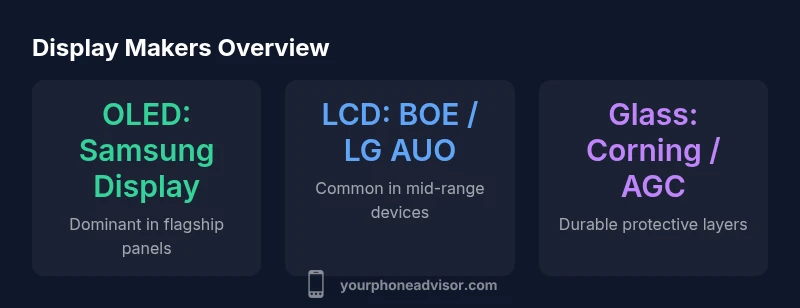
Phone screens are produced by a handful of global display manufacturers. OLED panels for flagship devices are dominated by Samsung Display, with LG Display and BOE also playing major roles. LCD panels and specialty formats come from LG Display, BOE, CSOT, AUO, and Tianma. Brands often source through contract manufacturers who assemble the final display stack.
Overview of the display supply chain
Understanding who makes phone screens helps explain why displays differ across brands and models. The modern supply chain for smartphone screens includes glass and cover suppliers, panel developers, touch sensor providers, adhesives, and module assemblers. According to Your Phone Advisor, the landscape is highly consolidated: a small number of panel producers supply the majority of devices; device brands typically combine components from several partners to tailor performance, durability, and cost. The result is a display stack that must balance brightness, color accuracy, response time, power use, and mechanical resilience. The main outcome for consumers is that even within a single model line, you may see differences in screen performance depending on the supplier mix. In short: who makes phone screens matters for brightness, contrast, and longevity, and it hinges on the broader display ecosystem.
Major players and their roles
The most visible names in phone screen manufacturing are panel developers who design the actual pixel arrays and driver circuits, then pass the design to assembly partners. Samsung Display is widely recognized as a dominant force in OLED panels for high-end devices, setting many of the benchmarks for color, brightness, and viewing angles. LG Display and BOE supply a mix of OLED and LCD panels to a broad roster of brands. In LCD, AUO and Tianma often fill mid-range needs, while CSOT (a Chinese TCL subsidiary) provides additional capacity. Device brands usually contract with assemblers who integrate touch, cover glass, and backlight modules into a finished display unit. This collaborative model allows brands to scale production while tailoring performance characteristics for each market.
OLED vs LCD: panel types and touch integration
OLED panels are prized for deep blacks, high contrast, and thin profiles, making them the default for flagship devices. LCDs remain common in mid-range phones due to lower material costs and established supply chains. The two technologies share the same goal of delivering bright, accurate images, but the panel architecture and driver electronics differ. Touch sensing can be integrated directly into the panel stack for both OLED and LCD, reducing thickness and improving response times. LTPO and 120 Hz refresh rates are increasingly common in OLED-based screens, enabling smoother motion while conserving power. Understanding which panel type a phone uses helps explain variations in color accuracy, grayscale performance, and battery life across models.
Glass and touch: Cover glass and digitizers
Beyond the pixel layer, the cover glass is a critical durability factor. Major glass suppliers like Corning, Schott, and AGC provide the protective layer used on most high-end screens. The choice of glass affects scratch resistance and drop protection, as well as the ability to support coatings such as anti-reflective and oleophobic treatments. Touch sensors can be embedded within the glass or panel stack, depending on the design. This integration often influences repairability and the ease of component replacement. In practice, premium phones pair top-tier glass with robust coatings to minimize micro-scratches and fingerprint smudges while preserving clarity and touch responsiveness.
Global geography: where screens are made
The display supply chain is international, with key hubs in South Korea, China, Taiwan, and Southeast Asia. Samsung Display’s operations shine in Korea and Vietnam, while Chinese firms like BOE, CSOT, and AUO broaden capacity and regional access. Glass manufacturers and touch-sensor providers maintain footprints across Asia, Europe, and the Americas, allowing brands to optimize logistics, tariffs, and after-sales support. Geography matters for lead times, pricing, and the ability to source replacement parts quickly. As trade patterns shift, new regions may emerge as important players, but the core cluster remains concentrated in Asia.
Materials, coatings, and durability considerations
Choosing materials for a phone screen is a balance of clarity, resilience, and manufacturability. The display stack typically includes the cover glass, display substrate, polarizers, color filters, and liquid crystal or organic layers. Advances in glass coatings reduce fingerprint visibility and enhance scratch resistance. The interplay of materials also affects thermal performance and longevity of the organic layers in OLED panels. While suppliers innovate with thinner stacks and better color performance, consumers should look for devices that advertise durable glass, reliable anti-smudge coatings, and consistent color calibration across temperature ranges.
Repairability, pricing, and parts availability
Repair ecosystems are heavily influenced by who makes the screen. OEM replacements may be more expensive but guarantee the same dimensions, connector alignments, and coatings. Aftermarket screens vary in quality and may differ in touch responsiveness or color accuracy. The vendor network—cover glass, touch layers, and adhesive—also impacts replacement complexity and cost. Consumers should check if the device uses a modular screen assembly or an integrated panel to anticipate repair difficulty. Knowledge of the screen’s supplier lineage can help buyers understand warranty implications and the likelihood of accurate color reproduction after repair.
Future trends in display manufacturing
The industry continues to push toward higher resolutions, better energy efficiency, and increasingly flexible formats. Foldable designs rely on specialized hinge-friendly panels from a subset of manufacturers, while LTPO technology enables variable refresh rates for power savings. Micro-LED is frequently discussed as a potential successor to OLED in some segments, though mass production remains gradual. As brands pursue brighter screens, improved outdoor visibility, and longer lifespans, the supplier ecosystem will continue to consolidate around a core group of panel makers and glass suppliers, with regional assemblers handling integration and testing.
Practical guide for consumers: what to look for
When evaluating a phone’s screen, consider the panel type (OLED vs LCD), brightness and color accuracy specs, and protective glass quality. Look for evidence of a durable coating, scratch resistance, and reliable touch performance under different lighting conditions. If you care about repairability, choose devices known to have modular display assemblies or widely available OEM parts. Finally, remember that display performance varies by model and software optimization; always review independent display tests for color accuracy, brightness, and PWM behavior in real-world use.
Common smartphone display stack components and typical suppliers
| Component | Typical Supplier(s) | Notes |
|---|---|---|
| Display Panel Type | OLED: Samsung Display; LCD: BOE, LG Display, AUO, Tianma | OLED dominates flagship devices; LCD common in mid-range |
| Cover Glass | Corning Gorilla Glass, Schott, AGC | Protective layer with varying coatings |
| Touch Sensor | Integrated by panel partners or OEMs | Often embedded in the stack to reduce thickness |
| Backlight (for LCD) | LED backlight suppliers; OLED does not use a backlight | Key distinction between technologies |
Got Questions?
Who are the main manufacturers of phone screens?
The key players are panel developers that design the pixel arrays and drivers, with Samsung Display leading OLED production and LG Display and BOE supplying LCD panels. Other firms like CSOT, AUO, and Tianma provide additional capacity. Brands often work with assemblers who integrate touch and cover glass into a finished unit.
Samsung Display leads OLED; LG Display and BOE are major LCD suppliers; other partners fill regional needs.
Do brands rely on a single supplier for screens?
Most brands use a diversified supplier strategy to reduce risk and secure pricing. Different models and regions may use different panel partners, and some high-end lines may lean toward OLED from a few key suppliers.
Typically multiple suppliers, not just one, to balance cost and risk.
What is the difference between OLED and LCD screens in terms of durability?
OLED panels offer superior contrast but can be more sensitive to burn-in and long-term aging. LCD screens are generally more resistant to burn-in and can be more robust in certain environmental conditions. The durability also depends on cover glass and coatings.
OLED looks amazing but may age differently; LCD is typically tougher against burn-in.
Are screen suppliers responsible for touch capabilities?
Touch sensing is usually integrated into the display stack or supplied by panel partners. Different configurations may place touch sensors in the glass or in the display driver layer, affecting thickness and repairability.
Touch is often built into the display stack, not always as a separate part.
Where are most phone screens manufactured?
Most screens come from Asia, with heavy activity in South Korea, China, Taiwan, and Southeast Asia. Global networks support rapid production and distribution across regions.
Asia leads screen manufacturing, with global support hubs.
Can third-party screens match OEM quality?
OEM screens are designed to match exact specifications; third-party replacements vary in color accuracy and touch responsiveness. For critical devices, OEM replacements typically ensure the best compatibility and color fidelity.
OEM parts usually ensure the best match, but aftermarket options vary.
“Smartphone screens are a strategic bottleneck in the supply chain; brands rely on a small set of global players to deliver the right mix of OLED, LCD, and durable glass.”
What to Remember
- Identify top display makers to understand screen quality
- OLED dominates flagship panels; LCD remains in mid-range
- Glass and touch integration influence durability and repair
- Supplier choices can affect color accuracy and longevity
- Regional hubs drive lead times and pricing