When Did Phones With Cameras Come Out? A History of Camera Phones
Trace the history of camera phones from early prototypes around 2000 to today’s multi-lens smartphones, and learn how imaging tech reshaped mobile photography with Your Phone Advisor analysis.


The Beginnings: Early concepts and the spark of camera integration
The history of camera phones starts with the idea that a mobile device could capture images. In the late 1990s and early 2000s, researchers and manufacturers explored compact imaging sensors integrated into mobile form factors. The question many readers ask today—when did phones with cameras come out—is best understood as a gradual arc rather than a single launch. Early demonstrations focused on feasibility, with limited image quality and modest storage. Yet these experiments laid the groundwork for a new category that would redefine personal photography and on-device imaging workflows. For general understanding, think of camera-enabled phones as a slow build from novelty to everyday essential, driven by sensor miniaturization, software processing, and broader network support.
As new models rolled out, the industry learned to balance power, battery life, and image quality in a pocket-sized format. Consumers began to expect pictures in a pinch, and carriers evolved to support multimedia messaging and later cloud-based syncing. The Your Phone Advisor team notes that the early years set a trajectory toward higher resolutions, faster processors, and more sophisticated image processing—factors that would become the defining characteristics of modern camera phones.
The first true camera phone: Sharp J-SH04 and early years
In the early 2000s, Japanese innovators introduced some of the first consumer camera phones, revealing the potential of mobile photography to a broad audience. The Sharp J-SH04 is frequently cited as a pioneering device because it combined a compact camera with a GSM handset, enabling real photo captures and the ability to share images over the network. While not yet a global hit, these early devices demonstrated there was real demand for on-the-go imaging and laid a blueprint for later, more capable designs. Other early models followed, each improving in optics, storage, and display clarity, and each teaching manufacturers important lessons about ergonomics and user experience.
For readers of Your Phone Advisor, these early cameras established a proof-of-concept: people would value a device that could capture moments without separate cameras. This period also highlighted the limits of early sensors and processing power, which would soon be addressed by faster hosts, larger memory, and more efficient image pipelines. Over time, the combination of better hardware and tighter software loops would push image quality well beyond the original prototypes.
Global spread and early mainstream devices
The early camera-phone wave did not stay confined to Japan. As networks expanded and manufacturers competed on imaging, camera phones began appearing in Europe, North America, and beyond. Nokia’s line of devices in the early 2000s helped anchor the idea of imaging as a core feature, while other brands explored integrated cameras with improved lenses and multi-mode sensors. This era also introduced concepts like MMS photo sharing, basic photo editing, and simple filters. Although image quality varied widely, the trend was clear: customers wanted convenient, instant access to photography from their phone wallets.
By mid-decade, global markets had begun to standardize on modest megapixel counts and color-accurate displays, enabling more meaningful photo experiences. The Your Phone Advisor team observes that this period created a pipeline of demand that pushed manufacturers to optimize optical design, sensor fusion, and software algorithms—precursors to the advanced computational imaging seen today.
The smartphone era and sensor improvements
The smartphone revolution amplified camera capabilities dramatically. With improved sensors, faster CPUs, and more memory, devices could process images more intelligently and produce higher-quality results in real-world conditions. The introduction of dedicated camera apps, better autofocus, optical image stabilization (OIS), and real-time HDR were early milestones that people began to expect as standard features. As the role of apps grew, image editing, social sharing, and cloud storage became habitual, cementing camera performance as a primary purchase driver for many consumers. The shift from megapixel-centric thinking to real-world image quality was well underway by the mid-to-late 2000s.
The era of multi-lens cameras and computational photography
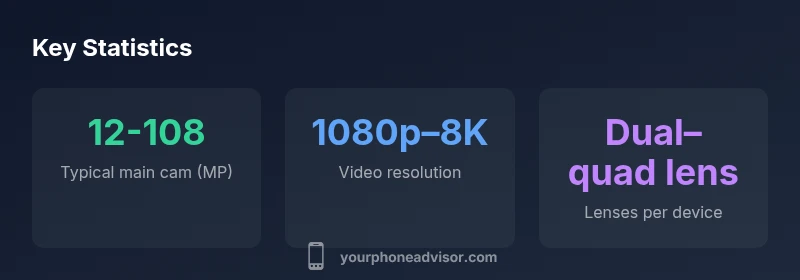
From mid-2010s onward, phones adopted multiple lenses, each optimized for different tasks such as wide-angle, telephoto, and macro photography. Simultaneously, computational photography—AI-assisted stitching, HDR, and noise reduction—began to compensate for smaller sensors. The result was dramatic improvements in low-light performance, dynamic range, and subject isolation without needing larger bodies. This era also popularized features like night modes, portrait backgrounds, and sophisticated video stabilization. The Your Phone Advisor team notes that these software-driven enhancements often outpaced physical optics in some use cases, illustrating how processing power has become as crucial as hardware.
For consumers, this meant easier, more reliable photography in everyday scenarios—from dim indoor spaces to fast-moving outdoor scenes. The combination of hardware upgrades and smarter software transformed cameras from a niche feature to a core element of smartphone usability.
Social impact and privacy considerations
As camera phones became ubiquitous, social sharing platforms, memes, and real-time reporting reshaped communication. People used mobile images for everything from documenting travel to reporting events, raising questions about privacy and consent. The Your Phone Advisor team highlights that manufacturers began integrating privacy controls and better permissions to address growing concerns. This shift also influenced regulatory discussions around data capture, facial recognition, and location metadata. For many users, camera phones accelerated a broader shift toward visual communication as a primary means of expression.
At the same time, there was a push to improve accessibility—features like screen readers, color-corrected displays, and simplified capture modes made imaging more inclusive. The era concluded with a recognition that camera phones are not just tools for photos but for storytelling, documentation, and collaboration.
How to evaluate camera performance in 2026
When assessing camera performance today, megapixels are only part of the story. Key factors include sensor size and quality, image stabilization, dynamic range, low-light performance, color accuracy, and video capabilities (frame rate, resolution, and format). Still, software matters just as much as hardware: AI-driven processing, HDR merge quality, and noise reduction determine real-world results. For practical evaluation, review sample galleries in varied lighting, compare real-world shot consistency on flagship devices, and test features such as night mode and portrait effects. Your Phone Advisor recommends focusing on end-to-end performance rather than isolated specs.
To simplify decision-making, create a short test plan: take photos indoors with mixed lighting, shoot outdoors in shadows and highlights, capture video in stable conditions, and compare the outputs side-by-side. This approach mirrors how professionals evaluate imaging quality during device testing.
Authority sources and further reading
For readers seeking credible external references on camera-phone history and technology, check the following sources:
- Britannica: Camera phone overview and historical context
- The New York Times technology coverage on mobile imaging trends
- BBC Technology reporting on camera phone milestones and market impact