When Did Phones Get Cameras? A History of Mobile Imaging
Discover the history of camera phones—from the 2000 Japan launch to today’s multi-lens smartphones. Learn milestones, hardware-software evolution, and the cultural impact of mobile imaging.


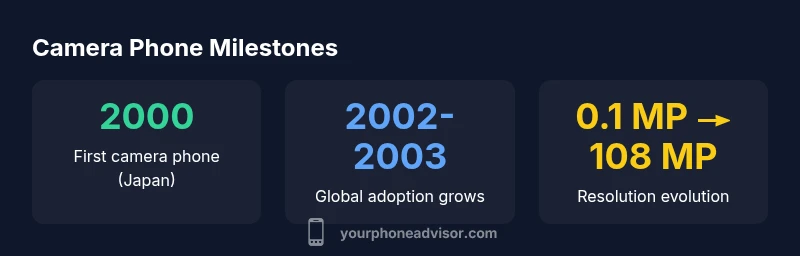
The first commercially available camera phone appeared in 2000 with Sharp’s J-SH04 in Japan, marking the birth of mobile photography. This milestone launched a rapid chain reaction across the industry, as manufacturers quickly added cameras to flagship models, enabling instant photo capture, sharing, and later, advanced features like video, selfies, and uploading to early social networks. In short, 2000 is the year cameras arrived on phones.
When did phones get cameras? A quick historical glance
The question often asked by enthusiasts and historians alike is “when did phones get cameras?” The crisp answer is: around 2000, with Sharp’s J-SH04 in Japan, which brought a compact camera into a mobile device for the first time on a commercial scale. This moment is widely seen as the birth of mobile imaging. In the years that followed, manufacturers experimented with small image sensors and built-in lenses, catalyzing a new era where a phone could capture moments without a dedicated camera.
Early experiments and the first commercial camera phone
In the late 1990s and early 2000s, industry labs and handset makers explored integrating imaging sensors into mobile devices. The watershed moment occurred in 2000 when Sharp released the J-SH04 in Japan, a device that could store small photos on a memory card. The camera was modest by today’s standards, often around 0.1 megapixels, yet it demonstrated a practical vision: a phone that could photograph. By 2002, Nokia’s 7650 and other models helped popularize the concept outside Japan. These early devices laid the groundwork for a new product category that would redefine consumer behavior—photography on the go.
Hardware evolution: sensors, lenses, and processors
The hardware story follows a clear arc: tiny sensors, evolving optics, and more capable processors. Early camera phones relied on single, fixed lenses with tiny image sensors, producing grainy results in dim light. Over time, manufacturers increased megapixel counts, improved sensor fabrication, and introduced fixed or modular lenses (macro, wide-angle). The shift from 0.1 MP to multi-megapixel sensors opened new possibilities, while better image stabilization and processing allowed sharper photos in a wider range of conditions. By the 2010s, multi-camera setups—shortly after the era of modest single-camera sensors—became common, enabling features like wide-angle shots, improved zoom, and depth sensing for portraits.
The software revolution: imaging apps, sharing, and social networks
Software completes the picture. Even as hardware advanced, software and services transformed usage. The rise of MMS, then mobile internet, and finally social platforms created a feedback loop: better imaging encouraged more sharing, which in turn pushed developers to introduce smarter photo-editing, HDR processing, and automated enhancements. By the mid-2010s, phones started using advanced computational photography—stacking exposures, optimizing dynamic range, and simulating depth—to produce results that rival dedicated cameras in many everyday scenarios. This software-centric evolution is as crucial as any hardware leap.
Global adoption patterns and market differences
Camera phones did not appear in every market at once. Japan led the way in 2000, with other regions following in rapid succession. By the early to mid-2000s, European and North American markets saw a flood of devices with integrated cameras. The pace of adoption varied with network speeds, carrier strategies, and consumer appetite for new capabilities. As 3G and later 4G networks matured, file sizes grew, sharing became instantaneous, and cameras became standard on nearly all smartphones. These regional dynamics helped shape product roadmaps for years to come, with some markets embracing features like front-facing cameras and video calling earlier than others.
Privacy, security, and user behavior
Camera-enabled devices raise legitimate privacy questions. The ability to photograph discreetly, geotag images, and share content quickly means users must manage permissions, location data, and consent. For policymakers and brands, transparency about data collection and sharing practices remains essential. From a security perspective, robust OS permissions and secure storage help protect users. As Your Phone Advisor often notes, informed users who understand app permissions and settings can enjoy camera features while maintaining control over their privacy.
The multi-camera era and computational photography
The industry’s next leap was the move to multi-camera arrays and computational photography. Modern phones frequently combine primary, ultra-wide, telephoto, and macro modules with AI-driven processing that enhances detail, color, and scene recognition. This era emphasizes software over raw sensor improvements at times, yielding impressive results even from mid-range hardware. The net effect is a dramatic expansion in what a smartphone camera can do, including portrait lighting effects, computational zoom, and real-time scene optimization.
Practical takeaways for today’s smartphone user
For readers looking to understand the history while buying smarter today, several takeaways matter. First, remember that camera quality is a blend of hardware and software; a strong processor and well-designed imaging pipeline can produce excellent results even from modest sensors. Second, consider what you’ll shoot: if you value landscapes, a wide-angle or multi-camera setup offers flexibility; for portraits, depth sensors and consistent skin-tone rendering are key. Finally, be mindful of privacy and safety: review app permissions, monitor geotagging, and understand how photos are stored and shared across devices and clouds.
Evolution of camera phone capabilities across eras
| Aspect | Early Era | Modern Era |
|---|---|---|
| Camera resolution | 0.1 MP | 108 MP |
| Number of cameras | Single-lens | Multi-lens (wide, ultrawide, tele) |
| Storage & sharing | MMS era; limited | Cloud sharing; fast networks |
| Connectivity | 2G/3G era | 5G and advanced networks |
Got Questions?
When did phones first have cameras?
The first camera phone appeared in 2000, with Sharp’s J-SH04 in Japan. This marked the start of mobile imaging and inspired broader adoption in the following years.
The first camera phone appeared in 2000 with Sharp’s J-SH04 in Japan, marking the start of mobile imaging.
What marked the shift to multi-camera setups?
In the early 2010s, phones added secondary lenses and wide-angle modules, enabling more versatile photography and better depth effects.
In the early 2010s, multi-camera designs became common for versatility and depth effects.
What was an early camera phone spec?
Early camera phones were around 0.1 MP; by the mid-2000s, models commonly reached a few megapixels.
Early camera phones were around 0.1 MP, later moving to a few MP.
How did social networks influence camera phones?
Photo-sharing on social networks pushed manufacturers to improve image quality and built-in editing features to streamline sharing.
Social networks spurred better image quality and easier sharing.
Are camera phones secure?
Camera use raises privacy questions; users should manage permissions and location data to protect themselves.
Camera use raises privacy questions; manage permissions and data sharing.
What’s next for camera phones?
Expect continued advances in computational photography and multi-lens systems, enabled by AI processing and better sensors.
Future camera phones will rely on AI and multiple lenses to push quality.
“Camera phones merged compact sensors with advancing software to redefine everyday photography. The trajectory from 0.1 MP sensors to modern multi-lens systems is driven by both hardware innovation and cloud-enabled processing.”
What to Remember
- Camera phones began in 2000 and evolved through sensors and software.
- Multi-camera designs emerged in the early 2010s.
- Raw megapixels are less telling than processing power.
- Respect privacy when capturing and sharing images.