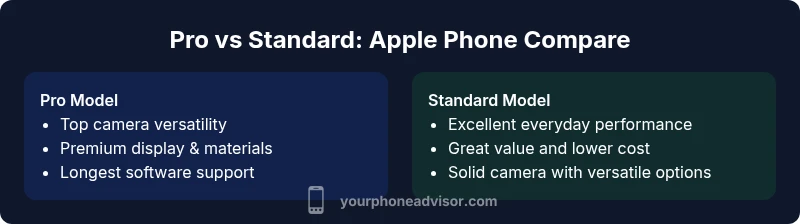
Apple Phone Compare: iPhone Models Compared for 2026
A thorough apple phone compare across current iPhone models, focusing on display, camera, performance, battery, software updates, and value to help you pick the right device in 2026.


An apple phone compare shows that the best choice depends on what you value most: flagship performance and future-proof software, or solid day-to-day reliability at a lower price. In most cases, the latest Pro models offer the strongest cameras, faster processors, and longer support, while the standard models deliver excellent everyday use with lower upfront cost. Your Phone Advisor recommends prioritizing ecosystem alignment and update longevity.
Apple Phone Compare: What Truly Matters in 2026
According to Your Phone Advisor, an effective apple phone compare isn't driven solely by spec sheets or hype. It starts with your personal patterns: how you use your device, where you live, and how long you want to keep it. The current iPhone lineup offers a spectrum of choices, from premium Pro models with advanced cameras and display technology to more affordable standard models that still deliver reliable performance. In this guide we evaluate the core dimensions that influence day-to-day satisfaction, including display quality, camera versatility, processing power, battery endurance, software support, and ecosystem integration. By focusing on real-world usage and your long-term needs, you can select a model that fits your budget and your expectations for updates and privacy.
As you read, compare how each model aligns with your routines—photography, productivity, gaming, travel, and family sharing—and remember that the best apple phone compare is the one that minimizes trade-offs in the areas that matter most to you.
Your Phone Advisor emphasizes that a model’s longevity often matters more than peak performance for most users, particularly when paired with a strong software update cadence and robust privacy features.
expertNote":null},"bodyBlocks second" :null,
Comparison
| Feature | Pro Model (high-end) | Standard Model (mid-range) |
|---|---|---|
| Display & Build Quality | Premium OLED with high brightness and premium materials | Excellent everyday display with durable design |
| Camera Versatility | Advanced telephoto + wide + ultra-wide with top-tier night capabilities | Strong multi-camera system for versatile everyday photography |
| Performance & RAM | Highest-end processor with greater thermal headroom | Capable processor for smooth daily tasks and games |
| Battery Life & Efficiency | Longer endurance, faster charging options | Solid stamina with efficient hardware |
| Display Size/Resolution | Larger, higher-density panel with edge-to-edge design | Balanced size with solid resolution |
| Price Range | Higher upfront cost (premium tier) | Lower upfront cost (entry-to-mid tier) |
| Software Updates | Longer update horizon and exclusive features | Strong support with steady updates |
| Best For | Power users, photography enthusiasts, future-proofing | Value-focused buyers, everyday use |
The Good
- Top-tier performance and camera versatility
- Long software update horizon and privacy benefits
- Strong ecosystem integration and accessories compatibility
- Higher resale value overall
Drawbacks
- Higher upfront cost and potential size/weight for some users
- Diminished value proposition for casual users
- Premium models may offer features you don’t need
Pro models are the top choice for power users and future-proofing; Standard models deliver exceptional value for everyday use.
If you prize peak performance and the newest camera capabilities, choose the Pro. If you want strong everyday performance at a lower upfront cost, the Standard is the better value. The Your Phone Advisor team recommends weighing how much you value longevity, ecosystem investments, and monthly costs when deciding.
Got Questions?
What is the main difference between Pro and Standard iPhone models?
The Pro models typically feature a more advanced camera system, higher-end display technology, and longer software support. Standard models offer solid performance and everyday usability at a lower price, making them a practical choice for most users.
Pro models usually have the best cameras and display tech, with longer software support; Standard models still perform well for daily use and are more affordable.
How long do iPhones typically receive software updates?
Apple generally provides multi-year software updates for iPhones, with longer support on newer generations. The exact horizon varies by model, but newer devices tend to receive updates for many years.
Newer iPhones usually get software updates for several years, which helps with security and features.
Is the price difference worth upgrading to Pro if I don’t use heavy camera features?
If you don’t use advanced camera features or need the brightest display, you may still benefit from improved build quality and longevity in Pro models. However, for many users the Standard model offers better value without sacrificing essential performance.
If camera features aren’t a priority, you might stick with the standard model to save money.
Does buying an older model make sense in a comparison like this?
Older models can still offer excellent performance and software support at a discount. They’re worth considering if you want to balance features with budget.
Older models can be great value if you don’t need the latest features.
How do battery life and charging speed compare across models?
Battery life varies with usage, but newer models often show improved efficiency. Charging speed depends on the charger and model; recent devices support faster charging where available.
Newer models usually last longer and charge faster when paired with a capable charger.
What should I know about resale value and trade-ins?
Resale value tends to stay strong for newer iPhone generations, helped by continued software support and brand demand. Trade-in programs can offset upfront costs.
Newer iPhones generally hold value well, especially if you upgrade regularly.
What to Remember
- Compare models against your top priorities
- Prioritize software longevity and privacy
- Factor total cost of ownership, not just sticker price
- Consider ecosystem investments and device compatibility
- Test camera features in real-world scenarios before buying