When You Can Record a Phone Call: A 2026 Legal Guide
Learn when you can record a phone call, the consent rules across federal and state law, and practical steps to stay compliant in 2026. Understand one-party vs two-party consent and how to handle cross-border calls.


You can record a phone call if you are a participant or have the consent of all parties in jurisdictions that require it. Federally, one-party consent is common, but many states require all-party consent. Always verify the exact rule for your location and the call's participants before recording. Non-consenting recordings can expose you to legal penalties.
When can you record a phone call?
The central question for most readers is: when can you record a phone call? The quick answer depends on location and the parties involved. In the United States, federal law generally allows recording with consent from at least one party, but many states require consent from all participants. This means if you are part of the call, you may legally record without telling others in some jurisdictions, while in others you must obtain explicit permission from everyone on the line. International calls introduce another layer: cross-border consent rules can apply, and different privacy regimes may interact with local wiretap laws. Your Phone Advisor emphasizes that you should confirm both the federal baseline and any state or country-specific requirements before recording. If you are ever unsure, err on the side of obtaining consent.
Federal vs. state consent landscapes
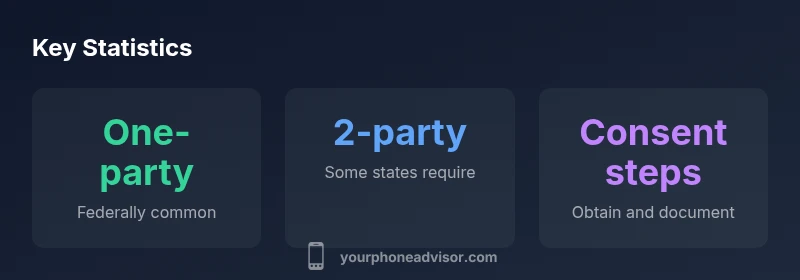
Consent laws divide roughly into two buckets: one-party consent and all-party consent. One-party consent means at least one participant may authorize recording without telling others. All-party (two-party) consent requires all participants to agree to the recording. The practical effect is that a call involving two residents of different states might be governed by the stricter state rule for the portion of the conversation that occurs within that state. Because laws change and hew differently to jurisdictions, it’s essential to check both federal guidelines and the relevant state statutes before capturing audio.
How to record legally: steps and documentation
To stay compliant, follow a clear workflow:
- Identify every jurisdiction involved (federal, state, and any international locations).
- Confirm consent rules for all parties before recording.
- If required, obtain explicit consent in a concise, pre-recording notice spoken or written.
- Document consent in a verifiable way (e.g., a short script captured in the call log or a written agreement for business lines).
- Implement a formal recording policy for organizations, and train staff on how to present consent notices. By building a repeatable process, you reduce legal risk and improve transparency with customers and colleagues.
Personal vs business use: differences and best practices
For personal calls, the simplest path is to obtain consent from everyone on the line before recording. In business contexts, you should publish a clear policy, include consent language in your terms of service, and provide a one-click or spoken notice at the start of every call. Commercially recorded calls may also trigger privacy disclosures under applicable consumer protection laws. When in doubt, document consent via a short pre-recording message and keep a log of consent for audit purposes.
Recording methods: devices, apps, and VoIP
You can record using built-in features on smartphones, third-party apps, or VoIP platforms. Each method has its own caveats: some apps store audio files locally, others in the cloud, and some require both parties’ consent to comply with local laws. Ensure you choose tools that offer clear indications that recording is active, provide easy access to downloaded files, and encrypt stored data where possible. Additionally, review platform policies to avoid app-store violations or terms that restrict recording.
Privacy, ethics, and retention considerations
Beyond legality, consider privacy and ethics. Limit data collection to what is necessary, implement retention schedules, and encrypt stored recordings. For personal data that includes sensitive content (financial information, health data, or identifiers), minimize storage duration and restrict access to authorized users. When sharing or storing recordings, comply with applicable data protection laws and corporate governance standards.
International considerations: cross-border calls and GDPR
Cross-border conversations complicate consent: EU/EEA participants fall under GDPR privacy rules, which emphasize lawful bases and transparency. If an international participant is included, you may need to obtain consent under GDPR alongside local laws. For mixed jurisdictions, seek consent under the strictest applicable standard and maintain a robust data processing agreement if third-party servers store or process the audio.
Quick-start checklist for your next call
- Determine all jurisdictions involved (federal, state, international).
- Confirm whether consent is required and who must consent.
- Prepare a brief consent notice and, if needed, obtain explicit consent before recording.
- Use a policy for business calls and train staff on consent language.
- Ensure secure storage and controlled access to recordings.
- Review retention schedules and delete recordings when no longer needed.
Common pitfalls and updates you should monitor
People often forget cross-border aspects or rely on outdated statutes. Always confirm current rules before recording, and beware that a call recorded in one state may be illegal if a participant is physically located in a different jurisdiction. Laws change; set a routine to audit your consent processes and update training materials accordingly.
Representative consent frameworks across major jurisdictions
| Jurisdiction | Consent Required | Notes |
|---|---|---|
| Federal law (U.S.) | One-party consent | Consent of at least one party; state laws add nuance |
| California (example of all-party) | Two-party consent | All parties must consent; stricter state rule |
| Florida (example) | One-party consent | Most calls require consent from at least one party |
Got Questions?
Is it legal to record a phone call without informing the other party?
Generally not. Many jurisdictions require consent from all parties, especially for business calls. If you are unsure about the location of participants, assume consent is not granted and obtain it before recording.
In most places, recording without consent can violate privacy laws. Check your jurisdiction or ask all participants for consent before recording.
Do I need consent if I'm recording a call for personal use only?
Personal use still requires awareness of local laws. If all participants are in a one-party consent state, your participation may suffice, but you should still inform others to avoid later disputes.
Even for personal use, it's best to get consent to stay on the right side of the law.
What is the difference between one-party and two-party consent?
One-party consent means only one person on the call must agree to recording. Two-party consent requires all participants to agree. State and federal laws determine which applies where the call occurs.
One-party means one person can consent; two-party means everyone must agree.
Can I record calls on my phone without using an app?
Some platforms offer built-in recording features, but these vary by OS and region. Ensure the feature is legal in your jurisdiction and that all participants are aware.
Check your phone’s built-in options and legality before recording.
What are the consequences of illegal call recording?
Penalties range from civil lawsuits to criminal charges, depending on jurisdiction. Violations can lead to fines, injunctions, and damaged trust or employment consequences.
You could face civil or criminal penalties, depending on where you live.
How should I handle international calls with multiple jurisdictions?
Treat the call as multi-jurisdictional. Obtain consent under the strictest applicable rule and document it. Be mindful of GDPR when EU residents are on the line.
International calls complicate consent—get clear consent and document it.
“What you record should reflect respect for privacy and legal compliance; always obtain consent or consult a lawyer if unsure.”
What to Remember
- Know the jurisdiction before recording
- Prefer obtaining consent in writing or via a spoken notice
- Business calls require formal policies and training
- Cross-border calls add GDPR and privacy complexities
- Regularly audit and update consent practices